[News] Micron Sees Tighter Memory Supply Through FY28: When Will the Big Three’s New Capacity Arrive?
October could bring another key test for the red-hot memory market, with Samsung and SK hynix set to report 3Q26 results later this month. Micron has already set a bullish tone: at its September 30 earnings call, CEO Sanjay Mehrotra said memory and storage supply-demand conditions could tighten further in fiscal 2027 and 2028 versus 2026, according to Reuters.
That outlook also appears more cautious than Micron’s earlier view. In June, the company expected industry supply to begin improving gradually in 2028, even as it acknowledged there was still no clear line of sight on when supply would fully catch up with rising demand, Benzinga reported. The latest comments suggest that even 2028 may offer less relief than previously expected—putting the timing of new capacity additions across the industry increasingly in focus.
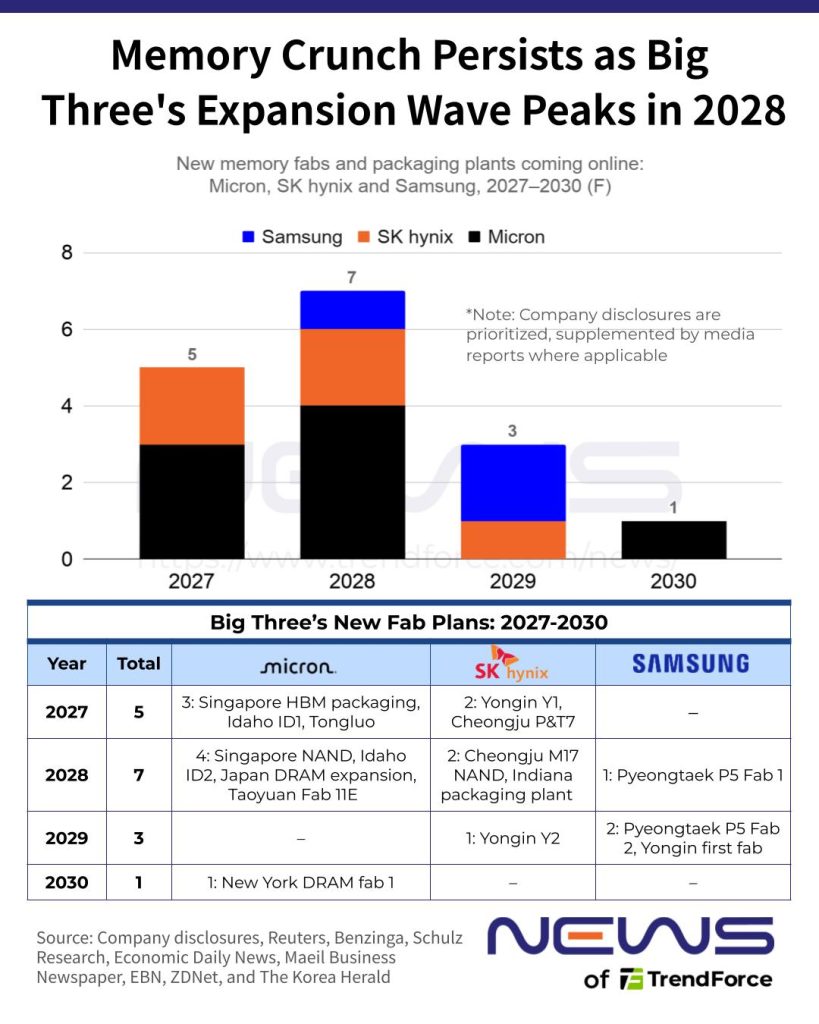
Industry capacity timelines help explain Micron’s tighter supply outlook. As Schulz Research notes, much of the next wave of supply—from Micron’s Idaho and Japan fabs to SK hynix’s Cheongju expansion—is not expected to arrive until late 2028, with meaningful output taking longer to ramp. That leaves a key question: how much new capacity can the Big Three actually bring online before then?
Micron’s Capacity Push Stands Out in Scale and Diversity
Schulz Research, citing company disclosures, notes that Micron plans to bring seven major memory facilities online between 2027 and 2030—the most among the Big Three. The first wave arrives in 2027, led by its Singapore HBM packaging facility in early 2027, followed by the Idaho ID1 DRAM fab and the Tongluo DRAM fab acquired from PSMC around mid-year, according to Schulz.
But then comes a gap: Micron’s next major capacity additions are not expected until 2H28, when its Singapore NAND fab, Idaho ID2 DRAM fab and Japan DRAM expansion are slated to come online, Schulz Research notes.
Micron is also accelerating its Taiwan expansion, adding another layer to its longer-term capacity buildout. According to the Economic Daily News, its second HBM advanced packaging facility in Taichung is set to begin operations this month, while the company is expanding its manufacturing footprint across Tongluo, Taoyuan and Tainan. Most notably, its new Fab 11E in Taoyuan—purpose-built for EUV and designed to accommodate future High-NA EUV systems—is expected to come online around 2028, making the year another key milestone in Micron’s capacity ramp.
Samsung, SK hynix Major Capacity Due From 2028
South Korea’s memory giants face a similar timeline, with much of their next wave of capacity also expected to arrive from 2028 onward. SK hynix, in particular, sees little sign of a quick supply reset: CEO Kwak Noh-jung said the semiconductor supply shortage could persist through 2030, according to Maeil Business Newspaper.
Against this backdrop, both SK hynix and Samsung are speeding up domestic expansion, with EBN reporting that the two memory makers are pursuing plans for as many as 17 new front-end memory fabs in South Korea, including projects under their longer-term roadmaps.
According to the report, Samsung is eyeing a total of 10 fabs: two at its Pyeongtaek P5 complex, six at the Yongin National Industrial Complex, and two in the Honam region. SK hynix, meanwhile, reportedly plans seven fabs, comprising four at its Yongin Semiconductor Cluster, the M17 fab in Cheongju, and two in the Honam region.
Still, the capacity boost will take time to build. While SK hynix has pulled forward the opening of Y1’s first cleanroom to February 2027, the next major milestones come later: its Cheongju M17 NAND fab is targeting first cleanroom operations in December 2028, followed by Y2 in June 2029, the report adds.
Samsung is accelerating as well. ZDNet reports that the company is considering moving Phase 1 tool installation at Pyeongtaek P5 forward to 2Q27 from 3Q27, as it races to add capacity for high-value AI DRAM and NAND. But as with SK hynix, the bigger supply boost comes later, with P5 targeted to begin operations in 2028, ZDNet suggests.
In terms of Yongin, The Korea Herald notes that Samsung is targeting a 2029 start for the cluster’s first fab—one to two years ahead of its original schedule.
And the tight-supply view extends beyond the Big Three. The Wire China reports that Chinese NAND giant YMTC expects the global memory shortage to persist for at least another three years. Taken together, the timelines point to 2028 as a key inflection point for new capacity—but with fabs ramping gradually, rather than all at once, supply relief may prove just as gradual.
Read more
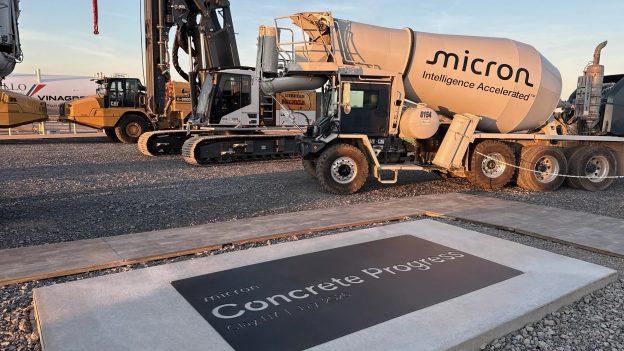
(Photo credit: Micron)