[News] OpenAI, Intel Reportedly Downplay CXL as HBM Replacement, Citing Use-Case and Data-Transfer Limits
As tight supply and soaring costs put HBM under growing pressure, the AI boom is opening the door to alternative memory technologies, with CXL (Compute Express Link) emerging as a key contender. Yet rather than replacing HBM, CXL may be better positioned to complement it, according to Chosun Biz and Financial News, citing remarks from OpenAI and Intel executives at the AI Infrastructure Summit in California.
As Chosun Biz explains, CXL is a next-generation interconnect that expands memory capacity by linking additional memory resources to computing systems and enabling memory to be pooled and shared across servers. AI accelerators can then tap into CXL-connected memory through the CPU, offering a more flexible way to scale capacity. Some industry observers, per the report, believe wider adoption could reduce the amount of costly HBM required without significantly compromising system performance, potentially bringing down the cost of large-scale AI server deployments.
CXL’s Two Key Limits: Use Cases and Bandwidth
Yet two major hurdles could limit how far CXL can encroach on HBM’s territory. Daniel Morris, an OpenAI researcher working on AI accelerator design, and Vidhya Thyagarajan, Intel’s head of AI System-on-Chip (SoC) architecture, pointed to a lack of practical use cases for AI model execution and a sizable bandwidth gap with HBM.
Chosun Biz, citing Morris, notes that he has yet to identify a compelling use case for CXL in actual AI model workloads. According to Morris, CXL’s role may be largely limited to storing inactive data that is rarely accessed by large AI models.
Meanwhile, Thyagarajan, points out that the technology is better positioned as a complement to secondary storage than as a substitute for HBM, as the data transfer speed between GPUs via CXL is “by no means as fast as HBM.”
Against this backdrop, Chosun Biz notes that the scenario could leave the competitive landscape largely intact for Samsung Electronics and SK hynix, which currently hold leading positions in the HBM market, even as CXL gains traction as an additional tier in the broader AI memory hierarchy.
SK hynix, Samsung Push Ahead With CXL Memory
Despite questions over CXL’s ability to challenge HBM, SK hynix and Samsung are pressing ahead with the technology as a new layer in the AI memory hierarchy. In June, SK hynix unveiled its new “Inference Tier Memory Expansion” (ITME) architecture, which inserts “CXL hybrid memory” between DDR and SSD in today’s HBM-based AI memory stack, according to SeDaily.
SeDaily, citing SK hynix, notes that by expanding the conventional HBM → DDR → SSD memory hierarchy into HBM → DDR → CXL memory → SSD, the memory giant was able to improve AI inference efficiency by 35.7%. Under the new architecture, CXL memory serves as a memory hub, predicting hot data that will be needed by HBM and DDR, retrieving that data from SSDs in advance and feeding it into the faster memory tiers, the report explains.
Against this backdrop, Samsung Electronics and SK hynix are racing to advance not only CXL-based architectures but also the memory products needed to support them. According to SeDaily, Samsung plans to begin mass production of its CXL Memory Module (CMM-D) 3.0, based on the latest CXL 3.2 specification, by the end of this year.
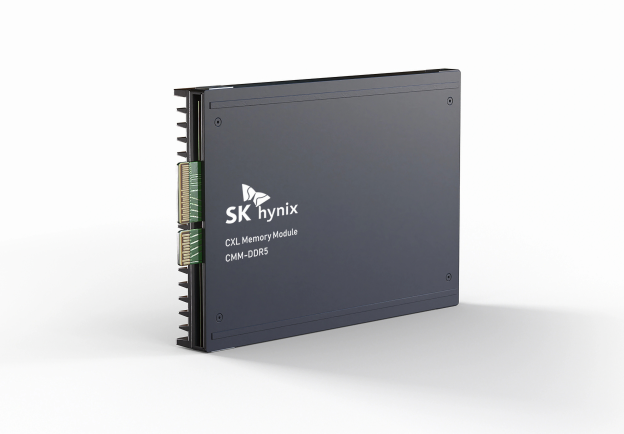
On the other hand, Sharing Economy News reports that SK hynix has debuted samples of its second-generation CMM-DDR5 based on CXL 3.2 and has since begun supply talks with potential customers, though it has yet to disclose a firm timeline for mass production.
Read more
-
- [News] Samsung Reportedly Targets 2026 CXL 3.2 Mass Production; SK hynix Advances New AI Memory Architecture
- [News] Kioxia Steps Up AI NAND Competition With South Korean Rivals, Eyes PCIe 6.0 and UFS 5.0 Mass Production
(Photo credit: SK hynix)