[News] Huawei Speeds Up AI Chip Roadmap, Reportedly Pulls Ascend 960DT Forward Three Quarters to 1Q27
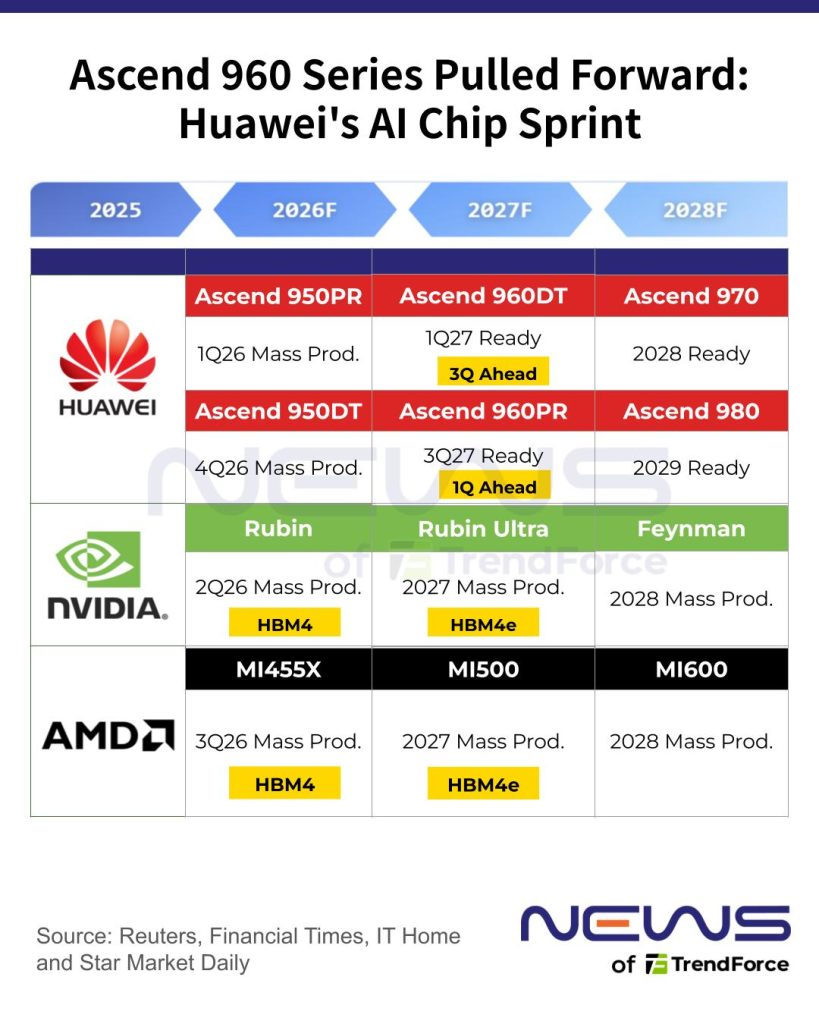
Huawei has unveiled an accelerated roadmap for its next-generation AI chips at Huawei Connect 2026 in Shanghai. Citing Rotating Chairman David Wang, Star Market Daily reports that the Ascend 960DT is running well ahead of schedule and is now expected to be ready in 1Q27—three quarters earlier than originally planned.
According to Guancha, the next iteration, Ascend 960PR, is slated for 3Q27, bringing its debut forward by one quarter.
Guancha, citing Wang, adds that Huawei will maintain a “one-generation-per-year cadence” for Ascend, with the Ascend 970 and 980 slated for 2028 and 2029, respectively. Following its “Tao’s Law” approach, the tech giant aims to keep doubling compute scale, while significantly boosting memory bandwidth, memory capacity and interconnect bandwidth.
The accelerated 960 timeline builds on Huawei’s AI accelerator roadmap unveiled last year, when it introduced the Ascend 950 architecture alongside its in-house HiBL 1.0 HBM. IT Home explains that within the 950 family, the 950PR targets inference prefill and recommendation workloads, while the 950DT focuses on decode and training with greater memory capacity and bandwidth.
NPO Comes to Ascend 960 SuperPoD
Meanwhile, IT Home notes that Huawei’s Ascend 960 SuperPoD will also be the industry’s first to adopt NPO (near-packaged optics). The liquid-cooled Atlas 960 SuperPoD, per the report, is slated for 3Q27, while the air-cooled Atlas 860 SuperPoD is scheduled for 2Q27.
Notably, Bloomberg reports that Huawei is already gaining traction both at home and overseas. According to the report, DeepSeek plans to deploy at least 160,000 Ascend 950DT chips at a new data center in Inner Mongolia to run its AI models. Meanwhile, the Chinese tech giant is also expanding its sights abroad, exploring opportunities in markets including Malaysia and Egypt, according to Bloomberg.
Still, Huawei faces a significant gap in its push to challenge NVIDIA. Bloomberg notes that leading Chinese AI labs such as DeepSeek still rely heavily on NVIDIA GPUs for model training, even as domestic chips gain ground in inference. The split underscores China’s continued dependence on Western technology at the high end, while small quantities of NVIDIA’s most advanced chips reportedly continue to enter the country through illicit channels, Bloomberg suggests.
Read more
- [News] Huawei Unveils 7.2Tbps Near-packaged Optics Module, Challenging NVIDIA and Broadcom’s CPO Push
- [News] Chinese AI Chipmakers Reportedly Hike Prices on HBM Costs, Huawei 950DT Up as Much as 50%
(Photo credit: Huawei)