

Marvell’s Acquisition of Lumentum to Unite Optical and Electronic Capabilities, Potentially Challenging Broadcom’s Market Leadership, Says TrendForce
Marvell has officially announced its acquisition of optical communications giant Lumentum, with both companies’ boards approving the transaction on November 2. The deal remains subject to shareholder and regulatory approval across multiple jurisdictions.
TrendForce notes that, if completed, the acquisition would significantly strengthen Marvell’s optical technology portfolio and enable the combined company to deliver more comprehensive next-generation optical interconnect solutions. The merger could also reshape the competitive landscape of the optical communications industry, where Broadcom currently holds a commanding position.
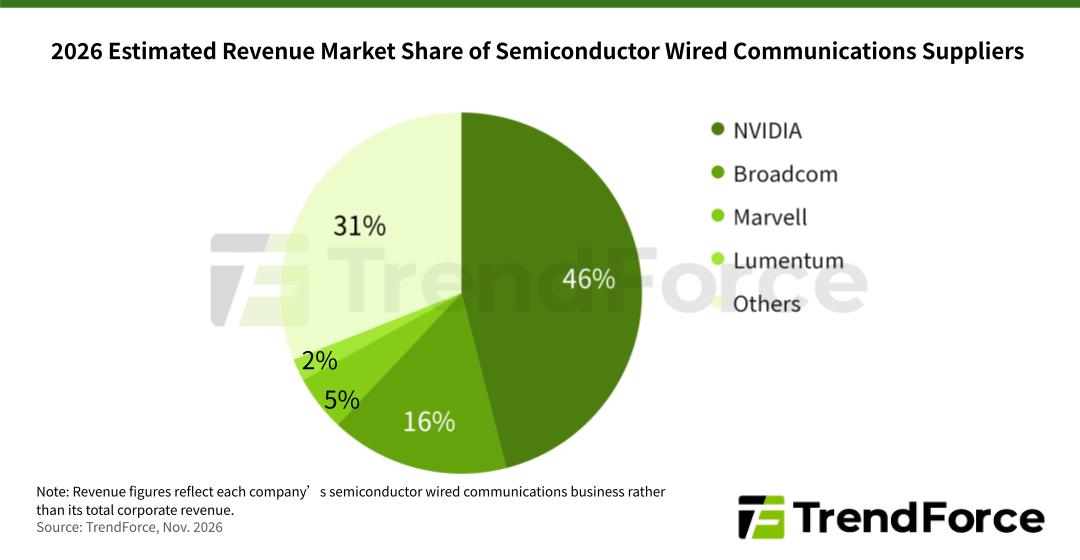
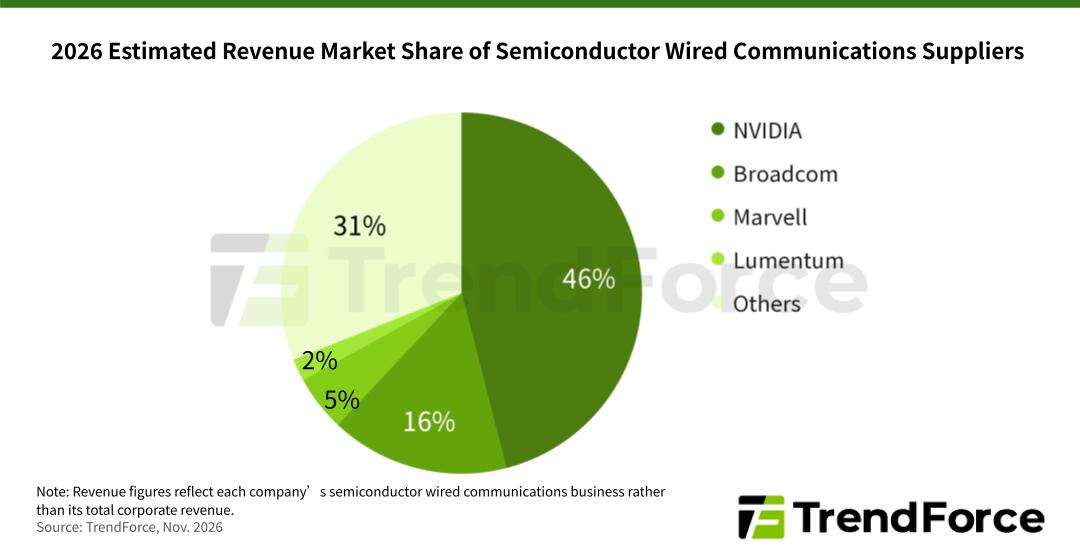
TrendForce estimates that Marvell and Lumentum’s market revenue will rank fourth and eighth, respectively, in the semiconductor wired communications market in 2026. Once the merger is completed, the combined market share will reach nearly 7%, placing the merged company behind only NVIDIA and Broadcom.
TrendForce explains that Broadcom’s competitive strength in AI optical communications and interconnects stems from its extensive portfolio that spans optical and electronic technologies. Its offerings include Tomahawk switch chips, digital signal processors (DSPs), and optical components such as electro-absorption modulated lasers (EMLs) and continuous-wave (CW) lasers.
By comparison, Marvell’s expertise lies primarily in electronic semiconductor technologies, while Lumentum specializes in optical components. Combining these complementary capabilities would create a more formidable competitor with expertise spanning both optical devices and semiconductor ICs, potentially challenging Broadcom’s market leadership.
TrendForce underscores that the two companies already play important roles in the optical communications supply chain. Lumentum is a key supplier of laser sources, while Marvell provides DSPs and other semiconductor solutions for optical communications applications. If the merger is approved, NVIDIA and other cloud service providers (CSPs) could gain access to a broader range of comprehensive electro-optical interconnect solutions, potentially reducing their reliance on Broadcom while maintaining sourcing flexibility.
From a technology perspective, TrendForce views the acquisition as a strategic move by Marvell to establish an early foothold in scale-in and scale-up interconnects as the industry transitions toward co-packaged optics (CPO) and near-packaged optics (NPO).
Incorporating Lumentum’s indium phosphide (InP) laser technology—a critical capability currently missing from its portfolio—would also allow Marvell to integrate its electronic and optical expertise into a more complete optical engine offering.
Furthermore, the combined company could bring together Marvell’s advanced CMOS chip design, high-speed switching chips, electro-optical interconnects, silicon photonics, and custom XPU capabilities with Lumentum’s high-performance InP lasers, optical transceiver modules, and optical circuit switching (OCS) technologies.
This would enable the development of integrated solutions spanning chips, optical engines, laser sources, and modules. Through coordinated design and pre-validation, the company could also help customers streamline development and accelerate the adoption of next-generation optical interconnect technologies.
The acquisition must still secure regulatory approval in the U.S. and China. TrendForce highlights that Chinese optical module makers are among the world’s leading suppliers of 800G and 1.6T optical transceivers, relying heavily on Marvell’s DSPs and EML/CW laser sources supplied by companies such as Lumentum.
The competitive implications are especially significant given Lumentum’s ownership of optical module maker Cloud Light. Chinese optical module makers could face a substantial competitive disadvantage if the merged company were to restrict competitors’ access to critical laser sources, bundle DSPs with laser products, or prioritize shipments to its own subsidiaries.
As a result, TrendForce expects the potential impact of the merger on the competitive position and long-term viability of Chinese optical module suppliers to be a central consideration in China’s regulatory review.
For more on the latest technology industry news and trends, please visit News.