

Integrated Optical-Electrical Testing Platforms Become Key to CPO Mass Production, Reshaping the Test Equipment Supply Chain, Says TrendForce
TrendForce’s latest research on AI interconnect technologies reveals that growing demand for high-speed transmission in AI data centers is accelerating the transition of co-packaged optics (CPO) toward mass production, making shorter test times and lower costs increasingly important. Furthermore, demand for integrated test equipment and software is rising as CPO requires coordinated electrical and optical measurements.
TrendForce expects 2027 to be a pivotal year for the convergence of CPO testing architectures. While established automated test equipment (ATE) suppliers are expanding their presence in this market, new manufacturing processes and technical challenges are also creating opportunities for equipment, test interface, and semiconductor assembly and test service providers.
CPO combines optical engines with switching or computing chips in a single package. One key challenge in mass production is ensuring precise optical coupling, which depends on alignment module suppliers equipped with multi-axis control. When combined with position feedback and optical search algorithms, these tools enable optical coupling and testing equipment to achieve faster and more stable alignment.
Although optical alignment times have already decreased to the second or even sub-second level, a complete test of a single photonic integrated circuit (PIC) can still take over 100 seconds. Consequently, the bottleneck in mass production is now shifting from alignment accuracy to testing speed.
CPO testing currently requires multiple instruments, including laser sources, optical switches, optical power meters, and optical spectrum analyzers. Coordinating instrument control, calibration, and test procedures therefore becomes more complex with functions and suppliers spread across different equipment categories. Additionally, each instrument is used for a different length of time during testing.
Equipping every test station with a complete set of instruments can leave some expensive equipment underutilized, driving up costs. The key to optical-electrical test integration lies in using unified software to coordinate electrical and optical measurements, supported by optical path switching and instrument sharing across multiple test stations to improve equipment utilization.
As CPO moves toward mass production, the ability to integrate different instruments effectively on a single platform will be critical to reducing costs and increasing throughput.
Competition shifts toward platform integration as suppliers expand their CPO testing capabilities
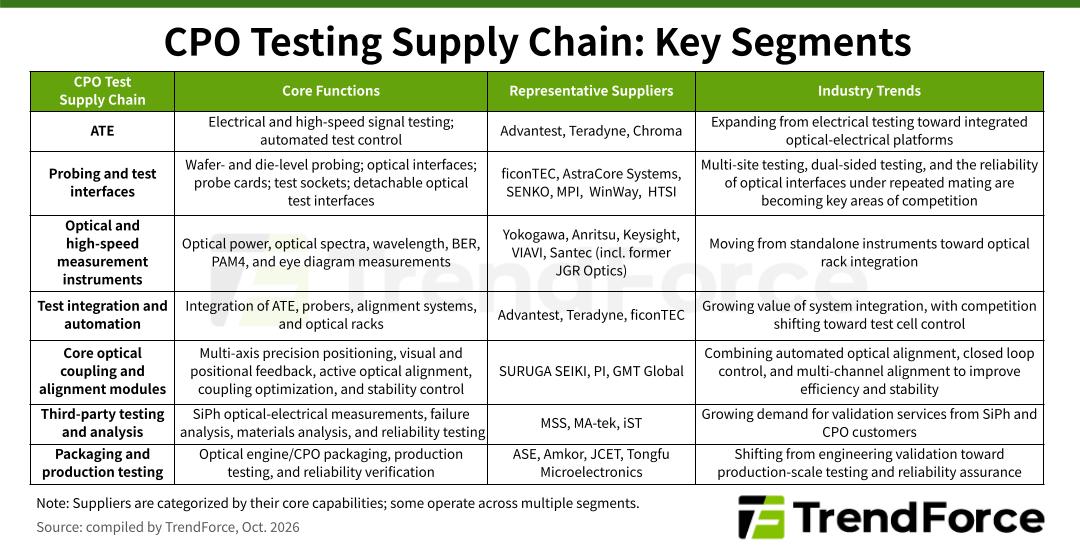
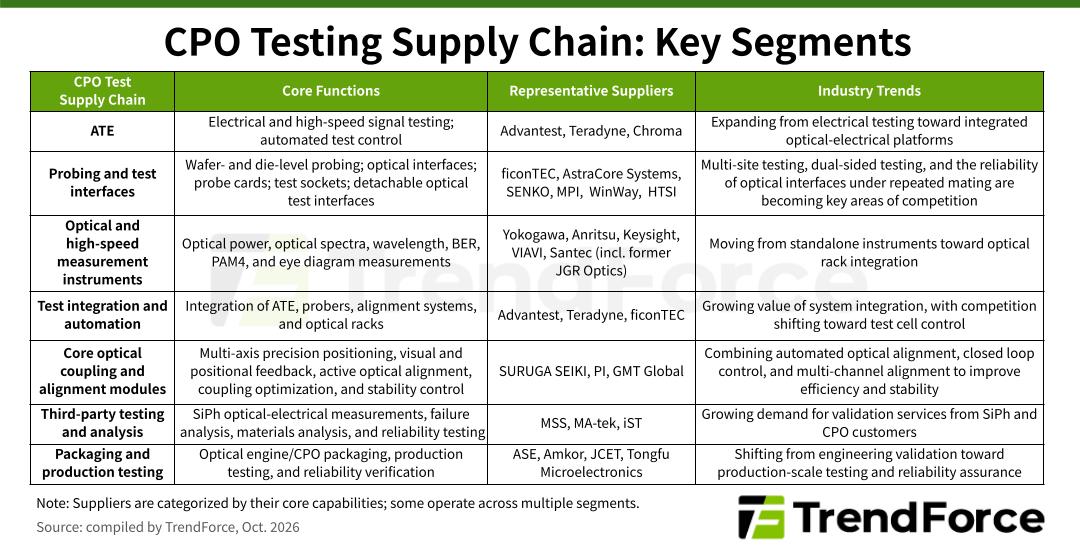
TrendForce identifies seven major segments in the CPO testing supply chain: ATE, probing and test interfaces, optical and high-speed measurement instruments, test integration and automation, core optical coupling and alignment modules, third-party testing and analysis, and packaging and production testing. Responsibilities across these segments continue to overlap.
Leading traditional ATE suppliers have increased investment in response to customer demand. Teradyne acquired Quantifi Photonics in 2025 to strengthen its optical measurement capabilities. Advantest is integrating optical instruments through its existing test platforms and software. In September 2026, the company announced a collaboration with VIAVI and SENKO to combine automated testing, optical measurement, and detachable optical interfaces. The partners subsequently demonstrated a simulated production testing workflow for CPO modules at ECOC 2026.
These developments indicate that industry value is gradually shifting from individual instrument performance to the ability to integrate complete production testing platforms. Further advances in instrument sharing across test stations and parallel testing of multiple devices could help reduce testing costs per unit.
TrendForce observes that Taiwanese suppliers have established a presence across several segments of the CPO testing supply chain. GMT Global provides multi-axis optical coupling and alignment modules, while MPI offers probing equipment and optical alignment solutions. WinWay specializes in test interfaces, and Chroma has capabilities in automated testing and burn-in testing.
Third-party testing providers, including MSS, MA-tek, and iST, are helping customers accelerate product development through optical-electrical measurements, materials analysis, failure analysis, and reliability verification. Packaging and testing providers such as ASE can further bridge the gap between packaging processes and production testing, extending the potential benefits across both equipment and service suppliers.
Chinese suppliers are leveraging their existing experience in optical communications manufacturing and testing to accelerate the localization of test equipment. For example, Semight Instruments has introduced a 65 GHz sampling oscilloscope and begun volume shipments, indicating progress in certain high-speed measurement technologies.
Nevertheless, China still relies heavily on imports for high-end measurement instruments overall. It also remains to be seen whether experience in optical module testing can be extended to complete CPO mass production platforms. Customer adoption, testing efficiency, and long-term stability will be key factors to monitor.
RoboTechnik completed its full acquisition of Germany-based ficonTEC in 2025, gaining a foothold in the global optoelectronic packaging and test equipment supply chain. Whether this ownership change will influence procurement decisions among European and U.S. customers will be another important development to watch.
TrendForce expects 2027 to be a pivotal year for the convergence of CPO testing architectures and equipment investment strategies, while 2028 will serve as a critical period for validating readiness for large-scale mass production. Suppliers that can integrate different test equipment and provide production-scale services are expected to strengthen their strategic positions in the supply chain as customers place greater emphasis on testing efficiency, quality, and cost.
For more on the latest technology industry news and trends, please visit News.