

NVIDIA’s AI Rack Transition Accelerates; NVL72 Output Value to Exceed US$710 Billion in 2027, Says TrendForce
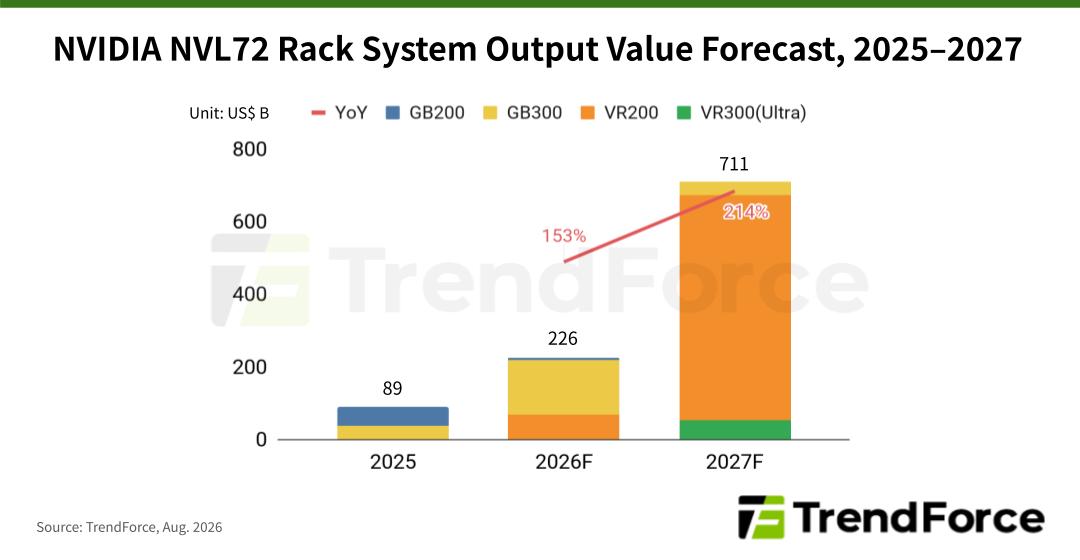
TrendForce’s recent AI server industry report reveals that GB300 rack-scale solutions are set to be NVIDIA’s leading driver of shipments in 2026, with demand anticipated to remain robust through the first half of 2027. Following that, the next-gen VR200 racks will increase production and account for the largest portion of shipments in 2027. Meanwhile, the newer Rubin Ultra platform (VR300) is expected to hold a relatively small share, as its HBM configuration and server architecture are still being finalized.
TrendForce estimates that shipments of NVL72 racks, including GB and VR platforms, will grow by more than 50% YoY in 2027. At the same time, the ASP of the Vera Rubin systems is expected to be roughly double that of GB300, while prices for key upstream components such as wafers and HBM could also rise. As a result, the combined output value of GB300, VR200, and VR300 NVL72 rack systems is projected to exceed US$710 billion in 2027, surging 214% YoY. This growth is expected to provide significant momentum for the broader AI data center supply chain, including ODM system manufacturers and power and cooling solution providers.
The customer mix for rack-scale solutions is also shifting. Although the five major North American CSPs remain the primary buyers, their share of procurement is expected to decline from approximately 70% in 2025 to 60% in 2026. This is primarily due to rising demand from companies such as Tesla (including xAI and SpaceX) and CoreWeave.
NVIDIA’s latest financial results also show that its Data Center business is approaching 93% of total revenue, while neocloud and sovereign cloud providers are emerging as additional growth drivers.
Chip competition expands into data center infrastructure
NVIDIA recently outlined its strategy for AI infrastructure during its earnings call, with the PORTS-Pike campus in Ohio serving as a notable example. The campus will be developed, owned, and operated by SB Energy, with OpenAI leasing 8 IT-GW of capacity.
NVIDIA will serve as the exclusive compute provider for the entire site and has provided a residual value guarantee for the initial 4.25 IT-GW, with aggregate payment obligations capped at $105 billion. The arrangement extends beyond chips to encompass land, power, and data center facilities, signaling NVIDIA’s expansion of its competitive presence from the xPU level into data center infrastructure.
TrendForce notes that Google, a leader in the ASIC ecosystem, is pursuing a similar strategy by guaranteeing lease payments for data centers used by Anthropic, with total commitments reaching $44 billion. In return, Google can obtain approximately 20% equity stakes in related data center and power plant projects while securing Anthropic as a major flagship customer for its TPUs. Broadcom, which co-designs Google’s TPUs, has also committed to repurchasing chips and covering price differences if the products cannot be sold.
Overall, both Google and NVIDIA are extending their strategies beyond chip and system supply into data center infrastructure. By incorporating their proprietary chips into financing arrangements, the companies are seeking to secure demand for their products over the longer term.
For more on the latest technology industry news and trends, please visit News.