

Liquid Cooling Becomes Standard for High-End AI Infrastructure, with Penetration Expected to Reach 53% in 2026, Says TrendForce
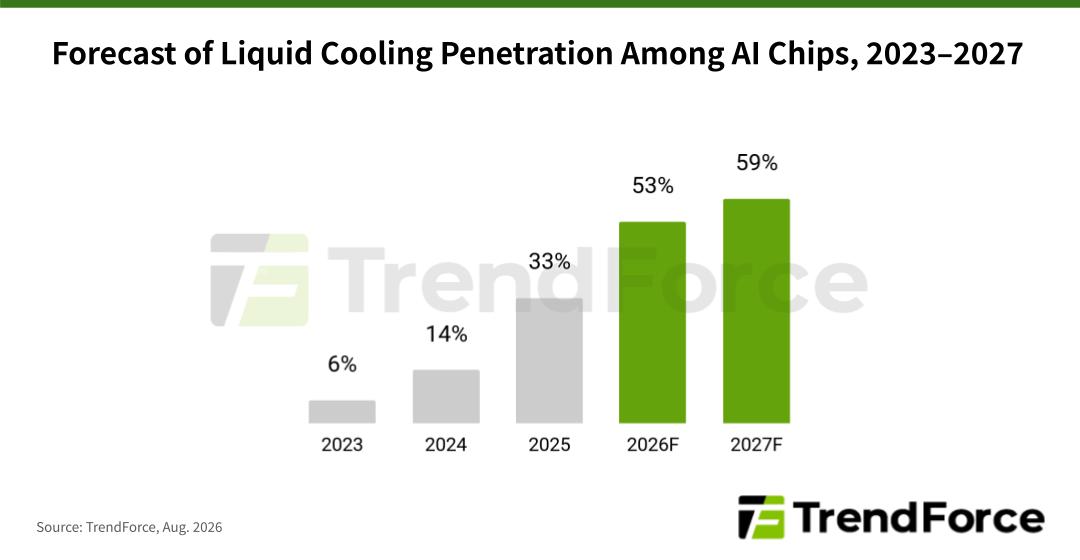
- Liquid cooling penetration among AI chips is projected to rise to 53% in 2026 and approach 60% in 2027.
- High-end chips from NVIDIA, AMD, and Google are driving the adoption of liquid cooling. NVIDIA’s rack-scale solution shipments are expected to double in 2026, while more than 80% of Google’s AI servers already use liquid cooling.
According to TrendForce’s latest AI server industry research, continued investment in AI infrastructure and the rapid iteration of AI chips from NVIDIA, AMD, and Google have pushed the TDP of individual chips above 1 kW. Meanwhile, rack-scale AI server solutions now consume hundreds of kilowatts. As a result, liquid cooling is increasingly becoming standard for high-end AI infrastructure.
TrendForce projects liquid cooling penetration among AI chips to reach 53% in 2026 and approach 60% in 2027.
High-end chips from NVIDIA, AMD, and Google drive liquid cooling demand
TrendForce notes that accelerated AI investment by Tier 2 data center operators and growing demand from Chinese CSPs for overseas AI projects are expected to double shipments of NVIDIA’s GB/VR rack-scale solutions in 2026. Despite the possibility of delays to Kyber NVL144 in 2027, strong AI infrastructure investment is expected to sustain overall GPU rack demand, with shipments still projected to grow by more than 30% YoY.
AMD is expanding its strategy from standalone GPUs to a comprehensive AI platform. Beginning in 2H26, the company will focus on its Helios AI rack-scale solution, which integrates CPUs, GPUs, and high-speed interconnects. Large-scale shipments are to be expected in 2027. AMD will also continue developing its MI450 platform, followed by the next-generation MI500 platform, which is positioned to compete with NVIDIA’s Rubin Ultra.
TrendForce notes that these chip platforms have fully adopted liquid cooling. New generations of AI chips are being introduced, and CSPs are accelerating upgrades to their AI data center architectures. Liquid cooling penetration among AI chips is expected to increase from approximately 33% in 2025 to 53% in 2026.
Among major CSPs, Google has been the most aggressive in adopting liquid cooling, with the technology now used in more than 80% of its AI servers. Drawing on years of experience developing its own AI accelerators—TPUs— and integrating AI infrastructure, Google has established a highly customized liquid cooling architecture.
As TPU power consumption and shipment volumes continue to rise, Google has taken the lead among CSPs in extending liquid cooling from individual servers to rack-scale system designs, providing another major driver of overall adoption.
From a supply chain perspective, liquid cooling systems include essential parts like cold plates, manifolds, and CDUs. They provide much higher cooling efficiency than air cooling and enhance power usage effectiveness (PUE). As NVIDIA’s Vera Rubin platform fully adopts a fanless, all-liquid-cooled design, this cooling method is spreading from GPUs and CPUs to CX9 network interface cards, busbars/power boards, optical transceiver modules, and other critical components, boosting the cooling capacity per rack.
Major cold plate suppliers include Cooler Master, AVC, BOYD, and Auras. AVC is expected to begin shipping Vera Rubin cold plate modules in the third quarter and has also entered the AI ASIC platform supply chains of AWS, Google, Meta, and OpenAI.
For the heat spreader co-packaged with the chip, NVIDIA originally planned to use a two-piece design for Rubin to improve cooling efficiency. However, issues such as substrate warpage have led it to adopt a one-piece design as an interim solution. Jentech is currently the sole supplier of heat spreaders for the Rubin platform.
For more on the latest technology industry news and trends, please visit News.