

AI Data Centers Ignite a Laser Shortage Wave; Nvidia’s Strategic Lock-In Reshapes the Global Laser Supply Chain, Says TrendForce
TrendForce’s recent research indicates that high-speed optical interconnects are now central to performance and scalability, especially as AI data centers grow into large clusters. The report predicts that worldwide shipments of optical transceivers of 800G and higher will hit 24 million units in 2025, then jump by 2.6 times to nearly 63 million units in 2026.
TrendForce reports that the surge in demand has caused a significant upstream bottleneck in laser light sources. Nvidia, motivated by strategic reasons, has secured capacity at key electro-absorption modulated laser (EML) suppliers, leading to extended lead times beyond 2027 and a worldwide shortage. Optical module manufacturers and CSPs are now actively searching for secondary suppliers and alternative designs, changing the competitive landscape within the laser industry.
Nvidia’s strategic monopoly on EMLs
Beyond VCSELs used in short-reach links, mid- to long-reach optical modules mainly depend on two laser types: EML and continuous wave (CW).
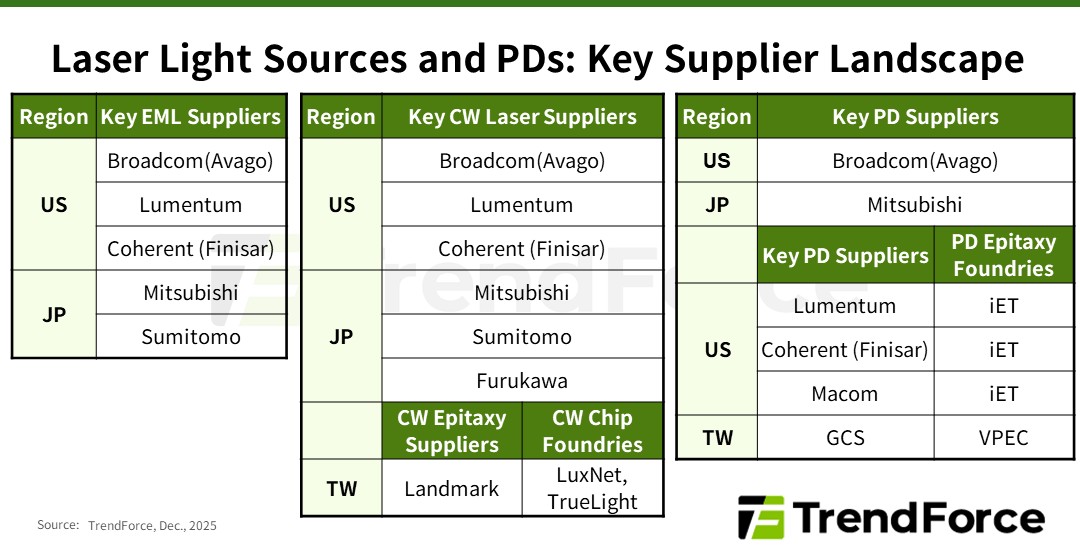
EMLs combine modulation functions on a single chip, which makes them highly complex and very challenging to produce. Only a few suppliers are available, such as Lumentum, Coherent (Finisar), Mitsubishi, Sumitomo, and Broadcom.
EMLs, known for their excellent reach and signal integrity, have become a critical bottleneck as hyperscale data centers extend their transmission distances. Nvidia’s silicon photonics and CPO development plans have advanced more slowly than anticipated, leading to ongoing dependence on pluggable modules for GPU cluster expansions. To ensure supply, NVIDIA pre-allocated a large portion of EML capacity, reducing availability for other regions.
CW lasers: The new favorite of CSPs—and the next capacity race
CW lasers offer a steady optical signal and are paired with silicon photonics chips produced at semiconductor foundries used as external modulators. Their simpler design stems from the absence of integrated modulation, which broadens supplier options. Consequently, CW lasers combined with silicon photonics has become the main alternative route for CSPs facing EML shortages.
However, CW production faces increasing constraints due to several factors: long equipment lead times restrict expansion, and strict reliability standards necessitate labor-intensive die-cutting and aging tests. Consequently, many vendors outsource these steps, which adds to downstream bottlenecks. This situation is causing the CW ecosystem to approach a capacity crunch, leading suppliers to hasten their expansion efforts.
High-speed PD demand surges; Taiwanese epitaxy vendors benefit
In addition to laser transmitters, optical modules need high-speed photodiodes (PDs) to receive signals. Leading vendors like Coherent, MACOM, Broadcom, and Lumentum are releasing 200G PDs to enable 200G-per-channel data transmission.
PDs are manufactured on indium phosphide (InP) epitaxial wafers, similar to EMLs and CW lasers. As laser manufacturers focus on expanding epitaxy capacity for laser production, many are outsourcing InP epitaxy to specialized foundries like IntelliEPI (iET) and VPEC, which presents a notable spillover opportunity for Taiwan’s epitaxy sector.
TrendForce forecasts that AI-driven demand is tightening not only memory supply but also the entire upstream laser ecosystem. Nvidia’s aggressive EML lock-in ensures its own supply security, but has inadvertently accelerated the shift toward CW-based and silicon-photonic solutions among non-NVIDIA players. Concurrently, the industry-wide race for capacity is restructuring supply-chain roles and fueling growth across compound-semiconductor epitaxy and processing vendors.
For more information on reports and market data from TrendForce’s Department of Semiconductor Research, please click here, or email the Sales Department at SR_MI@trendforce.com
For additional insights from TrendForce analysts on the latest tech industry news, trends, and forecasts, please visit https://www.trendforce.com/news/