[News] Micron Reportedly Says All Major Customers Eye 3D DRAM Tie-Ups, Broader Adoption Expected by 2030–31

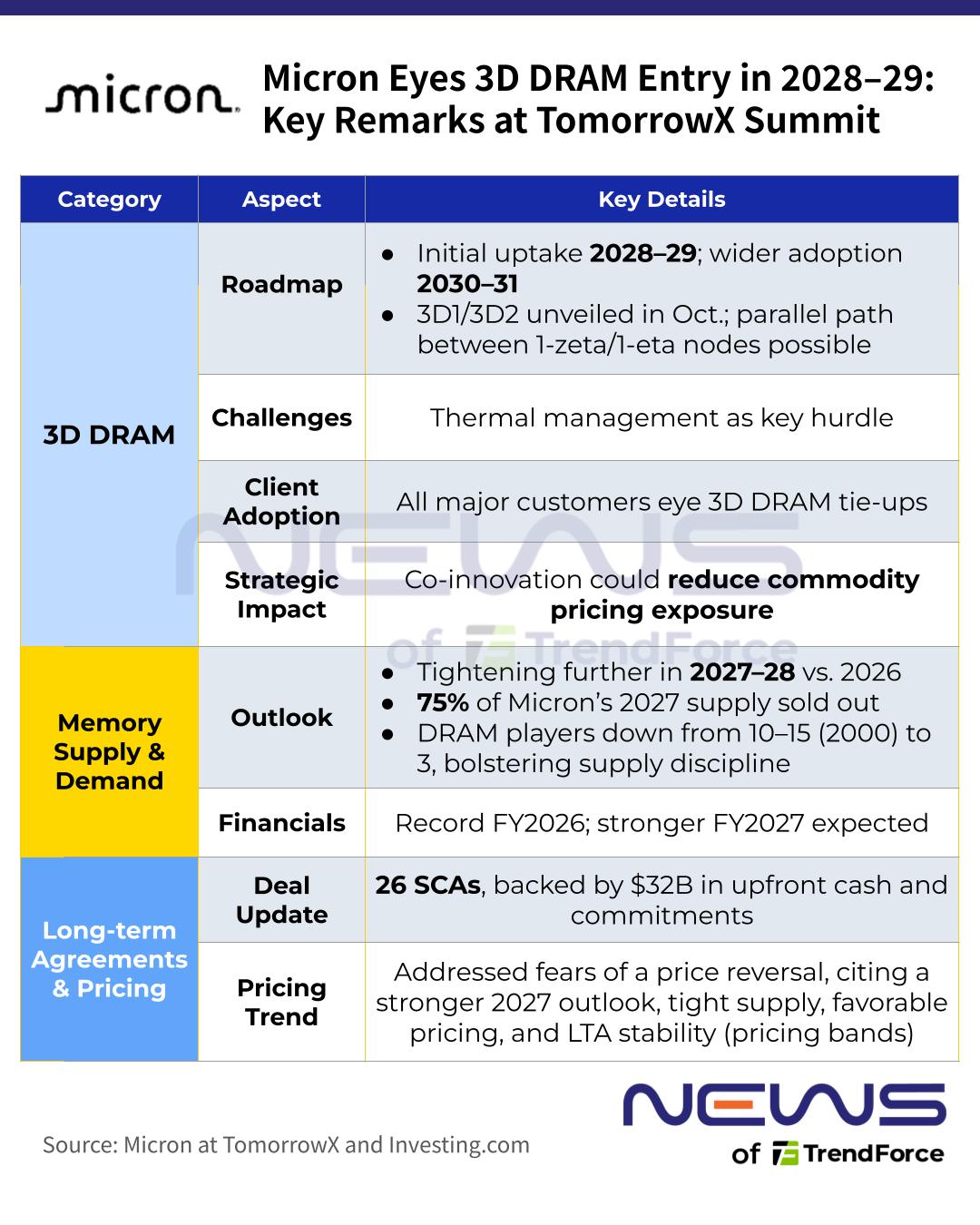
A month after outlining its technology roadmap, including 3D DRAM and vertical HBM (vHBM), Micron offered a clearer timeline at the November 18 TomorrowX Summit. According to an Investing.com transcript, CEO Sanjay Mehrotra said all major customers are seeking to collaborate on stacked 3D DRAM, with broader adoption expected in 2030–2031.
Despite thermal management remaining a major technical hurdle, Micron expects 3D DRAM to begin gaining market traction in 2028–2029, potentially emerging as a key growth engine toward the end of the decade, the report adds.
Notably, Investing.com, citing management, also suggests that stacked 3D DRAM will require close co-innovation with customers, potentially helping Micron move beyond commodity-driven pricing toward a more strategic role in AI system design, while fostering deeper collaboration with major AI players.
The latest remarks build on Micron’s October technology webinar, where the company unveiled two generations of 3D DRAM—3D1 and 3D2—without specifying their architectures or launch schedules, as previously reported by TechNews.
At the time, CTO Scott J. DeBoer indicated that 3D DRAM was being pursued as a parallel development path, potentially entering the roadmap between the 1-zeta (1ζ) and 1-eta (1ζ) nodes. Its introduction would hinge on striking the right balance among cost, complexity and device performance, according to TechNews.
Meanwhile, Micron is also exploring application-specific memory architectures beyond conventional DRAM scaling, including vertical HBM (vHBM), vertical EIM (vEIM) and customized HBM (cHBM) solutions. Among these, the first generation of vHBM is targeted for around 2028, TechNews noted.
Micron Pushes Back Against Memory Price Reversal Fears
On the other hand, Mehrotra, at TomorrowX, reiterated that memory supply-demand conditions are expected to tighten further in 2027 and 2028 compared with 2026, noting that 75% of Micron’s 2027 supply is already sold out, HotHardware reports, adding that the company is now in discussions with customers over commitments extending into 2028.
Against this backdrop, Micron sought to ease concerns over a potential reversal in soaring memory prices, pointing to a stronger outlook for 2027 and the stability offered by long-term supply agreements (LTAs). According to Investing.com, the chipmaker described 2026 as a record financial year, with even stronger results expected in 2027 as robust demand, tight supply and favorable pricing continue to underpin the market.
According to Micron, the company has secured 26 Strategic Customer Agreements (SCAs), backed by $32 billion in upfront cash and financial commitments. As highlighted by Investing.com, many extend five years or more, incorporating take-or-pay clauses, cash deposits and pricing bands, alongside closer collaboration on technology roadmaps, with CEO Sanjay Mehrotra suggesting customers have little incentive to walk away from their commitments.
Interestingly, according to the Investing.com transcript, Micron also highlights a more disciplined memory market compared with previous cycles, pointing to industry consolidation as a key factor enabling longer-term supply agreements.
According to Micron, the DRAM industry has undergone significant consolidation, shrinking from 10–15 competitors around 2000 to just three major players today. Management noted that this more concentrated market structure has fostered greater supply discipline, creating a stronger foundation for durable, long-term customer agreements.
Read more
- [News] Micron Reportedly Rules Out 4F² DRAM Scaling, Backs 6F² and 3D DRAM in Next-Gen Memory Roadmap
- [News] CXMT Accelerates 4F² DRAM Push, Eyes Year-End Server DDR5 RDIMM Launch
(Photo credit: Micron)