[News] China Unveils 90%-Domestic EUV Light Source Prototype, Mass Production Reportedly 3–5 Years Away
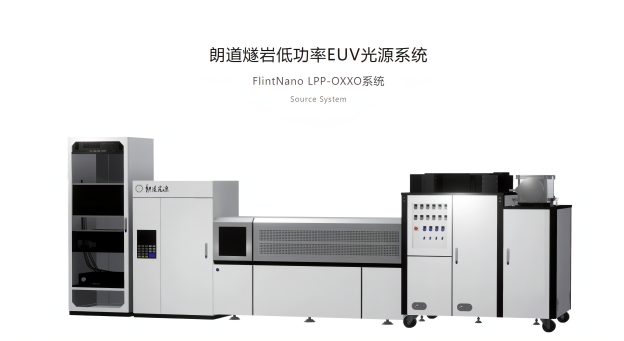
China is advancing domestic extreme ultraviolet (EUV) light source technology, though significant hurdles remain before commercial production. According to ijiwei, citing JIEFANG Daily, Langdao Silex unveiled its first EUV light source prototype at the 26th China International Industry Fair. On-site staff said the system has a 90% domestic content rate, with most core components developed in-house. It follows a technical approach similar to that of leading international suppliers and can be used for chip exposure testing.
Providing further details on the company’s EUV technology, ICsmart cites specifications from Langdao Silex’s official website showing that its FlintNano LPP-OXXO low-power EUV light source, based on laser-produced plasma (LPP) technology, features a 1,000W driving laser, a repetition rate of 1–20 kHz, conversion efficiency above 2%, brightness of 100W/mm²sr, and EUV output exceeding 15W. The system supports over 100 hours of continuous operation, with a plasma size of 60 μm, plasma stability of 3% RMS, and energy stability of 5%.
The company’s FlintMicro-LPP high-power EUV light source series has completed proof-of-principle validation, while its low-power FlintNano-LPP series has entered the productization stage, ICsmart reports.
However, Langdao Silex’s technical staff said the prototype remains three to five years away from large-scale commercial production, requiring further engineering development and optimization. The main challenges are increasing output power and improving long-term operational stability, according to EE Times China.
China’s EUV Light Source Progress Faces Significant Power Gap
A significant gap remains between Langdao Silex’s technology and commercial EUV requirements. As ICsmart notes, commercial lithography systems typically require EUV light sources delivering several hundred watts with sustained reliability. ASML has used 250W EUV light sources in volume production since 2018 and is working toward 1,000W.
The prototype showcased by Langdao Silex at the industry fair demonstrates the feasibility of its technical approach, but significant challenges remain before it is ready for industrial applications. According to ICsmart, moving from EUV output of around 15W to the several hundred watts required for commercial production will demand not only a substantial increase in power but also major improvements in plasma stability, light source lifetime, and system integration reliability.
The challenges extend beyond the light source itself. As South China Morning Post notes, citing Changjiang Securities, commercial EUV lithography systems also require precision optics, wafer-stage technology, and complex system integration. ASML’s EUV machines contain hundreds of thousands of components sourced from more than 800 suppliers, highlighting the complexity of building a complete system.
Langdao Silex Builds Capabilities Across the EUV Ecosystem
Founded in 2024, Langdao Silex develops high-power LPP-EUV light sources for semiconductor lithography, with applications extending to the broader EUV ecosystem, including photoresist and photomask inspection equipment, according to ICsmart, citing the company’s official website.
The development comes as China steps up efforts to build domestic lithography capabilities. In July, Reuters, citing The Information, reported that China had begun manufacturing homegrown immersion deep ultraviolet (DUV) lithography machines, with deliveries to major domestic chipmakers expected in 2026. However, EUV technology remains a more demanding challenge, requiring advances across multiple critical subsystems.
Read more
- [News] China’s DUV Could Reach High-Volume Production in 2–5 Years; EUV Reportedly Unlikely Within a Decade
- [News] ASML Warns of 2027–28 Supply Shortfall Despite 30% Annual Capacity Hikes; Pricing Impact Starts in 2027
(Photo credit: Langdao Silex)