[News] NVIDIA, Cisco Target 4× Bandwidth Density With 400G USFP Optical Module; Taiwan Suppliers Eye Gains
NVIDIA is expanding its open AI infrastructure strategy, with a new optical connectivity initiative alongside Cisco and more flexible rack designs creating opportunities for Taiwan’s optical communications, server, and component suppliers. According to Economic Daily News, NVIDIA announced plans for a 400Gb/s-per-lane optical module specification at the Open Compute Project (OCP) Global Summit in San Jose, California, while also opening up its Vera Rubin rack and compute tray designs.
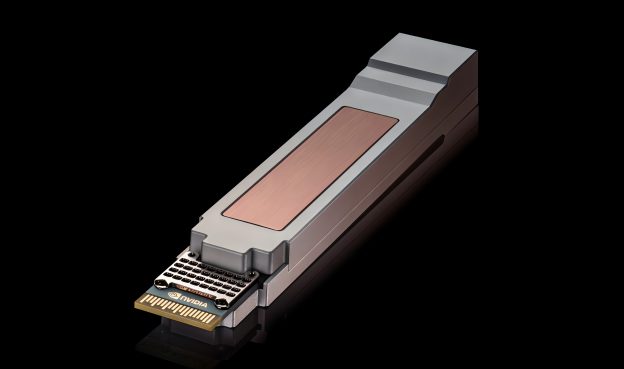
In optical connectivity, NVIDIA has partnered with Cisco to develop the Ultra-Dense Small Form Factor Pluggable (USFP) specification, designed to support 400Gb/s per lane, Economic Daily News reports. NVIDIA and Cisco say the new design is expected to deliver four times the bandwidth density and 1.3 times the power efficiency of existing 200Gb/s-per-lane optics, with a path to 12.8Tb/s of total capacity. The companies plan to establish an open industry specification, potentially encouraging adoption by major cloud providers and creating new opportunities in the optical transceiver market.
For Taiwanese optical communications suppliers, the open specification could reduce reliance on proprietary technologies controlled by a limited number of vendors, expanding opportunities in the pluggable optical module market. Economic Daily News highlights Luxnet and PCL Technologies as potential beneficiaries.
NVIDIA’s networking push also extends to Ethernet switches, with Meta adopting its Spectrum-6 switch chips for the IceCube platform in its next-generation IcePack liquid-cooled network racks, according to NVIDIA’s OCP announcement.
Vera CPU and Open Rack Designs Expand Opportunities for Taiwan’s Server Supply Chain
Beyond networking, NVIDIA is also expanding its AI computing infrastructure through standalone Vera CPU MGX racks, which have entered mass production and begun shipping, Economic Daily News reports. Primarily designed for AI inference, the racks give cloud service providers (CSPs) greater flexibility to integrate NVIDIA CPUs with other GPUs, ASICs, and networking architectures, rather than relying solely on NVIDIA’s more closed DGX systems or semi-open HGX platforms. Manufactured using TSMC’s 3nm node, Vera delivers 50% higher performance and twice the performance per watt compared with conventional x86 CPUs, the report adds.
This greater flexibility could also benefit Taiwan’s server manufacturers. Commercial Times identifies 12 Taiwanese companies among NVIDIA’s Vera CPU MGX rack partners, including Foxconn, Quanta subsidiary QCT, Wistron, Wiwynn, Inventec, Compal, Pegatron, MiTAC, ASUS, GIGABYTE, MSI, and ASRock subsidiary ASRock Rack. The broader deployment options are expected to drive demand for customized server systems, creating new business opportunities for Taiwanese suppliers.
NVIDIA is also opening up its Vera Rubin rack and compute tray designs under the third-generation MGX 1.2 specification, Commercial Times notes. Compared with the previous GB300 generation, the new architecture upgrades power delivery, cooling, and mechanical layouts. Its modular liquid-cooling design eliminates internal cables, hoses, and fans from compute trays, reducing assembly and maintenance times from hours to minutes, while supporting up to 5,000 amperes to increase power density.
Further simplifying maintenance, the specification introduces MGX Quick Disconnect (MQD) and blind-mate liquid-cooling connectors to make component replacement easier and reduce leakage risks. NVIDIA says the open designs will allow suppliers to manufacture components earlier and shorten delivery times for customized systems, creating new opportunities for Taiwanese server, power, and liquid-cooling suppliers, Commercial Times adds.
Read more
- NVIDIA and Broadcom Begin Volume Ramp of CPO Switches, with Optical Engine Yield and Advanced Packaging Capacity Emerging as Key Expansion Bottlenecks, Says TrendForce
- [News] NVIDIA’s NVHBM Reshapes Base Die Strategies: How Micron, Samsung Are Bringing TSMC Into the Fold
(Photo credit: NVIDIA)