[News] NVIDIA’s NVHBM Reshapes Base Die Strategies: How Micron, Samsung Are Bringing TSMC Into the Fold
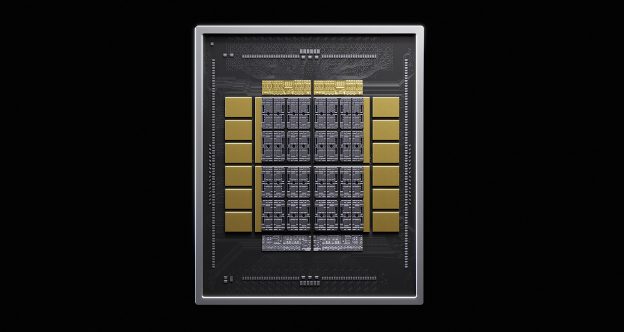
NVIDIA’s NVHBM, announced in August, could mark a turning point for custom HBM. By moving the memory controller into the HBM base die, the architecture gives base dies a bigger role—and is already reshaping how memory makers source them.
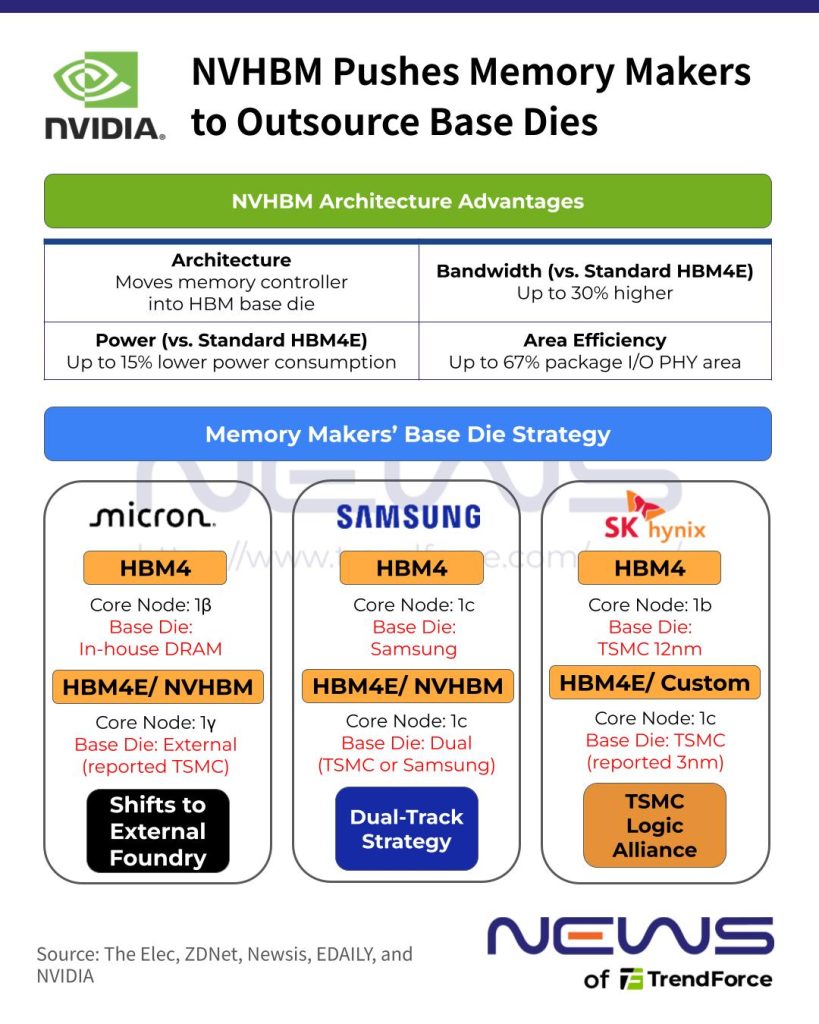
Against this backdrop, Micron and Samsung are already signaling a shift beyond fully in-house base dies. According to The Elec, Micron said both its NVHBM, co-designed with NVIDIA, and JEDEC-standard HBM4E will use base dies manufactured by an external foundry.
Samsung is taking an even more notable step: ZDNet earlier reported that Samsung is also pursuing a dual-track strategy for custom HBM such as NVHBM, pairing its HBM core dies with base dies made by either Samsung Foundry or archrival TSMC, depending on customer requirements.
Micron Sees Higher Value in NVHBM
For HBM4, Micron pairs 1-beta (1β) core dies with an in-house base die, according to The Elec. HBM4E marks a broader shift: the core dies move to Micron’s more advanced 1-gamma (1γ) process—broadly equivalent to Samsung and SK hynix’s 1c generation—while base die production moves outside Micron’s own fabs, with TSMC expected to take on the role, the report suggests.
The outsourcing shift, however, does not appear to come at the expense of profitability. Citing COO Manish Bhatia, The Elec reports that Micron expects NVHBM to command higher ASP and deliver stronger margins. According to Bhatia, HBM already carries a premium, while NVHBM’s added customization creates even greater value—potentially translating into a strong return on investment (ROI) once commercialized.
According to NVIDIA, NVHBM delivers up to 30% greater memory bandwidth and 15% lower HBM power consumption than standard HBM4E, while freeing up to 25% more area on the XPU compute die. The Elec explains that a customized input/output (I/O) physical layer (PHY) for NVHBM further reduces the package area occupied by the I/O PHY by as much as 67%. As highlighted by ZDNet, Amazon’s Annapurna Labs is also set to adopt the technology for its next-generation Trainium 4 AI accelerator.
The custom HBM push is extending to SK hynix. According to Newsis, the memory maker is working closely with NVIDIA on customized HBM solutions. At NVIDIA’s GTC earlier this year, SK hynix unveiled a custom HBM concept based on its Stream DQ technology, designed to continuously manage and feed data to compute processors and optimize data flow between memory and processing units, the report adds.
That custom HBM push is also deepening SK hynix’s foundry partnership with TSMC. EDAILY reports that SK hynix already uses TSMC’s 12nm logic process for its HBM4 base die, while TSMC’s more advanced 3nm process is being prioritized for HBM4E and future custom HBM products. As more customer-specific functions move onto the base die, the report expects collaboration between the two companies to grow even closer.
Samsung’s Unlikely Partner for NVHBM Base Dies
Notably, ZDNet, citing industry sources, reports that Samsung is rethinking its traditionally in-house base die strategy as custom HBM takes shape. While the company has so far sourced HBM base dies internally through its System LSI and Foundry divisions, it is now pursuing a dual-track approach for products such as NVHBM.
Under the new model, Samsung’s HBM core dies could be paired with base dies manufactured by either Samsung Foundry or foundry rival TSMC, depending on customer requirements, the report notes. For TSMC-made base dies, Samsung’s Memory Business is expected to take charge of chip design and optimization support—a notable departure from its traditional reliance on System LSI and Samsung Foundry.
Read more
(Photo credit: NVIDIA)