[News] AI Chip Memory Strategies Diverge: Microsoft’s Maia 300 Fuels HBM4 Demand as Intel Bets on LPDDR5X
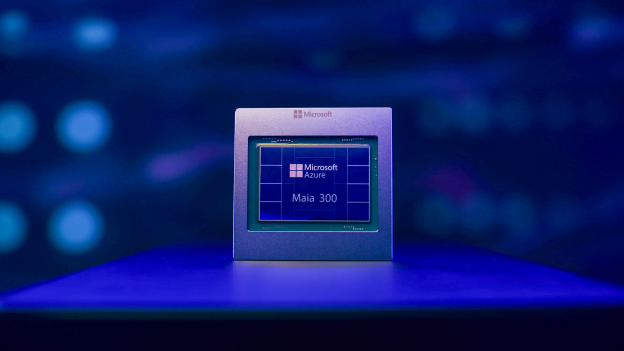
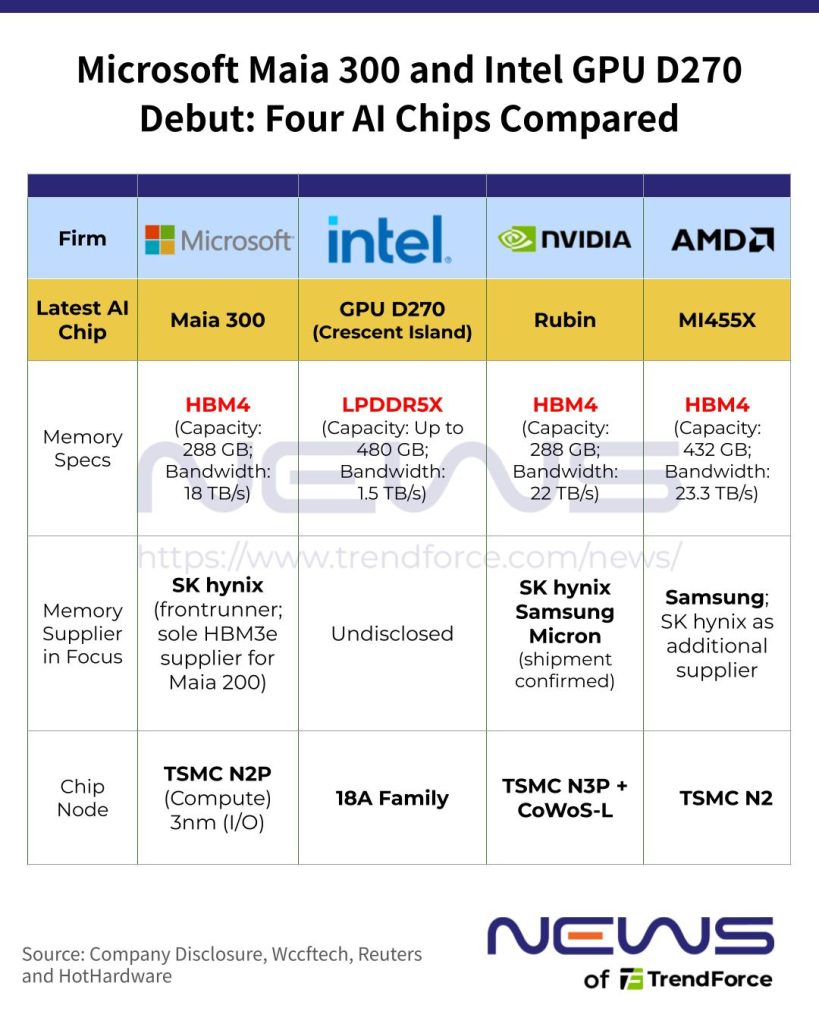
Microsoft and Intel unveiled their latest in-house AI accelerators on Monday, stepping up their challenge to NVIDIA with distinct approaches to AI inference performance and efficiency. According to Reuters, Microsoft’s Maia 300 features a multi-chiplet architecture leveraging TSMC’s 2nm process for core computing functions. It also packs eight HBM4 stacks, up from six HBM3E stacks in Maia 200, Seoul Economic Daily notes.
Intel, meanwhile, is taking a different route. Its newly branded D-Series GPU, formerly known as Crescent Island, opts for LPDDR5X over the increasingly costly and supply-constrained HBM favored by NVIDIA and AMD, Wccftech reports, adding that built on the Xe3P architecture, the accelerator supports up to 480GB of LPDDR5X memory.
Microsoft’s Maia 300 Eyes Million-Chip Rollout, Fueling HBM4 Demand
Notably, Microsoft is tapping TSMC’s cutting-edge N2P process for Maia 300’s compute-intensive chiplets, while shifting memory controllers and I/O functions to more cost-effective dies optimized for bandwidth and connectivity. The latter use the 3nm technology to handle data transfers between the processor, Reuters notes, allowing Microsoft to balance computing performance with cost efficiency.
The architecture delivers 36% more compute FLOPs, 2.5 times the HBM bandwidth and 14% higher scale-up bandwidth, Microsoft said.
According to Reuters, the company plans to roll out potentially more than one million Maia 300 accelerators next year, with each rack housing 96 chips and consuming around 167kW. Despite the substantial power draw, Microsoft claims the platform delivers roughly 40% more computing output per megawatt than leading GPU-based systems, Reuters notes.
The expansion could also fuel a surge in HBM demand. According to Seoul Economic Daily, upgrading from six HBM3E stacks in Maia 200 to eight HBM4 stacks, Maia 300 increases memory capacity from 216GB to 288GB. Combined with the doubling of accelerator density to 96 per rack, total HBM stacks per rack reportedly jump 2.7-fold from 288 to 768, potentially opening a major new growth opportunity for memory supplier, Seoul Economic Daily adds.
Attention is therefore turning to Maia 300’s HBM suppliers. SK hynix is seen as a leading contender, having served as the sole HBM3E supplier for Maia 200, Economy Tribune reports, adding that Samsung could also secure orders with its 36GB 12-high HBM4 now in mass production.
Intel’s GPU D-Series Taps LPDDR5X for Cost-Efficient AI Inference
On the other hand, Tom’s Hardware reports that at OCP 2026, Intel officially branded its Xe3P architecture-based Crescent Island AI inference accelerator as the Intel GPU D-Series, unveiling new performance targets of 1.3 PFLOPS in FP8 compute and 1.5TB/s of memory bandwidth.
Tom’s Hardware explains that by comparison, each of the 72 Rubin GPUs in NVIDIA’s liquid-cooled Vera Rubin NVL72 system delivers a theoretical peak of 17.5 PFLOPS in FP8 compute, but requires liquid cooling and is expected to draw several kilowatts of power. Intel’s GPU D-Series, by contrast, targets conventional air-cooled rack servers supporting up to eight accelerators, similar to NVIDIA’s HGX configurations.
Intel is also taking a different approach to memory. According to Wccftech, by opting for LPDDR5X over HBM, Intel is positioning Crescent Island as a cost-efficient alternative for AI inference and token-as-a-service workloads, with support for a wide range of data formats.
The accelerator supports up to 480GB of LPDDR5X memory, although Intel’s reference PCIe card comes with 160GB, Wccftech reports, adding that ODM partners can offer customized configurations with higher capacities.
Notably, as previously reported by HotHardware, Intel is positioning Crescent Island around token throughput per watt, although its manufacturing process remains undisclosed. While 18A appears a likely candidate, the enhanced 18A-P node could also be well suited to the 350W accelerator, given its reported 20–40% improvement in thermal resistance through material and design optimizations, the report suggests.
Read more
- [News] Microsoft Eyes Maia 300 Launch in Sep., Reportedly Seeks 300K TSMC Capacity as Google, AWS Race Ahead
- [News] Intel Unveils Three AI Architectures at Hot Chips 2026, Diamond Rapids Taps In-House 18A-P and Packaging
(Photo credit: Microsoft)