[Breaking] Intel EMIB Substrate Yields Reportedly Hit 45%, Suppliers Eye 60% by 1Q27
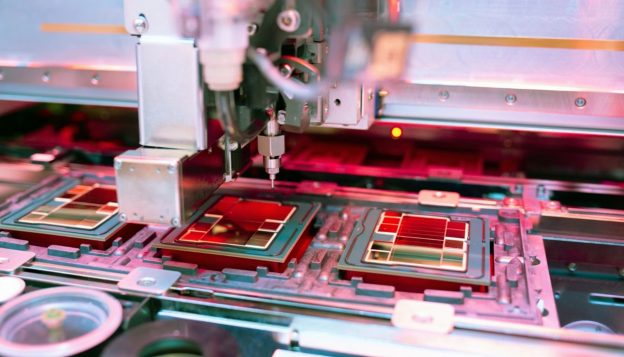
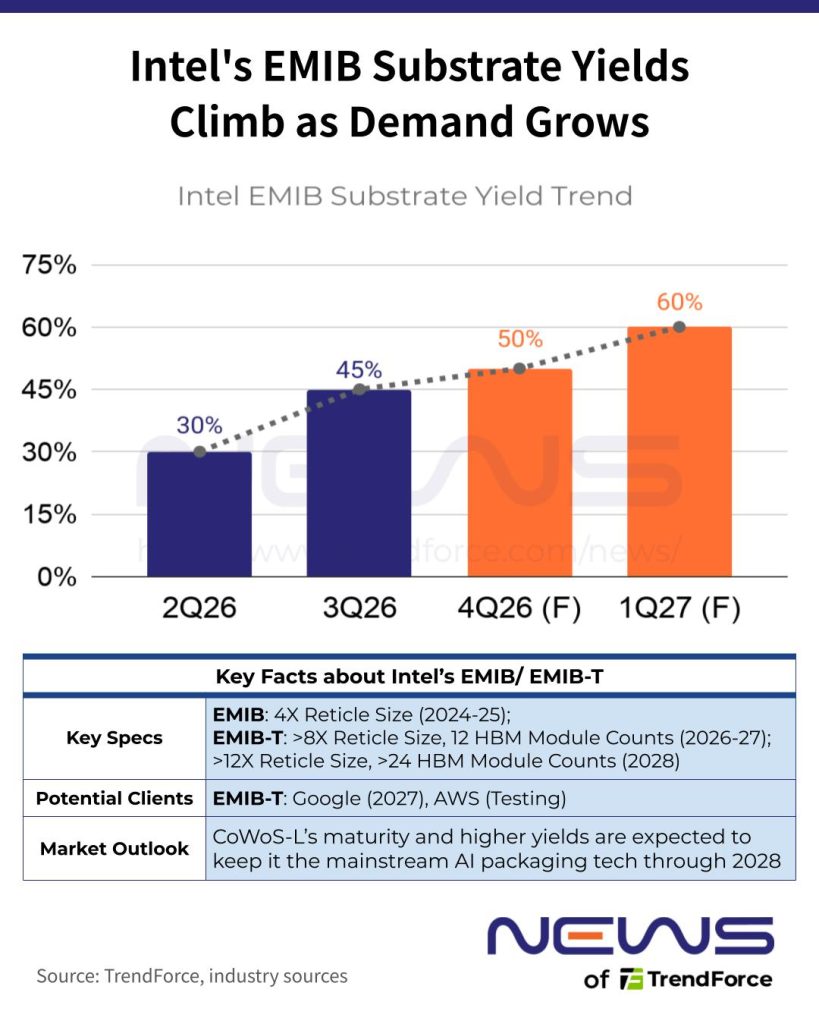
As interest from external customers in Intel’s EMIB (Embedded Multi-die Interconnect Bridge) continues to grow, substrate yields are emerging as a key gauge of its readiness. Industry sources suggest EMIB substrate yields improved to around 45% over the past quarter, with the supply chain targeting 60% by 1Q27.
Sources trace the yield improvement back further: yields stood at roughly 30% in 2Q26 before reaching the current ~45% level. The supply chain’s near-term milestones are reportedly 50% by 4Q26 ahead of the 60% target in 1Q27, with Japanese suppliers said to be running more stable than their peers.
As explained by Common Wealth Magazine, the yield challenge stems in part from EMIB-T’s architecture. Unlike TSMC’s CoWoS, which uses a silicon interposer, EMIB-T embeds silicon bridges directly into the package substrate, shifting the demanding interconnect integration to substrate suppliers and making their manufacturing capabilities critical to the ramp.
For substrate makers, one key challenge is the stark difference in thermal expansion between ABF substrates and silicon bridges, Common Wealth Magazine reports. During repeated high-temperature processing, the bridge must sit precisely in its cavity and remain flush with the substrate surface—but as the two materials expand and contract at different rates, maintaining that alignment is difficult.
Adding another layer of complexity is NCF (Non-Conductive Film), a new material applied beneath the TSVs at the bottom of the silicon bridge, the report adds. During bonding, NCF is prone to trapping air bubbles, which can compromise adhesion, according to Common Wealth Magazine.
Despite current yield hurdles, customer interest is already translating into adoption. TrendForce expects Google to adopt EMIB-T in 2027, while AWS is also testing EMIB technology. CoWoS-L, however, is expected to remain the mainstream AI packaging technology through 2028, supported by its greater maturity and higher yields, according to TrendForce.
EMIB-T Substrate Race Heats Up as New Players Eye Entry
As EMIB demand builds, substrate supply is emerging as another key pressure point. Speaking at Splunk’s .conf26 Global Broadcast earlier this month, Intel CEO Lip-Bu Tan identified advanced packaging as the company’s next major growth area while flagging substrates as a bottleneck. Intel even “has to prepay” to secure suppliers’ attention, he said, pointing to four major partners—two each in Japan and Taiwan.
ZDNet reports that Intel’s EMIB-T substrate supply chain includes established players such as Japan’s Ibiden and Shinko Electric and Taiwan’s Unimicron. Ibiden, the world’s largest FC-BGA supplier, has reportedly secured upfront payments from major tech customers including Google, Amazon and Intel, the report suggests.
Their head start could raise the bar for newcomers. An industry source cited by ZDNet says Ibiden and Unimicron have spent seven to eight years mass-producing Intel EMIB substrates, building up proven technology and manufacturing capabilities. Even so, Samsung Electro-Mechanics and LG Innotek are now reportedly targeting entry into the EMIB-T supply chain as they expand deeper into the high-value FC-BGA market.
Read more
- [News] Samsung Electro-Mechanics, Qualcomm Reportedly Develop Organic Bridge Packaging, Eye Intel EMIB Alternative
- [News] MediaTek Reportedly Adopts Dual Packaging Strategy With Intel EMIB, TSMC CoWoS for AI ASIC Push
(Photo credit: Intel)