[News] “DRAM Godfather” Kau Rejects TSMC DRAM Rumors, Flags Glut Risk from CXMT’s 10-Fab Ramp Within 2 Years
Amid reports that TSMC is exploring 3D DRAM production at NVIDIA’s urging, semiconductor veteran Charles Kau, dubbed the “Godfather of DRAM” and former president of Taiwan’s Nanya Technology, has dismissed the possibility. Drawing on his extensive industry experience, including executive roles at TSMC and Intel, Kau, cited by TechNews, argued that TSMC would never venture into DRAM manufacturing. Instead, he flagged China’s CXMT’s aggressive expansion as a greater threat, warning of a potential global memory supply glut.
Kau: CXMT’s 10-Fab Expansion Raises Supply Glut Fears, but 4F² Ambitions Face Hurdles
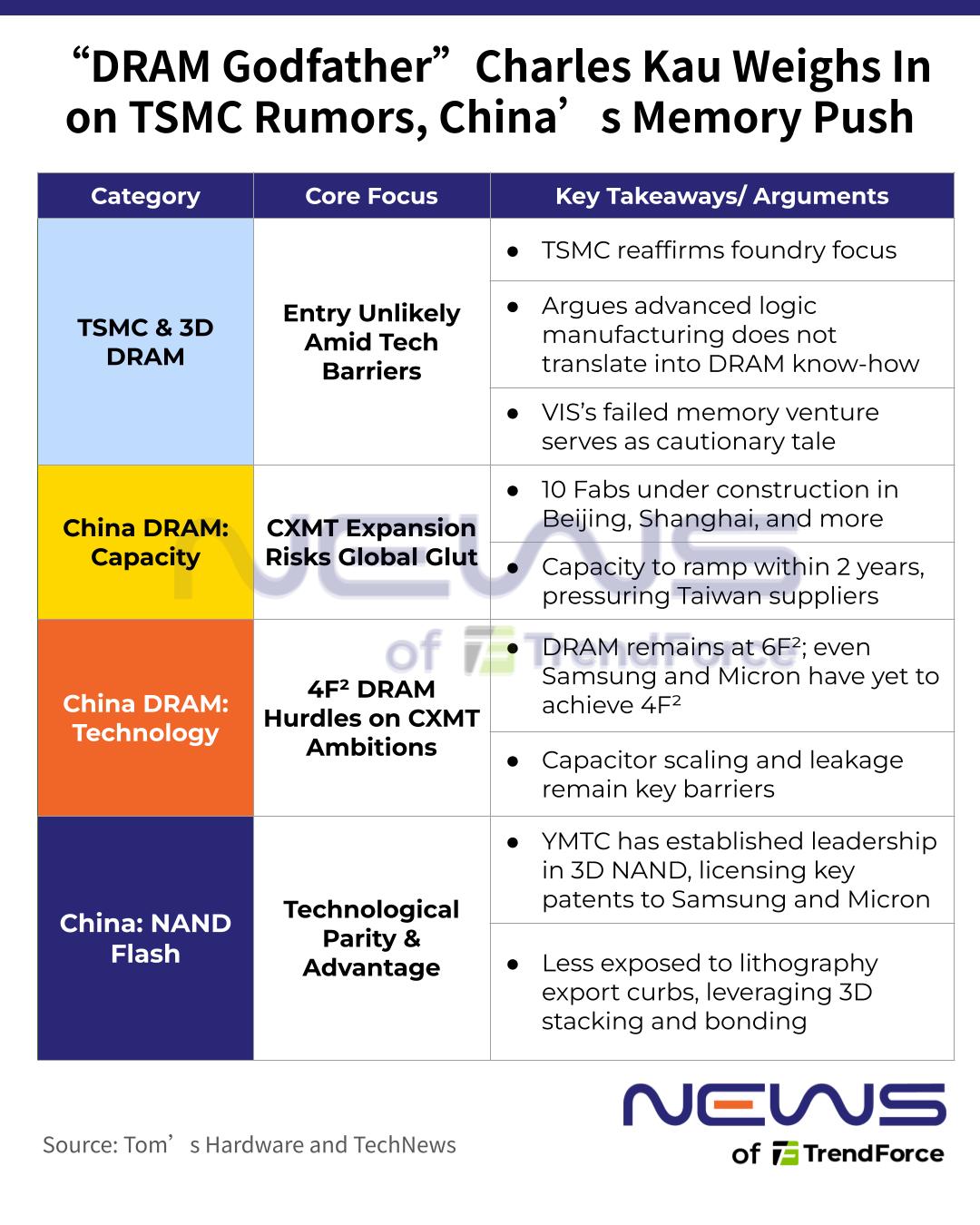
China’s CXMT is building 10 wafer fabs across Beijing, Shanghai and other locations, with massive new capacity expected to come online within two years, according to TechNews, citing Kau. He warned that the expansion could trigger a global memory supply glut and squeeze Taiwanese suppliers, even if CXMT remains reliant on mature processes due to EUV restrictions.
Beyond capacity, CXMT is also pushing the technological frontier, targeting the launch of 4F²-based DDR5 RDIMMs by year-end. Yet Kau questioned whether the architecture could reach mass production, arguing that even substantial R&D spending may not overcome its technical barriers, according to the Economic Daily News.
As TechNews notes, citing Kau, DRAM scaling remains at 6F², with no manufacturer yet achieving 4F². Unlike NAND flash, DRAM’s one-transistor, one-capacitor structure makes further miniaturization particularly challenging, with capacitor scaling and leakage posing major obstacles. These constraints also complicate the development of 3D DRAM, he added.
Kau stressed that even industry heavyweights Samsung and Micron have yet to overcome these hurdles, casting further doubt on CXMT’s ambitious timeline.
Meanwhile, the competitive landscape is markedly different in NAND flash. TechNews, citing Kau, notes that China’s YMTC, whose early development he personally led, has emerged as a global technology leader, even licensing patents to Samsung and Micron. Unlike China’s logic foundry sector, which remains constrained by limited access to extreme ultraviolet (EUV) lithography equipment, its flash memory industry holds a competitive edge, backed by substantial fundraising capabilities, he said.
TSMC Pushes Back on 3D DRAM Rumors as Kau Casts Doubt on Memory Ambitions
Amid reports that TSMC may be exploring 3D DRAM production at NVIDIA’s urging, the foundry giant has pushed back against the speculation, reaffirming its commitment to its core foundry business, according to Tom’s Hardware, citing a company spokesperson.
Kau echoed that skepticism, arguing that TSMC’s leadership in advanced logic manufacturing does not necessarily translate into expertise in DRAM production. The two fields require fundamentally different technologies, making a move into conventional memory manufacturing highly unlikely, according to the Economic Daily News.
Pointing to an industry precedent, Kau cited TSMC affiliate Vanguard International Semiconductor (VIS), whose unsuccessful venture into memory manufacturing ultimately led it to refocus on foundry operations, TechNews reports. The experience, he suggested, underscores the challenges of crossing between the two businesses.
And while AI is accelerating the convergence of logic and memory through 3D stacking and heterogeneous integration, closer integration does not necessarily require TSMC to manufacture DRAM itself, Kau stressed, according to the Economic Daily News.
Read more
- [News] Beyond CXMT’s 89.53% Gross Margin in 3Q26: 3 Key Takeaways on LTAs, 4F² Advancement and LPDDR6
- [News] CXMT Accelerates 4F² DRAM Push, Eyes Year-End Server DDR5 RDIMM Launch
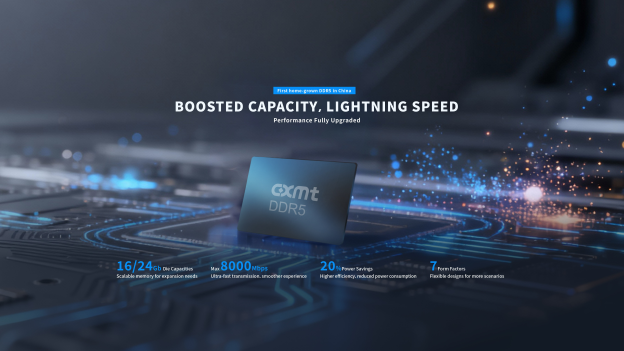
(Photo credit: CXMT)