[News] Intel’s Mixed 3Q26: PC, Israel Fab Weigh on Guidance; EMIB Brightens as a Couple of Customers Near Announcement

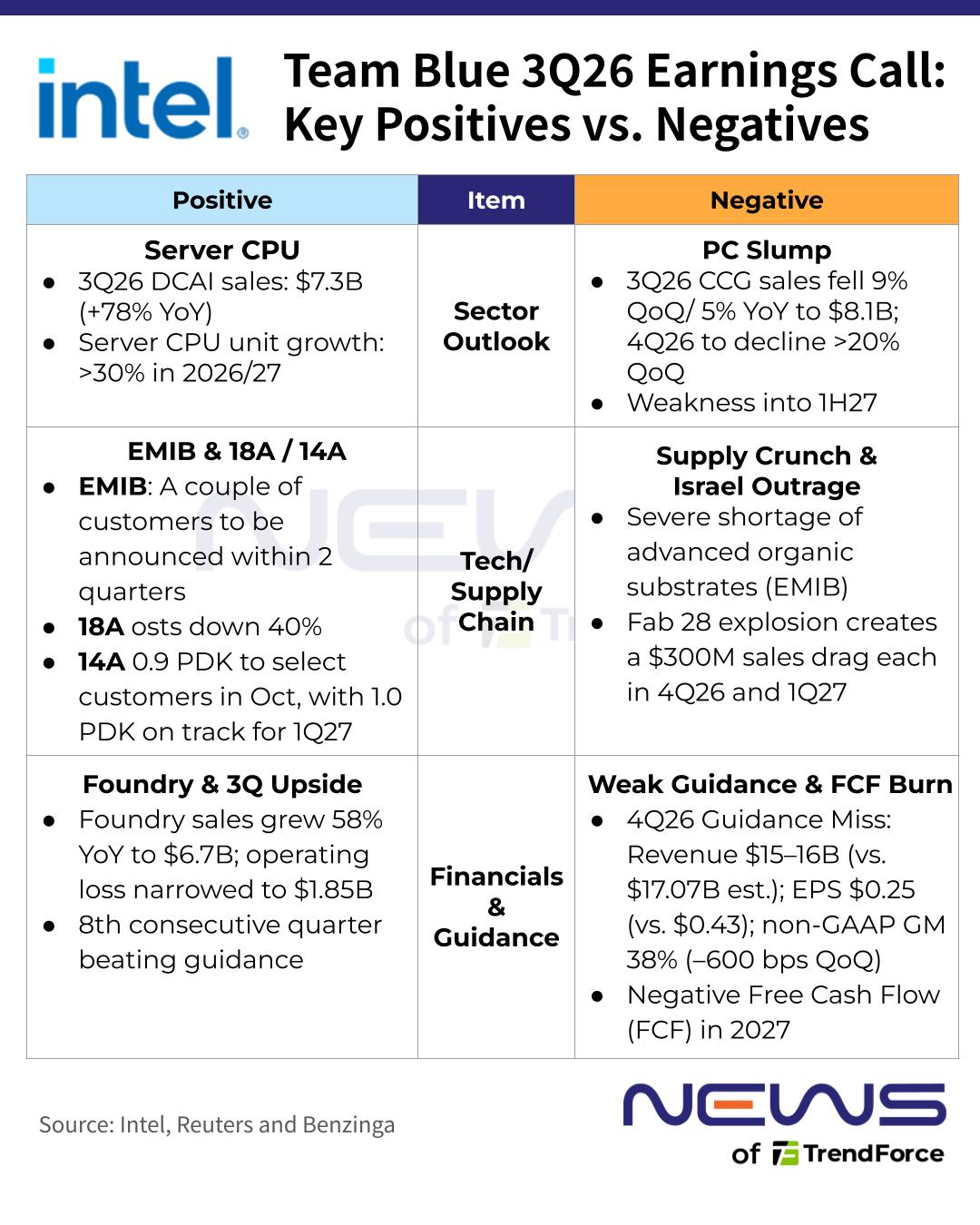
Intel’s 3Q26 earnings painted a mixed picture. While Data Center and AI (DCAI) revenue surged 78% to $7.3 billion and operating income more than tripled to $3.04 billion, the chipmaker remains vulnerable to weakness in the PC market. According to Reuters, a fatal explosion at Intel’s Israeli plant is expected to cost the company roughly $600 million in revenue over two quarters, while sluggish PC demand could persist through 1H27.
Reflecting these headwinds, Intel forecast fourth-quarter revenue of $15 billion to $16 billion, missing the $17.07 billion LSEG consensus, Reuters reports. Adjusted earnings are projected at 25 cents per share, also falling well short of analysts’ expectations of 43 cents, Reuters notes.
“I’m disappointed that we were not able to meet strong customer demand in this quarter,” CEO Lip-Bu Tan said, citing manufacturing supply shortages, an unprecedented memory crunch and the resulting weakness in PC demand as key near-term challenges.
Among the supply bottlenecks, Tan singled out advanced packaging materials as another constraint. According to Benzinga, he noted that despite rapidly ramping Intel 3 wafer output, an industry-wide shortage of advanced organic substrates for EMIB packaging continues to limit production scaling.
PC Sales Could Face 20% Plus Drop in 4Q26
The October explosion at Intel’s Kiryat Gat fab, which primarily produces data center processors using its 10nm technology, is dealing another blow. According to Reuters, CFO David Zinsner said the incident would reduce fourth-quarter revenue by roughly $300 million and shave 200 basis points off gross margin, with a similar revenue hit expected in 1Q27.
Following a two-week shutdown, Intel aims to begin restoring production at the Israeli facility by the end of this week, he added.
Meanwhile, weakness in the PC market is compounding the pressure. Zinsner expects Intel’s PC business revenue to plunge by a percentage in the mid-20s in the fourth quarter, after sales fell 5% to $8.10 billion in 3Q26, missing analysts’ $8.98 billion estimate, Reuters notes.
Aggressive capacity expansion is also adding to its financial strain. According to Reuters, Zinsner warned that the chipmaker is unlikely to generate positive cash flow in 2026. Intel had already raised its capital expenditure guidance from $18 billion to $20 billion in July, with a further substantial increase expected in 2027 to support its manufacturing buildout.
Despite these headwinds, Intel sees brighter prospects in the server CPU market. According to the earnings call transcript from Benzinga, CFO David Zinsner expects industry-wide server CPU unit shipments to grow more than 30% in both 2026 and 2027, pointing to robust demand beyond the struggling PC segment.
Meanwhile, Intel Foundry revenue surged 58% to $6.7 billion in 3Q26, including internal sales, while its operating loss narrowed to $1.85 billion from $2.32 billion a year earlier. The improvement points to progress in the foundry business despite continued losses.
Intel’s EMIB Making Strides
Notably, CNBC, citing Tan, reports that Intel expects a couple of customer announcements over the next two quarters, while touting “tremendous progress” on its upcoming 14A process technology. According to Tan, in October, the chipmaker delivered its industry-standard 0.9 process design kit (PDK) to select customers as planned.
In the transcript from Benzinga, Tan singled out the momentum for its EMIB and EMIB-T advanced packaging solutions, flagging that “We’re going to have a couple of customers ready to announce next two quarters, so stayed tuned.” According to Tan, Intel has got a lot of capacity in the next two years in terms of the substrate material, and it is also improving the yield as the days go by.
Customer interest is already translating into adoption. TrendForce expects Google to adopt EMIB-T in 2027, while AWS is also testing EMIB technology.
Industry sources earlier suggested Google’s TPU v9 lineup includes three variants: Broadcom-designed WhaleFish, and MediaTek-designed HumuFish and TriggerFish. WhaleFish is expected to adopt TSMC’s CoWoS-L, with mass production slated for 2H27. HumuFish, meanwhile, is set to enter mass production in 1H28, relying exclusively on Intel’s EMIB-T. TriggerFish is also planned to use EMIB-T, with production targeted for 2H28 or later.
Read more
- [Breaking] Google Reportedly Sticks With Intel EMIB-T Despite 35% Substrate Yields as HumuFish Schedule Tightens
- [Breaking] Intel EMIB Substrate Yields Reportedly Hit 45%, Suppliers Eye 60% by 1Q27
(Photo credit: Intel)