[News] BOE Joins Glass Substrate Race as Samsung Electro-Mechanics, SKC, LG Eye 2027–2028 Ramp
Glass substrate adoption by major tech players may be closer than expected. KIPOST reports that NVIDIA has asked substrate makers to accelerate development, potentially bringing adoption forward to before 2028.
That is raising the stakes in the emerging supply-chain race. As Samsung Electro-Mechanics, LG Innotek and SKC target 2027–2028 mass production, China’s BOE is also moving in, with Aju News reporting that the display giant could begin mass production as early as 2028.
BOE Moves Closer to Commercialization
Aju News, citing BOE Chairman Chen Yanshun at IPC 2026, reports that the company is preparing to invest in a semiconductor glass substrate mass-production line. The push comes as BOE has produced 24-layer substrates larger than 100 × 100 mm, with in-house reliability tests already completed, according to IT Home.
The substrates are now undergoing customer validation with actual CPUs and GPUs in servers, IT Home suggests, adding BOE aims to meet the requirements for a mass-production investment decision by 1H27, though Aju News expects full-scale production no earlier than 2028.
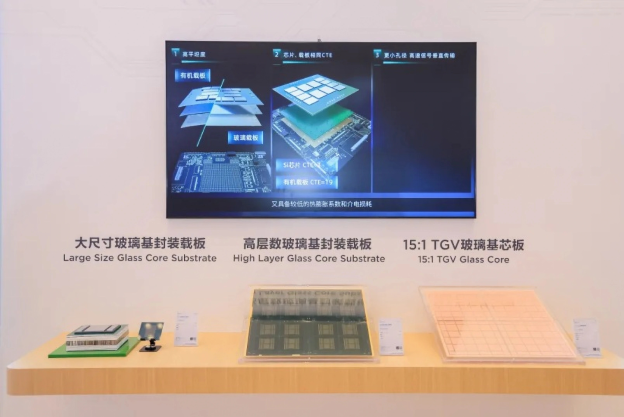
Notably, ZDNet reports that BOE has also unveiled its first 15:1 aspect-ratio through-glass via (TGV) glass core substrate at IPC 2026, upgrading from the 10:1 designs it had previously showcased. The new substrate is reportedly 1 mm thick with 67 μm-diameter TGVs and 24 buildup layers. The aspect ratio measures the depth of a via relative to its diameter, meaning a higher ratio enables smaller vias through a given substrate thickness—supporting denser interconnects for advanced packaging, the report explains.
ZDNet notes that BOE has spent three years developing glass cores, glass interposers and glass carriers. As TrendForce’s Substack explains, glass core substrates replace the conventional substrate core with glass, while glass interposers use glass in place of silicon. Both remain in the finished package, whereas glass carriers serve only as temporary supports during packaging.
Meanwhile, Aju News notes that other Chinese panel makers are also accelerating their push into the market, with TCL China Star (CSOT) having formed a dedicated team to validate key glass-substrate packaging processes and plans to unveil prototypes and build a pilot production line in the second half of this year.
Korean Players Step Up the Race
Korean players are also stepping up their push as competition in glass substrates intensifies. Samsung Electro-Mechanics is forming GlaSSEM, a glass-core joint venture with Sumitomo Chemical affiliate Dongwoo Fine-Chem, according to Aju News. The company is already producing prototypes at its Sejong pilot line and plans to begin mass production through the JV from 2027, the report adds.
SKC, meanwhile, is pushing into the market through its U.S. subsidiary Absolics. The company is conducting glass-substrate evaluations and customer qualification while investing in equipment to improve production yields and quality. According to ZDNet, SKC is stepping up its glass substrate push with an additional KRW 92.1 billion investment in Absolics, bringing its total commitment to the company to KRW 373.1 billion.
On the other hand, Aju News reports that LG Innotek is also accelerating development as it targets mass production of glass substrates in 2028. The company recently showcased its glass-substrate technology at KPCA Show 2026 as it prepares to expand its next-generation semiconductor substrate business, the report adds.
Read more
- [News] Intel Unveils Micro-LED-Based Glass Substrate Packaging Technology Patent
- [News] Shinko Electric Advances 22-Layer Glass Substrates; Samsung Electronic Mechanics Faces Ramp-Up Uncertainty
(Photo credit: BOE)