[News] Micron Earnings Preview: Can the Margin Boom Last? HBM4 Ramp and Long-term Contracts in Focus
AI demand is showing little sign of slowing over the next couple of years. NVIDIA CEO Jensen Huang, according to CNBC, expects chip sales to double in 2027, while combined CAPEX at Alphabet, Amazon, Meta, Microsoft and Oracle is projected to climb 13.2% to $1.17 trillion in fiscal 2028, per News 1, citing data from NICE Investors Service.
Against this backdrop, all eyes are on Micron’s upcoming earnings call on September 30, as its broad memory portfolio—from DDR5 and NAND to HBM—spans markets from consumer devices to data centers.
Compared with Samsung and SK hynix, however, Micron still trails in the HBM market, making surging conventional memory prices a bigger driver of its first-half growth. Can that tailwind—and the profit boom it fueled—last? Here are three key things to watch when Micron reports earnings, from profit expectations to its HBM ramp.
Micron’s Profit Boom Could Roll On
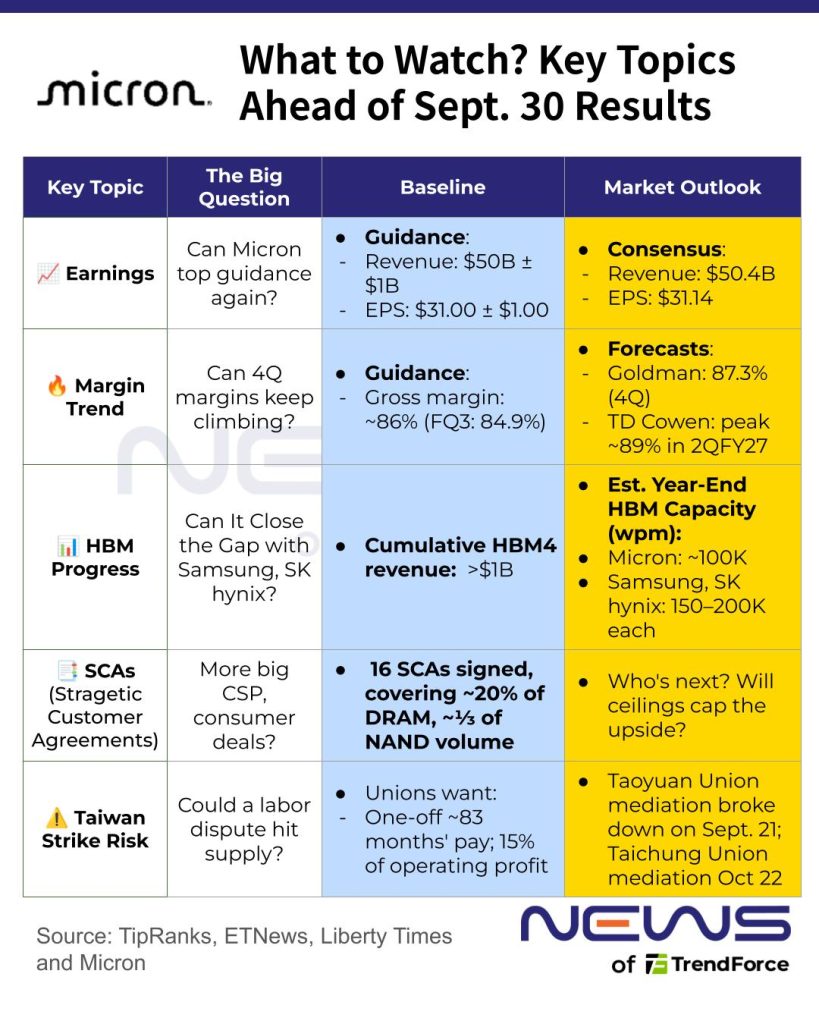
In fiscal Q3 2026, Micron posted revenue of $41.46 billion, up 74% sequentially. GAAP net income more than doubled from the previous quarter to $28.24 billion, while non-GAAP gross margin climbed to a record 84.9%.
The momentum is expected to carry into 4QFY26. Financial research platform TipRanks notes that Wall Street expects EPS of $31.14, more than 10 times the $3.03 reported a year earlier. Revenue is forecast to surge more than 345% to $50.42 billion, TipRanks adds.
Goldman Sachs, cited by TipRanks, forecasts Micron’s gross margin will rise to 87.3% in 4QFY26. The momentum is expected to extend into 1QFY27, with low-teens sequential revenue growth supported by a richer product mix and further pricing gains. TD Cowen, meanwhile, is similarly optimistic, though it sees margin expansion beginning to moderate, with gross margin peaking at around 89% in 2QFY27.
HBM4 Ramp: Can Micron Close the Gap?
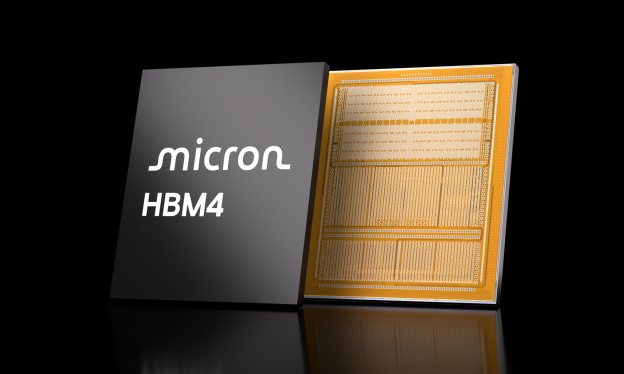
Meanwhile, attention is turning to whether Micron will offer more concrete updates on its HBM4 ramp as rivals expand aggressively. The U.S. memory giant has already shipped more than $1 billion worth of HBM4, company management said.
According to SeDaily, Samsung is gearing up to at least double its HBM4 and next-generation HBM4E output next year. Industry estimates reportedly put Samsung’s total HBM capacity at around 250,000 wafers per month next year, up nearly 40% from 180,000 this year, with HBM4-series products rising to roughly 80% of shipments from about 40%.
SK hynix is moving just as fast. The Fact reports that monthly wafer input at its M15X fab in Cheongju is set to jump eightfold, from 10,000 to 80,000 wafers, while the company speeds up its first Yongin fab, targeting operations in 2027.
Against this backdrop, ETNews reports Micron plans to add as much as 60,000 wafers per month of HBM capacity by year-end, reaching around 100,000 by one industry estimate, versus roughly 150,000–200,000 each at Samsung and SK hynix. If it hits the target, the gap could narrow by about half. With both rivals expanding just as aggressively, whether Micron can turn its HBM4 push into a larger slice of the market remains a key watch point.
More Big SCAs Ahead?
Among the three memory giants, Micron stands out with 16 Strategic Customer Agreements (SCAs) announced so far, though many involve automotive and other smaller customers, with relatively few major cloud service providers (CSPs) publicly disclosed. Samsung, meanwhile, reportedly plans to supply as much as 70% of its total capacity under long-term agreements, while SK hynix has finalized LTAs with around 10 customers, including key strategic partners.
That puts Micron’s next SCA moves firmly in the spotlight—and not just with cloud customers. Apple is rumored to have signed a long-term NAND supply deal with Kioxia, suggesting that major consumer electronics players are also moving to lock in memory supply. With Micron already a key LPDDR5 supplier for the iPhone, whether Apple could emerge as another long-term customer is worth watching.
Still, the agreements could come with a trade-off: pricing ceilings. According to Investing.com, once all planned SCAs are executed, those with fixed prices or ceilings at or near current market levels are expected to account for about 40% of Micron’s revenue.
Since the largest agreements typically set ceilings at 2Q26 market levels, they could limit how far gross margin can climb if memory prices keep rising. With 4QFY26 gross margin guided to about 86%, investors will be watching whether Micron’s commentary points to more room to expand, or to a plateau.
Read more
- [News] Micron Unveils Record Rewards: Taiwan Staff Get NT$1M Bonus, Up to 68 Months of Compensation
- [News] Micron Reportedly to Add 60K HBM Wafers/M, Reaching 100K by Year-End to Narrow Gap With Rivals
(Photo credit: Micron)