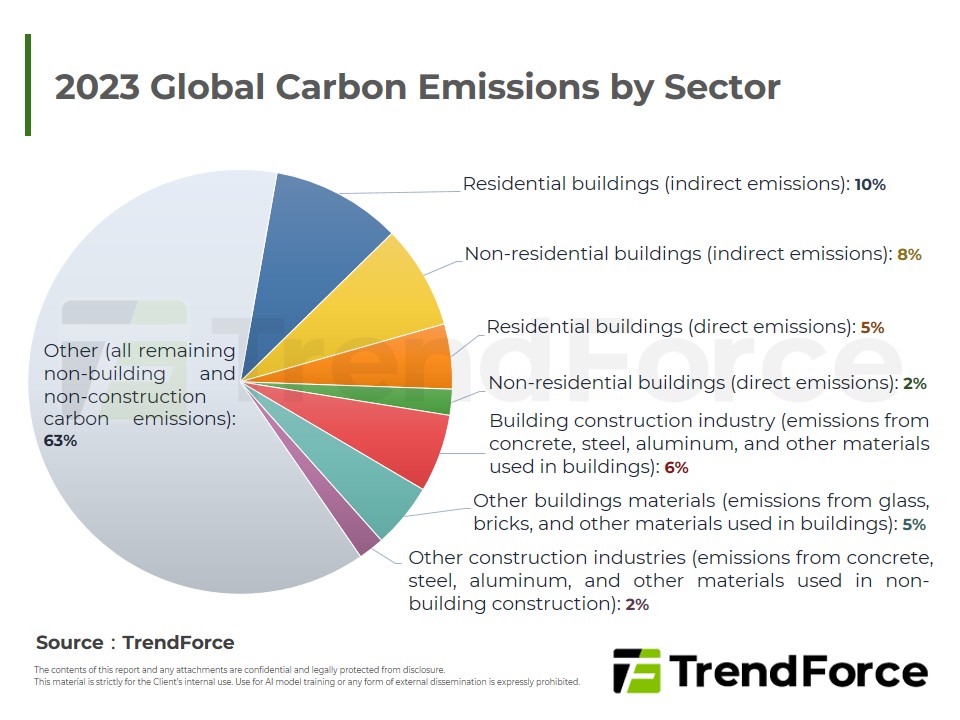
Policy Drivers, Technology Development, and Challenges for Solar Adoption in Buildings
The building sector is a key area for global decarbonization, with policies promoting solar adoption in buildings gradually shifting from incentives and subsidies toward mandatory installation. Rooftop solar remains the most widely adopted solution, while building-integrated photovoltaics (BIPV), which incorporate solar modules into façades, windows, and other building materials, are growing rapidly.
In addition to conventional crystalline silicon, perovskite solar cells are regarded as a promising technology for BIPV due to their lightweight, thin, semi-transparent, and flexible characteristics, as well as continued advances in conversion efficiency. Key challenges include balancing power-generation efficiency with architectural aesthetics, high upfront installation costs, and structural load-bearing and waterproofing requirements for existing buildings.
Meanwhile, solar adoption in buildings is also driving business models toward integrated services combining power generation, energy storage, electricity consumption, and grid interaction—creating new opportunities for the industry.












![[News] China Unveils 15th Five-Year Battery Plan, Targets Initial Large-Scale All-Solid-State Battery Deployment by 2030](https://img.trendforce.com/blog/wp-content/uploads/2026/09/29152616/Gotion-all-solid-state-battery-20260929-300x150.jpg)
![[News] Xiamen Sets Up China's Largest GaAs Satellite Solar Cell Production Base](https://img.trendforce.com/blog/wp-content/uploads/2026/02/03182221/Chip-FREEPIK-20260203-300x169.jpg)
![[News] China’s Rare-Earth Shipments Hit Record in Aug. Before Xi-Trump Talks Amid Ongoing Access Risks](https://img.trendforce.com/blog/wp-content/uploads/2025/06/10164609/GRINM-advanced-materials-China-rare-earth-300x200.jpg)