





 Download Report
 Contact Us
Bumpless Bonding: An Analysis of Alternative Technologies to Hybrid Bonding and Their Market Prospects

Last Modified
2026-10-16

Update Frequency
Not

Format
The rising adoption of TSMC’s SoIC-X packaging in AI chips has driven substantial order growth for hybrid bonders across advanced foundries. However, hybrid bonding entails prohibitive costs and demands an extreme cleanroom environment. To address these barriers, Kulicke & Soffa (K&S) published a paper on Cu-Cu thermo-compression bonding (TCB) in June 2025, and MIT Lincoln Laboratory published a paper on bumpless flip-chip in May 2026, both aiming to find lower-cost bumpless bonding technologies than hybrid bonding.
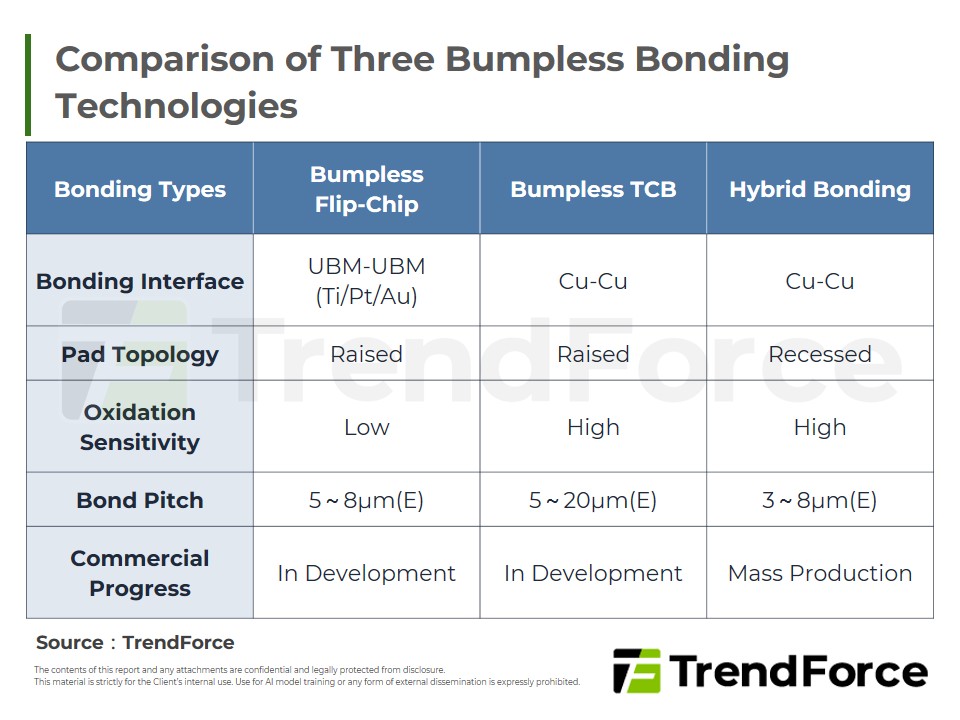
This report mainly delivers an in-depth analysis of: (1) die bonder technology evolution; (2) a comparison of different bumpless bonding technologies; and (3) the market outlook for fluxless TCB and bumpless bonding. It aims to analyze the different die bonder technology roadmaps transitioning from micro-bumps to bumpless interconnects, the underlying bonding principles and performances of various bumpless bonding technologies, and the strategic positioning of major die bonder equipment providers.
Key Highlights
- The expanding adoption of TSMC’s SoIC-X packaging in AI chips is driving growing demand for hybrid bonders.
- Hybrid bonding carries prohibitive costs and requires an extremely stringent cleanroom environment.
- Kulicke & Soffa (Cu-Cu thermo-compression bonding) and MIT Lincoln Laboratory (bumpless flip-chip) are both pursuing lower-cost alternatives.
- The report covers die bonder technology evolution, a comparison of bumpless bonding technologies, the market outlook, and the strategic positioning of equipment providers.
Table of Contents
- Evolution of Die Bonder Technology
- Figure 1: Flip-Chip Process Flow
- Figure 2: Process Flows of Conventional Flux-Based TCB and Fluxless TCB
- Figure 3: Schematic Cross-Sections of Micro-Bump and Cu Pad
- Figure 4: Hybrid Bonding Process Flow
- Figure 5: Bumpless TCB as an Interim Solution for Hybrid Bonding
- Comparative Analysis of Bumpless Bonding Technologies
- Figure 6: High-Precision Thermal and Compression Control Enabling Cu Pillar and Resin Bonding
- Figure 7: Schematic Cross-Section of UBM
- Figure 8: Process Flow Comparison Across Three Bumpless Bonding Technologies
- Table 1: Comparison of Three Bumpless Bonding Technologies
- Market Prospect on Fluxless TCB and Bumpless Bonding
- Figure 9: SK hynix’s Research on Advantages of Hybrid Bonding towards HBM Packaging
- Figure 10: Samsung’s Research on Advantages of Hybrid Bonding towards HBM Packaging
- Table 2: Deployment of Major Die Bonder Suppliers
- TRI’s View
<Total Pages: 12>

Spotlight Report
-

AI Surge Drives NOR Flash Deficit: 2026 Industry Outlook
2026/09/10
Selected Topics
PDF
-

iPhone 18: Modest Hardware Gains, Pricing and AI Drive Sales
2026/09/02
Selected Topics
PDF
-

US Data Center Buildout Faces Midterm Risks
2026/10/07
Selected Topics
PDF
-

AI Server Boom Outpaces U.S. Grid Buildout
2026/09/07
Selected Topics
PDF
-

AI Server Value Surges on Pricing and Capex Boom
2026/10/08
Selected Topics
PDF
-

AI Wave & DRAM Deficits: 2027 Global DRAM Outlook
2026/07/28
Selected Topics
PDF
Selected TopicsRelated Reports

Download Report
2,500

Membership
- Selected Topics
- Selected Topics-219_Bumpless Bonding: An Analysis of Alternative Technologies to Hybrid Bonding and Their Market Prospects New
Spotlight Report
-
AI Surge Drives NOR Flash Deficit: 2026 Industry Outlook
2026/09/10
Selected Topics
PDF
-
iPhone 18: Modest Hardware Gains, Pricing and AI Drive Sales
2026/09/02
Selected Topics
PDF
-
US Data Center Buildout Faces Midterm Risks
2026/10/07
Selected Topics
PDF
-
AI Server Boom Outpaces U.S. Grid Buildout
2026/09/07
Selected Topics
PDF
-
AI Server Value Surges on Pricing and Capex Boom
2026/10/08
Selected Topics
PDF
-
AI Wave & DRAM Deficits: 2027 Global DRAM Outlook
2026/07/28
Selected Topics
PDF