


ASSBs Enter Engineering Validation Phase as Japanese, Korean, and Chinese Suppliers Accelerating Auto Testing and Broaden beyond Auto to New Frontiers, Says TrendForce
TrendForce’s latest “Quarterly Report on Developments in Global SSB Industry, 2Q26” reveals that the all-solid-state battery (ASSB) sector has reached an important stage of engineering validation in 2026. Companies including Toyota, Honda, Nissan, and Samsung SDI are slightly ahead in small-scale ASSB pilot production. Moreover, Japanese suppliers have already verified key automotive-grade performance metrics and are speeding up the assessment of ASSB modules for vehicle use.
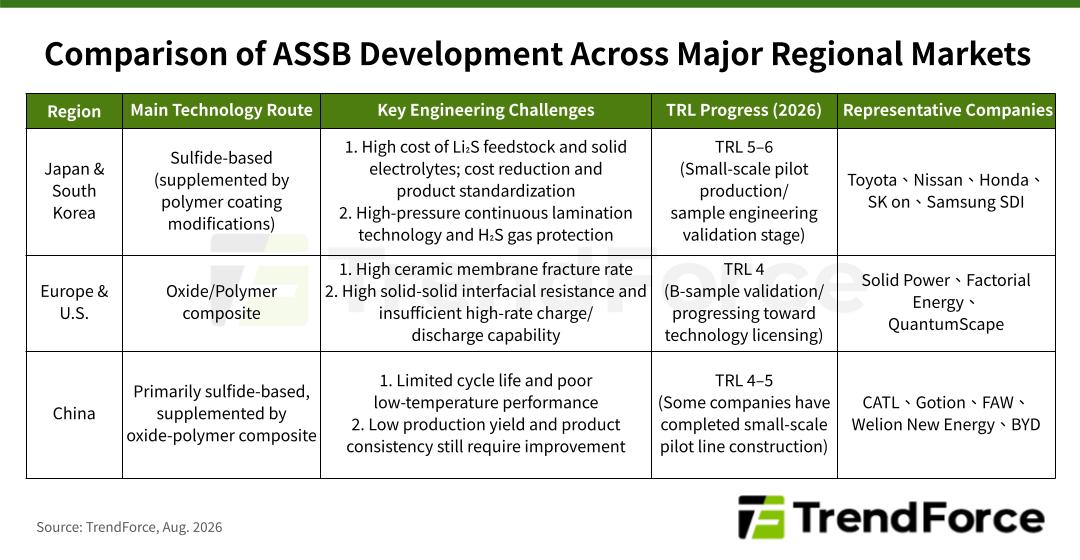
TrendForce observes that ASSB Technology Readiness Levels (TRLs) have advanced significantly in 2026. Across key development regions including China, Japan, and South Korea, ASSB performance validation has progressed beyond the laboratory proof-of-concept stage (TRL 1–3), with some leading companies advancing toward TRL 5–6. This marks a shift in R&D priorities from achieving laboratory-scale material breakthroughs to improving manufacturing processes, ensuring product consistency, and meeting automotive qualification requirements.
Leading Japanese and Korean companies achieved breakthroughs in ASSB sample validation on pilot engineering lines during the first half of 2026, with automotive ASSB cells completing partial performance and reliability verification. The cells met design targets for key metrics, including charge-discharge performance and durability. For example, Nissan’s thick-format 23-layer stacked automotive ASSB cell has completed charge-discharge testing and demonstrated better capacity retention than conventional liquid lithium-ion batteries.
Meanwhile, leading Chinese companies including CATL, BYD, and FAW continued advancing small-scale ASSB pilot lines, accelerating progress toward TRL 4–5.
Alongside automotive-grade validation, ASSB applications are expanding from EVs into higher-value markets. TrendForce uncovered that SSB products from companies including Samsung SDI, Maxell, Ilika, ProLogium, and Factorial are targeting drones/eVTOLs, microelectronics, construction machinery, and embodied robots, with several applications and orders beginning to materialize.
Core materials such as lithium sulfide (Li2S) enter a new growth phase
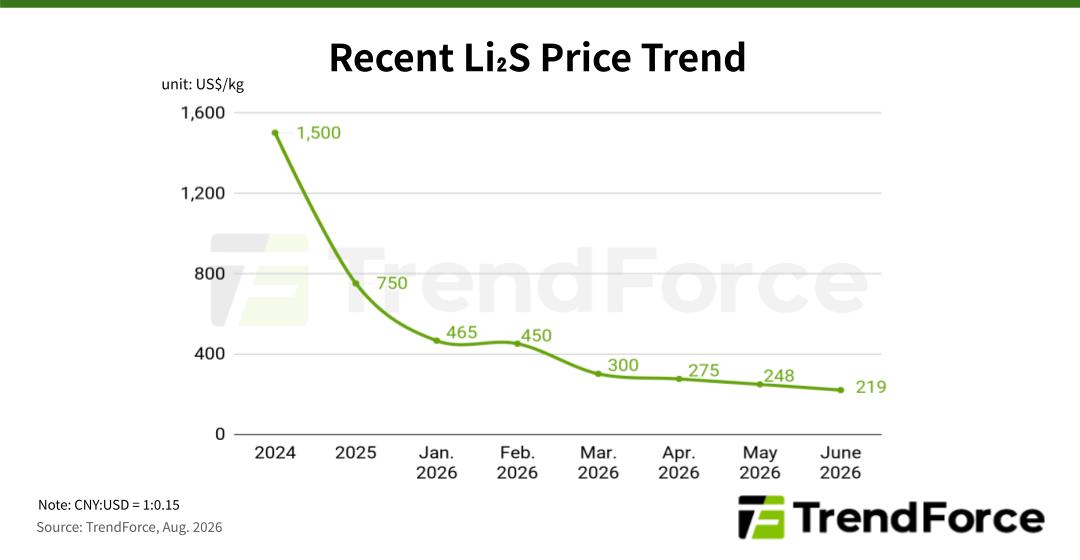
Since 2025, investment and capacity expansion across China, Japan, and South Korea have increasingly focused on solid electrolytes and key raw materials such as Li2S. TrendForce estimates that global installed lithium sulfide capacity has exceeded 600 metric tons by 1H26 and is expected to increase substantially to the thousand-ton scale by 2027.
The sulfide-based route has emerged as the mainstream technology during the small-scale ASSB pilot production and R&D stage, driving higher Li2S demand and accelerating cost reductions. TrendForce notes that since 2026, monthly Li2S shipments from some suppliers have increased from the kilogram scale to the metric-ton scale, marking the first wave of market opportunities. Driven by cost-reduction pressure across the ASSB supply chain, Li2S prices have fallen by more than 50% over the past six months, reaching approximately US$219/kg in June.
Overall, total demand remains limited as ASSBs are still primarily in the small-scale pilot production and R&D stage. However, if ASSB-pack vehicle validation progresses smoothly, demand for core materials is expected to increase significantly.
For more on the latest technology industry news and trends, please visit News.