[News] CXMT’s Earnings Boom Faces Test as 3Q Profit Growth Slows to 1–4% QoQ: What’s Behind the Slowdown?
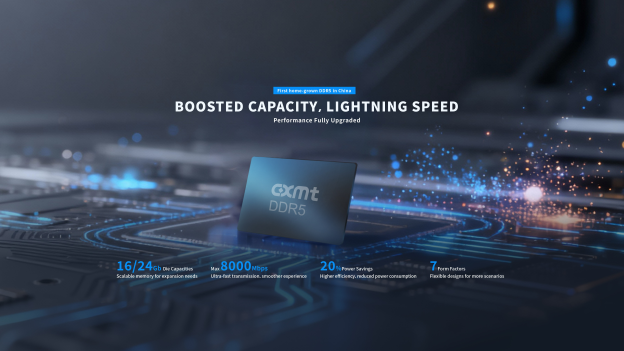
Ahead of its October 31 earnings release, CXMT forecast revenue of RMB 265–270 billion for the first nine months of 2026, surging more than sevenfold YoY, according to Star Market Daily. Yet another key watch point is its slowing profit momentum, as its third-quarter net profit growth eased sharply to single digits QoQ, as highlighted by Eastmoney.
At its October 19 extraordinary shareholders’ meeting, CXMT elaborated on its earnings outlook, projecting net profit attributable to shareholders of RMB 131–132.5 billion for the first nine months of 2026. As reported by South China Morning Post, this would mark a sharp reversal from a net loss of RMB 5.3 billion in the same period last year.
Addressing shareholders’ questions on capacity and demand, CXMT said its fabs in Hefei and Beijing continue to run at high utilization rates, backed by full order books, according to Star Market Daily.
Concerns Arise as CXMT’s QoQ Profit Growth Narrows to 1–4%
Despite its stellar nine-month outlook, CXMT’s quarterly figures reveal a different story. According to Eastmoney, third-quarter revenue is projected at RMB 114.69–119.69 billion, up 15.25–20.28% QoQ, while net profit is expected to rise just 1–4% to RMB 53.40–54.90 billion.
The slowdown marks a sharp reversal from the first half, when CXMT’s net profit more than doubled to RMB 52.84 billion in 2Q26. Eastmoney attributes the cooling momentum to moderating DRAM price gains, which may be narrowing the room for further profit expansion.
As 36Kr notes, CXMT benefited heavily from rising memory prices in 2025, with DDR and LPDDR ASPs climbing 61% and 24.46% YoY, driving revenue growth of 515.36% and 105.59%, respectively. The momentum carried into 1H26, when DDR and LPDDR revenue reached RMB 69.47 billion and RMB 78.19 billion, respectively, before moderating price gains in the third quarter began weighing on earnings growth, the report adds.
The trend was also reflected in the earnings forecast of Chinese memory module maker Longsys: after net profit climbed from RMB 3.86 billion in 1Q26 to RMB 6.72 billion in 2Q26, its third-quarter profit is expected to be at RMB 3.42–4.32 billion, a sharp sequential decline of up to 49%, according to Ijiwei.
This cooling price momentum aligns with TrendForce’s outlook, which projects more moderate contract price increases of 13–18% QoQ for conventional DRAM and 10–15% for NAND Flash in 3Q26. TrendForce notes that record-high memory prices are pushing PC and smartphone customers toward their affordability limits, tempering further price gains.
CXMT Faces Profitability Test Amid Expansion
Against this backdrop, CXMT faces a key challenge: sustaining profit growth while advancing its product roadmap and expanding capacity. As noted by 36Kr, in its 1H26 financial report, the company disclosed that its depreciation expenses rose 27.85% YoY to RMB 14.51 billion, with continued capacity investments expected to add further pressure on earnings over the coming years.
According to 36Kr, CXMT currently operates two 12-inch DRAM fabs in Hefei and one in Beijing, each with a monthly capacity of up to 100,000 wafers. The company is also expanding its testing facility in Hefei, while developing new DRAM and HBM production lines in Shanghai, the report adds.
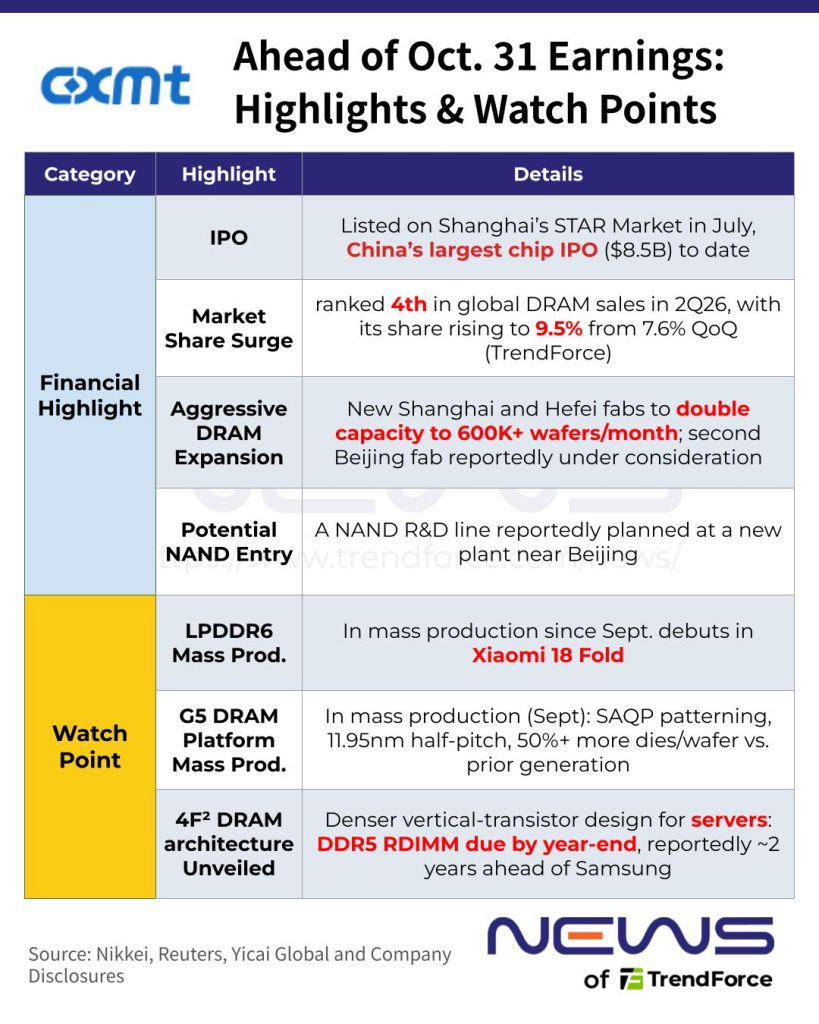
Looking ahead, whether CXMT can sustain earnings momentum will hinge on its October 31 results and the trajectory of fourth-quarter DRAM prices. With fabs running at high utilization and capacity set to expand, the key question is whether CXMT can turn its advances in LPDDR6, LPDDR5X and emerging 4F² architectures into new growth drivers. With DRAM price gains moderating, its October 31 earnings release could offer further clues on whether product upgrades and capacity expansion can sustain profit growth beyond the current pricing cycle.
Read more
- [News] CXMT Accelerates 4F² DRAM Push, Eyes Year-End Server DDR5 RDIMM Launch
- [News] CXMT, YMTC Ramp Memory Capacity, but China’s AI, Cloud Boom Could Soak Up New Supply Through 2027
(Photo credit: CXMT)