[News] TSMC Earnings Preview: Terafab Talks, Price Hikes and A14-Intel Race Lead Five Key Themes
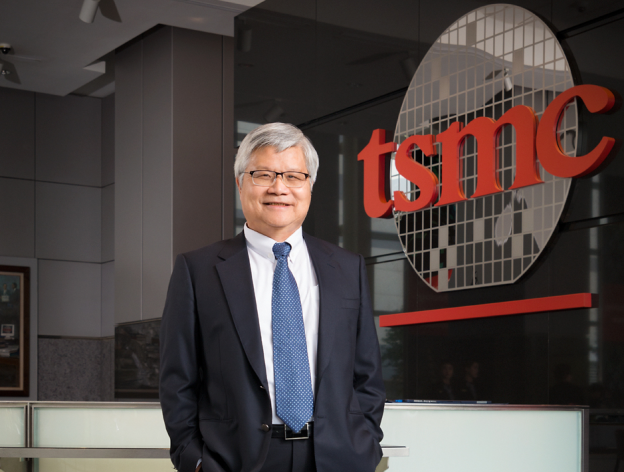
Ahead of TSMC’s October 15 earnings call, expectations are building as Elon Musk’s confirmation of talks over a potential Terafab partnership adds another layer to the foundry giant’s growth story. Here are five key themes investors will be watching—and what TSMC could signal next week.
Terafab Partnership in Focus
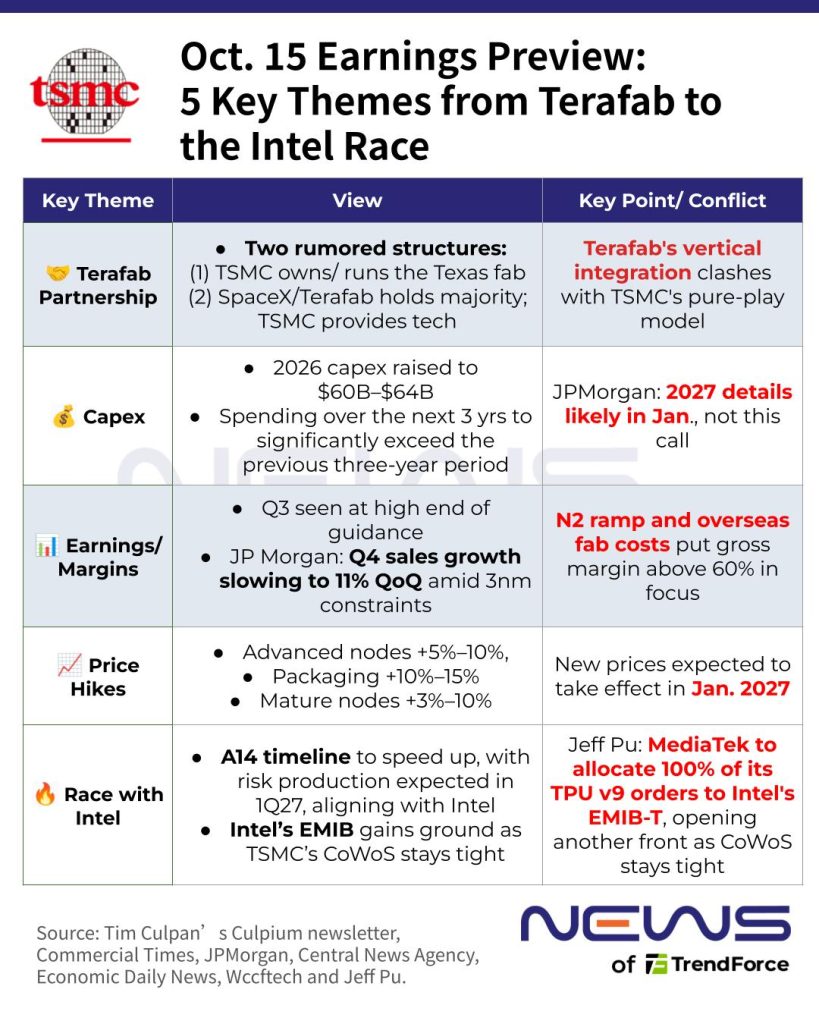
After Intel earlier signaled its involvement in Elon Musk’s Terafab project, TSMC could now be entering the picture. Commercial Times, citing Tim Culpan’s Culpium newsletter, reports that the foundry giant is exploring a potential partnership with Terafab that could include a new fab in Texas. Musk himself later confirmed the talks on X, saying: “Just discussions, but something may come of it.”
Several partnership structures are reportedly on the table. According to Culpan, TSMC could own and operate the fab, with SpaceX and Terafab taking equity stakes, committing to wafer purchases, or both. Alternatively, SpaceX and Terafab could take majority ownership, while TSMC contributes less capital but provides process technology and fab-operating expertise.
Business Today notes that the talks may reflect setbacks in Musk’s earlier efforts to work with Intel and Samsung. Yet Terafab’s push for vertically integrated manufacturing clashes with TSMC’s pure-play foundry model, which is built around serving fabless customers such as NVIDIA, Apple, AMD and Broadcom, the report adds.
From TSMC’s perspective, the preferred path could be to fold Terafab into its own Texas expansion, with Musk as a major anchor customer rather than handing over manufacturing control, Business Today reports.
2027 Capex and Expansion Plans
The Terafab talks also put TSMC’s broader U.S. expansion and capex plans back in the spotlight. As noted by Central News Agency, market reports suggest TSMC could be considering a second U.S. manufacturing hub in the Dallas, Texas area, potentially involving another six advanced wafer fabs.
As highlighted by the report, TSMC has already raised its 2026 capex guidance to $60 billion–$64 billion and expects spending over the next three years to significantly exceed the previous three-year period. That comes on top of another $100 billion committed to Arizona, bringing its planned investment in the state to $265 billion.
Notably, Commercial Times, citing JPMorgan, suggests that details related to TSMC’s 2027 capex plans could come in January 2027 rather than at the upcoming earnings call. Management, however, could continue to emphasize its accelerated capacity expansion plans through 2028, the report adds.
Earnings and Margin Outlook
Back to the fundamentals, investors will first be watching whether TSMC can land at the high end of its third-quarter guidance. The company expects revenue of $44.6 billion–$45.8 billion and a 65%–67% gross margin, while JPMorgan sees both reaching the upper end at $45.8 billion and 66.8%, respectively.
Attention then shifts to the fourth quarter. JPMorgan, cited by Commercial Times, expects revenue growth to moderate to 11% sequentially, capped by tight 3nm capacity and no further price hikes this year. Meanwhile, as N2 ramps and overseas fabs expand, rising depreciation and start-up costs will put the spotlight on whether gross margin can stay above 60%.
More Price Hikes Ahead?
Against this backdrop, whether—and by how much—TSMC will raise prices next year is another key focus. Central News Agency, citing institutional investors, estimates that prices for the company’s advanced nodes could rise by 5%–10% next year, while advanced packaging prices could increase by 10%–15% and mature-node prices by 3%–5%.
Another Economic Daily News report notes that TSMC will raise prices starting next January, with mature-node prices set to increase by roughly 3%–10%.
Race with Intel: A14 vs. 14A and CoWoS vs. EMIB
Meanwhile, TSMC’s A14 roadmap is reportedly accelerating, putting it increasingly head-to-head with Intel’s 14A. Commercial Times reported in September that A14 pilot production at Baoshan, Hsinchu, could begin as early as 1Q27—nearly aligning with Intel’s reported 14A risk-production schedule.
Wccftech reports that Intel CEO Lip-Bu Tan is targeting 1Q27 for 14A risk production, while Intel’s official roadmap remains more conservative, with internal 14A products slated for 2H27 and high-volume manufacturing in 2028.
The rivalry could extend beyond leading-edge nodes to advanced packaging. As TSMC grapples with tight CoWoS capacity, Intel’s EMIB-T is also gaining traction: analyst Jeff Pu expects MediaTek, one of Google’s key ASIC partners alongside Broadcom, to allocate 100% of its TPU v9 orders to Intel’s EMIB-T—adding another front to the TSMC-Intel race.
Read more
- [News] TSMC Reportedly Eyes Texas Expansion That Could Top US$265B; VIS-NXP Mulls Second Singapore Fab
- [News] Qualcomm Says Announced 2nm Chips Will Use TSMC, Keeps Door Open to Samsung Foundry
(Photo credit: TSMC)