[News] Replacing the Irreplaceable: NVIDIA’s Next Moves as CEO Jensen Huang Faces Potential Ouster
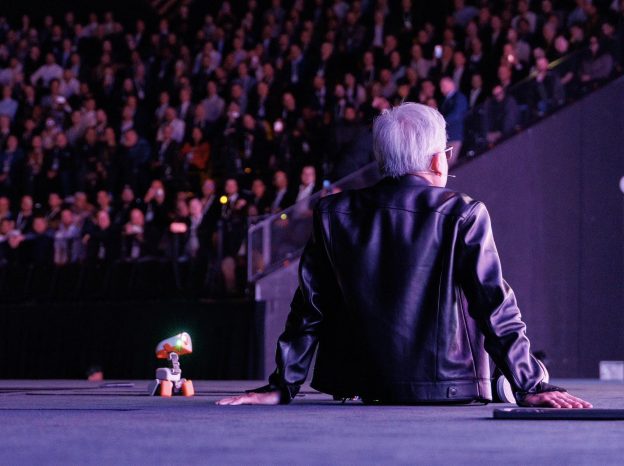
NVIDIA CEO Jensen Huang is facing mounting scrutiny as a second alleged extramarital affair comes to light. Following reports of his relationship with Megaspeed executive Alice Huang, who has been linked to suspicions of Chinese espionage and illicit AI chip transfers, The New York Times has reported another alleged affair involving Kimberly Powell, NVIDIA’s vice president of healthcare, who reported directly to him.
The latest revelation could put Huang’s leadership at risk. According to Reuters, citing The Wall Street Journal, NVIDIA’s board is reportedly preparing to oust its longtime CEO, with directors expected to meet as early as Wednesday to weigh his future.
With Huang’s future now hanging in the balance, the stakes extend well beyond NVIDIA’s boardroom. How might his departure reshape the AI chip giant and the broader AI supply chain—and who could take the helm if he is forced out? Here’s a closer look at the potential fallout and NVIDIA’s succession options.
NVIDIA Insiders and Outside Heavyweights in Focus
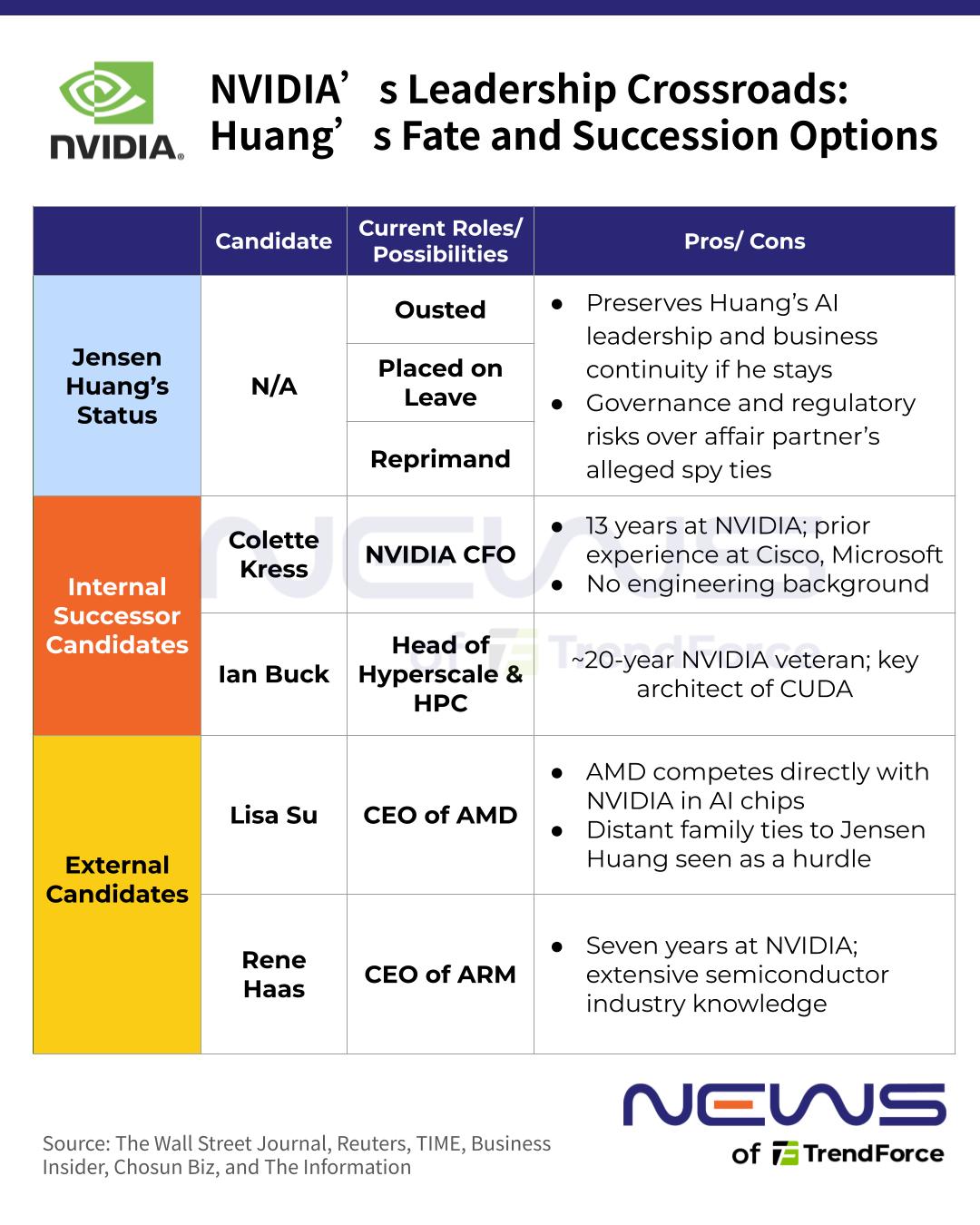
As highlighted by TIME, NVIDIA’s board reportedly faced three options over Huang’s future: oust him, place him on leave, or issue a reprimand. While extramarital affairs alone rarely lead to CEO dismissals, a loss of boardroom trust can prove decisive, as seen in past cases involving BP’s John Browne, McDonald’s Steve Easterbrook, and HP’s Mark Hurd, TIME notes.
Complicating matters, NVIDIA has no publicly disclosed succession plan, while Huang’s centralized management structure—with roughly 60 direct reports—makes replacing him particularly challenging. TIME also notes that the board reportedly lacks an experienced former CEO who could step in temporarily.
Among potential internal successors, longtime CFO Colette Kress brings 13 years at NVIDIA and previous finance experience at Cisco and Microsoft, according to Business Insider, though her limited technical background could be a drawback. Another contender is Ian Buck, NVIDIA’s hyperscale and HPC chief, a roughly 20-year veteran and key architect of CUDA. Meanwhile, co-founder Chris Malachowsky could play a role in any leadership transition, Business Standard notes.
Beyond NVIDIA’s ranks, even rival chip executives have surfaced as potential successors. Chosun Biz, citing The Information, names AMD CEO Lisa Su and Arm chief Rene Haas among the possibilities.
While Su has driven AMD’s rapid growth, the company’s fierce rivalry with NVIDIA and her distant family ties to Huang could complicate matters. Haas, by contrast, may have an edge given his seven-year stint at NVIDIA and extensive semiconductor industry experience, according to the report.
Interestingly, as of this morning, according to Polymarket’s betting, Ian Buck has emerged as the frontrunner on the chip giant’s next CEO, with a 34% implied probability. CFO Colette Kress follows at 27%, while Jensen Huang’s chances of staying at the helm stand at 19%. Other contenders include Arm CEO Rene Haas (10%), NVIDIA’s worldwide field operations chief Jay Puri (4%), NVIDIA CTO Michael Kagan (3%), AMD CEO Lisa Su (2%), and NVIDIA executive Madison Huang (2%), daughter of Jensen Huang.
Beyond Huang: Could NVIDIA’s AI Momentum Hold?
As Reuters notes, Huang’s departure could create a leadership vacuum at the roughly $4 trillion chip giant he co-founded and built over three decades into the dominant force in AI chips, placing NVIDIA at the center of the global AI boom and U.S.-China tech rivalry.
Yet analysts caution against equating a leadership crisis with a business slowdown. Citing Shay Boloor, chief market strategist at Futurum Equities, Reuters highlights that NVIDIA’s Blackwell demand, Rubin roadmap, networking expansion, and CUDA ecosystem were firmly established well before the controversy. These foundations, Boloor suggests, could help sustain revenue momentum over the next 12 to 18 months even if Huang departs.
NVIDIA’s China strategy, however, could face greater uncertainty. According to Reuters, Saxo chief investment strategist Charu Chanana warned that a leadership shake-up could raise questions over the chipmaker’s China plans and whether Huang’s successor would uphold his broader vision. While NVIDIA’s technological strengths remain intact, lingering uncertainty over its leadership, ongoing investigations, and China operations could make investors less willing to pay a premium for its future growth, Reuters notes.
Read more
- [News] NVIDIA Faces Leadership Test Ahead of Earnings: CEO Probe, Congressional Briefing and Key Risks to Watch
- [News] NVIDIA Order Cuts Reportedly Loom Amid Huang Controversy; AMD, ASIC Rivals May Gain TSMC Capacity
(Photo credit: NVIDIA)