[Insights] SpaceX Goes Beyond Satellites with Qualcomm Dragonwing, Taking Aim at U.S. Telecom Giants
A company known for rockets and satellites has just committed to building out a terrestrial cellular network. On November 4, SpaceX and Qualcomm announced a multi-year agreement under which Starlink Mobile will use Qualcomm’s Dragonwing Cellular Infrastructure platforms to build a nationwide 5G network in the U.S.
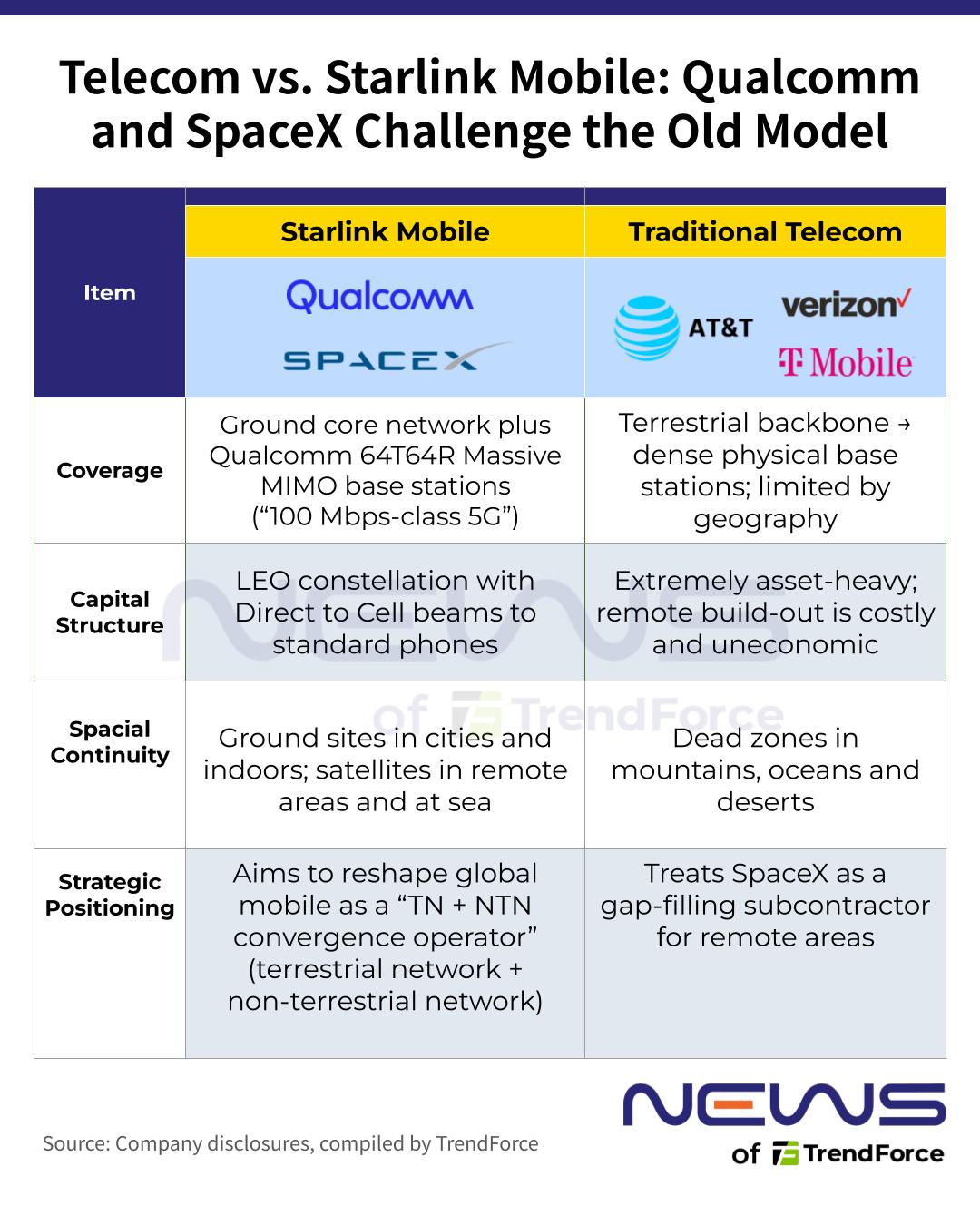
While Qualcomm called it its “biggest 5G deal yet,” TrendForce also reads the collaboration as a step toward “space-ground integration,” pairing Starlink’s satellites with a ground network. In its view, that could challenge AT&T, Verizon and T-Mobile, whose ground-only model has long meant heavy spending in crowded cities and thin returns in remote areas.
Starlink’s Current Bottlenecks
LEO satellite deployment has scaled rapidly in recent years. As of October 2026, SpaceX had launched more than 11,500 Starlink satellites, with over 11,156 operating in low Earth orbit, reportedly covering 150–160 countries and regions and reaching 9–10 million users.
Yet scale in orbit has not translated into mobile broadband. Starlink’s Direct to Cell service, which connects ordinary phones to satellites, has hit hard technical limits. According to TrendForce, just 5–10 MHz of cellular spectrum from partner carriers, limited handset transmit power and antenna gain, and satellite payload throughput of only 10–20 Mbps hold real-world per-user speeds to around 1–4 Mbps.
How the Qualcomm Deal Responds
The deal adds a terrestrial layer to Starlink’s network. Qualcomm’s QRU100 (Radio Unit) and QDU100 (Distributed Unit), though being large, power-hungry and heat-intensive for smartphones, are base-station-class hardware that form the radio and baseband backbone of a conventional 5G cell site, letting SpaceX handle heavy broadband traffic in densely populated areas.
Beyond expanding ground capacity, improving signal efficiency is equally critical. Traditional satellite signals spread over wide areas and weaken before reaching receivers, making them prone to distortion. While Starlink V3 satellites reportedly feature 64-transmit, 64-receive (64T64R) Massive MIMO antenna arrays, Qualcomm’s Dragonwing infrastructure platform brings advanced 3D beamforming capabilities to Starlink Mobile’s terrestrial 5G base stations, helping direct radio signals more precisely toward individual devices.
Users would need no special equipment. Direct to Cell satellites emulate standard 4G/5G cell towers, so existing smartphones that support standard bands are natively compatible, TrendForce notes.
A Telecom Game-Changer in the Making?
Against this backdrop, TrendForce sees the alliance as a potential threat to the dominance of AT&T, Verizon and T-Mobile. Rather than remaining a “satellite gap-filling subcontractor” for remote coverage, SpaceX is building tens of thousands of terrestrial 5G base stations integrated with its Starlink constellation. By combining high-capacity ground networks with global satellite coverage, the company could challenge the infrastructure advantage U.S. carriers have built over decades.
The competitive push comes as SpaceX’s business model enters a new phase. In 3Q26, Starlink contributed just 36% of SpaceX’s revenue but nearly 85% of its operating income. According to TrendForce, SpaceX is moving beyond the capital-intensive buildout of its low Earth orbit (LEO) constellation into a cash-generating phase. With Starlink Mobile’s terrestrial 5G rollout slated for 2027, both average revenue per user (ARPU) and subscriber numbers are expected to surge.
For Qualcomm, the deal opens another growth front as the smartphone market matures. According to TrendForce, with its Dragonwing 5G platform serving as the hardware backbone of Starlink Mobile’s nationwide terrestrial network, Qualcomm gains a foothold in next-generation “space-ground integrated” telecom infrastructure while paving the way for its Open RAN (O-RAN) and 6G ambitions.
(Photo credit: Qualcomm)