[News] Trump’s Proposed Tariffs: Chip Giants Largely Spared, but Korean Memory and Testing Tools Face Risks
U.S. President Donald Trump unveiled a fresh round of proposed tariffs on Wednesday targeting 14 major trading partners, including China, Japan and the European Union. As highlighted by Reuters, Washington proposed maximum tariff rates ranging from 20% to 40% to address alleged industrial overcapacity, with China facing the highest proposed capped rate of 20%, on top of roughly 25% in duties imposed during Trump’s first term.
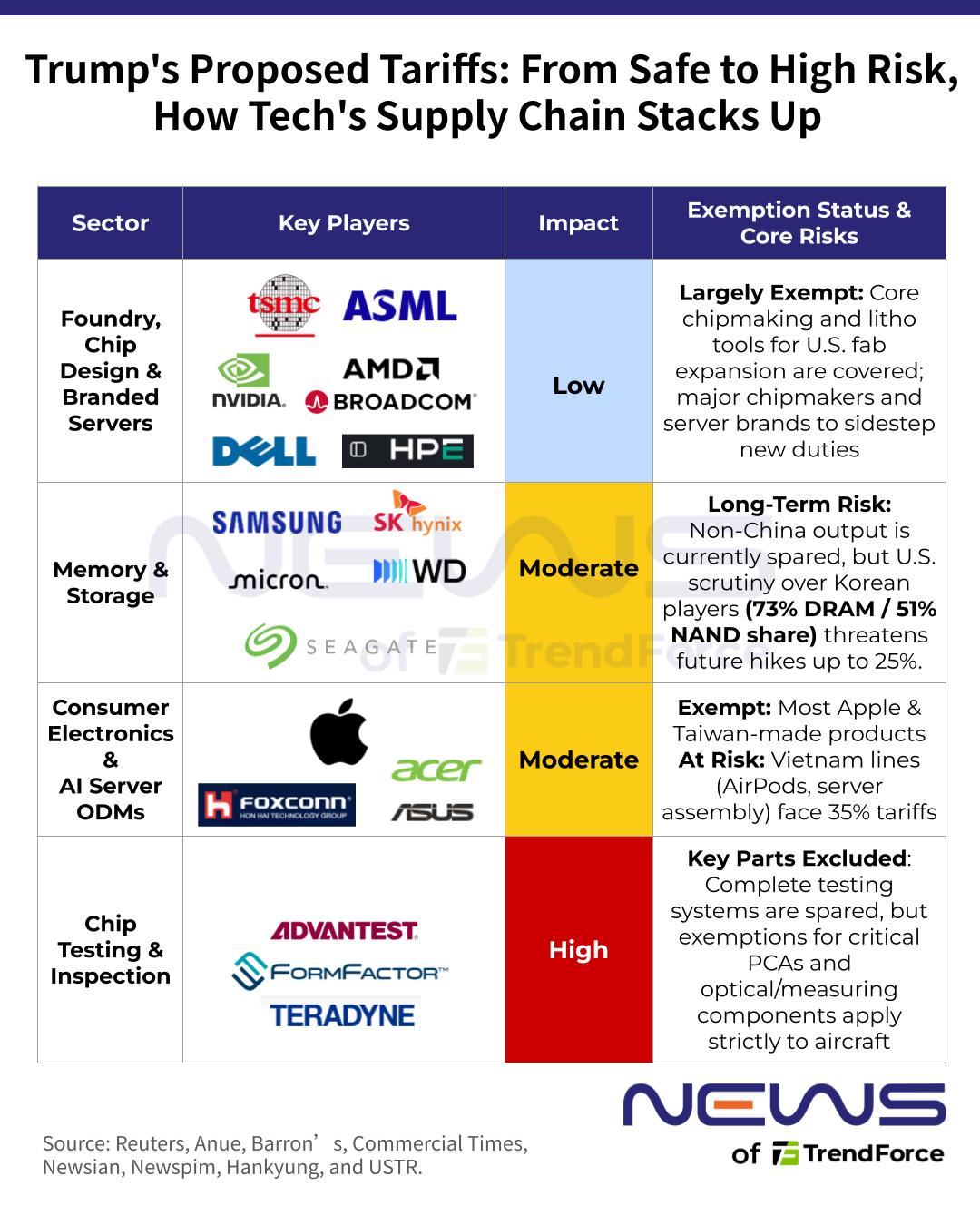
With a new tariff offensive taking shape, the tech industry’s focus is shifting to who could escape the levies and who remains exposed. According to Anue, citing Barron’s, TSMC’s U.S. expansion could benefit from exemptions covering key chipmaking tools, including ASML’s lithography systems. Major chipmakers and server manufacturers—from NVIDIA, AMD, Intel, Broadcom and Marvell to Dell, HPE and Super Micro—are also expected to largely sidestep the proposed duties.
From Chip Testing to AI Servers: Where Tariff Risks Linger
However, as noted by Anue, certain semiconductor testing equipment components fall outside the proposed exemptions, potentially affecting suppliers such as Teradyne, FormFactor, Cohu and Advantest.
A closer look at the USTR’s proposed tariff exemption list for Taiwan, released on November 25, reveals that while semiconductor testing systems are covered, exemptions for certain printed circuit assemblies are limited to aircraft applications. For instance, tariff relief for certain printed circuit assemblies (9030.90.66), measuring and checking instruments (9031.80.80), and certain optical measuring and inspection equipment components (9031.90.59) is limited to aircraft applications.
On the consumer electronics front, Anue, citing Barron’s, notes that Apple’s diversified manufacturing footprint and proposed product exemptions could help shield much of its portfolio from the new tariffs. However, some U.S.-bound products may still originate in China, while AirPods, manufactured in Vietnam as recently as last year, could face duties of up to 35%, the report suggests.
Commercial Times reports that while Taiwan-made laptops are slated for exemption, ASUS and Acer models manufactured overseas remain subject to tariffs based on their country of origin. Customers reportedly absorb U.S. import duties on certain power supplies, thermal management products and server slide rails under existing commercial arrangements.
For AI server makers such as Foxconn, Quanta, Wistron and Wiwynn, tariff exposure hinges on the classification of complete systems, racks and individual components, Commercial Times notes. While Mexico remains outside the latest tariff proposals, Vietnam faces a potential 35% ceiling. Such tariff disparities could reshape order allocation and assembly footprints, even if customers absorb the duties.
Korea’s Memory Dominance Draws U.S. Scrutiny
Amid concerns over the impact on memory giants, Anue, citing Barron’s, notes that Micron, SK hynix, Samsung Electronics, Western Digital and Seagate will face no additional tariffs outside China.
South Korea, however, is not entirely off the hook. As Newsian reports, Washington has identified the country’s semiconductor and automotive policies as contributing to excess capacity, leaving the door open to tariff hikes of up to 25%. Newspim further highlights U.S. concerns over potential semiconductor oversupply in the years ahead.
Notably, beyond citing Samsung and SK hynix’s combined global market shares of 73% in DRAM and 51% in NAND flash, the USTR report also takes aim at Korea’s domestic expansion plans. According to Hankyung, the planned South Jeolla–Gwangju semiconductor cluster, backed by roughly KRW 800 trillion in corporate investment commitments, was singled out as a key example of government-led capacity expansion.
Read more
- [News] Trump Reportedly Plans Broad Chip Tariffs on End Products; Consumer Demand Could Face Further Pressure
- [News] U.S. Chip Tariffs Could Hinge on Investment Scale: What’s at Stake for TSMC, Samsung, SK hynix?n
(Photo credit: Samsung)