[News] NVIDIA’s 1st Earnings Without Huang: Comeback Ruled Out; Memory, Packaging Secured as TSMC Helps Ease Supply Gap

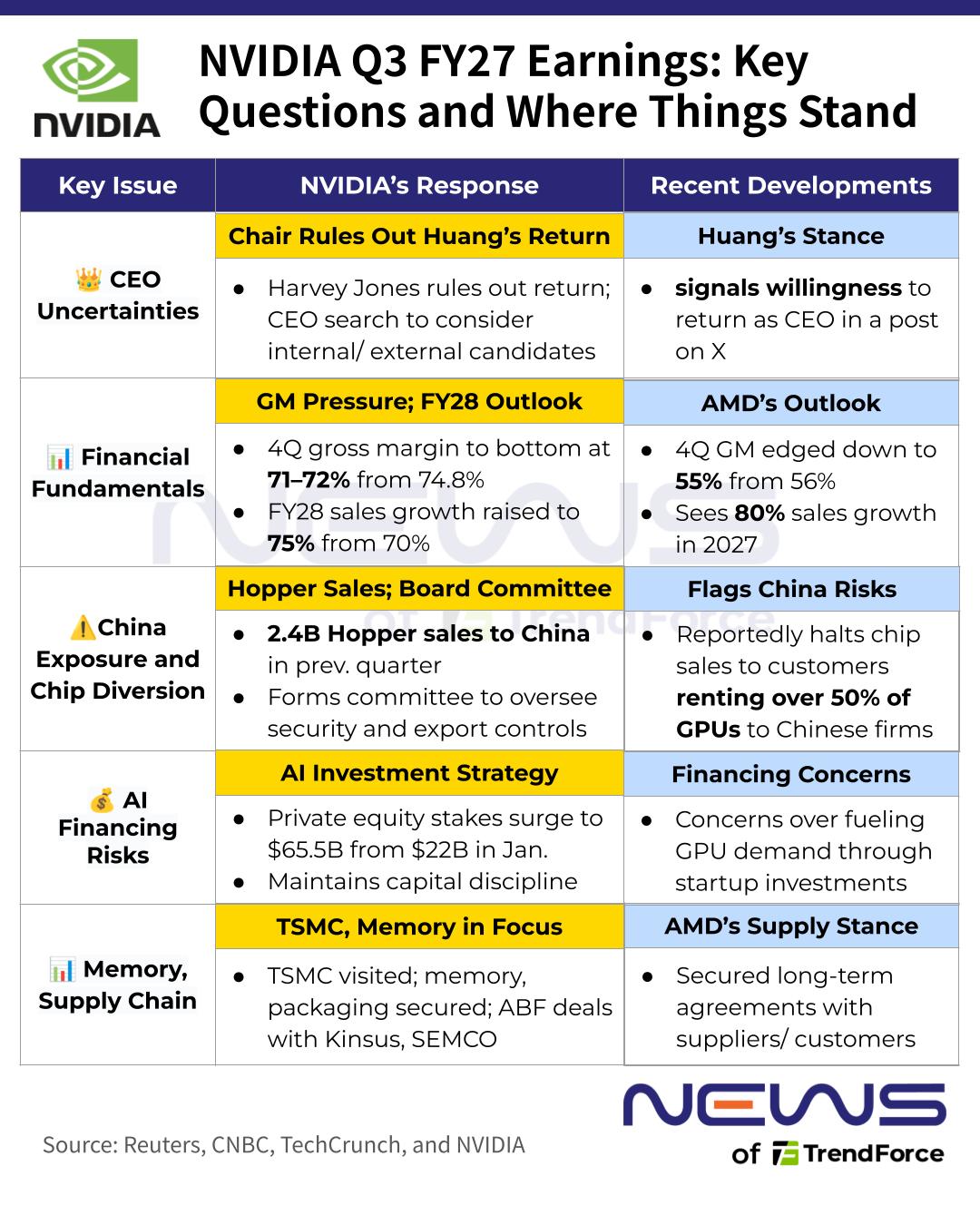
Just hours before NVIDIA’s earnings call, Jensen Huang signaled he would be “honored” to return as CEO, putting the chip giant’s leadership turmoil back in the spotlight. Yet the door appears firmly shut: according to Reuters, Chairman Harvey Jones ruled out reinstating Huang and made clear that questions surrounding his departure would be off-limits during the call.
Jones, cited by Reuters, said NVIDIA would prioritize finding the right permanent CEO over rushing the succession process. The board will consider both internal and external candidates, with executive search firm Heidrick & Struggles enlisted to lead the effort, the report notes.
NVIDIA’s Margins Squeezed Despite Frenzied AI Demand
While investors are watching whether it can navigate mounting supply chain pressures amid Huang’s exit, Reuters, citing interim CEO and CFO Colette Kress’ remarks, said hyperscalers are “feverishly” seeking more NVIDIA computing capacity. Commercial Times, citing Kress, adds that business was “operating as usual,” noting that customers had continued asking for additional shipments over the past week.
Yet soaring component costs are taking a toll on profitability. As Commercial Times reports, NVIDIA is still fulfilling existing orders at previously agreed prices, absorbing some of the cost increases. Gross margin is therefore projected to slip from 74.8% in 3Q to a cyclical low of 71–72% in 4Q, before rebounding to 72–73% in fiscal 2028 as revised pricing agreements take hold.
Notably, NVIDIA’s purchase commitments reached $390 billion at the end of its third quarter, up $111 billion from $279 billion in the previous quarter, with the increase primarily driven by multiyear memory procurement agreements, Commercial Times suggests.
NVIDIA Raises FY2028 Growth Outlook to 75%
According to The Wall Street Journal, NVIDIA delivered another record quarter, with revenue reaching $115.8 billion, 6.3% above the $108.9 billion consensus estimate compiled by FactSet. Net income climbed to $65.3 billion, also surpassing Wall Street expectations. Yahoo! Finance, citing NVIDIA, highlights that Hopper platform sales to China generated $2.4 billion in third-quarter revenue, though the chipmaker is no longer shipping to the country.
For the fourth quarter, despite gross margin pressures, the company forecasts revenue to surge roughly 90% to $130 billion, comfortably beating analysts’ consensus estimate of $125.1 billion, CNBC reports.
Meanwhile, investors had been watching whether NVIDIA would walk back its earlier forecast of 70% revenue growth for the fiscal year ending January 2028. Kress struck a bullish note, raising the outlook to 75%, CNBC reports.
TSMC Executives Reportedly Visit NVIDIA as Supply Pressures Mount
As rivals including AMD and ASIC developers vie for capacity amid NVIDIA’s leadership turmoil, the AI chip giant is moving to shore up its supply chain. According to Commercial Times, TSMC executives visited NVIDIA this week to help bridge the supply-demand gap, while Kress reaffirmed that memory and advanced packaging capacity had been secured.
NVIDIA also unveiled new agreements with Kinsus and SPIL to expand ABF substrate and advanced packaging capacity, respectively. Kinsus plans to boost dedicated ABF substrate capacity for NVIDIA to more than 3.5 times current levels, with new production lines slated for 2H27 and additional capacity in 3Q28. Meanwhile, NVIDIA will invest several billion dollars in ASE subsidiary SPIL, covering bumping, silicon interposers, assembly and testing, with capacity expansion targeted by mid-2029, Commercial Times reports.
The push extends beyond Taiwan. According to NVIDIA, it is also expanding substrate commitments with Samsung Electro-Mechanics, alongside previously announced agreements supporting Amkor’s manufacturing expansion in the U.S. and South Korea.
For now, NVIDIA appears to have weathered its first earnings call without Huang, backed by robust AI demand and deeper supply chain commitments. Yet securing capacity is only part of the challenge. With margins under pressure, the bigger test lies in whether Huang’s successor can sustain the technological vision that helped drive NVIDIA’s dominance, retain key talent, and keep the chip giant ahead of increasingly aggressive rivals.
Read more
- [News] NVIDIA without Huang: New Tests Ahead as AMD Eyes Gains, TSMC Finds a Cushion and Memory Giants Weigh Risks
- [News] NVIDIA’s CEO Succession: Three Scenarios, from Huang’s Rumored Comeback to Internal and External Picks
(Photo credit: NVIDIA)