[News] NVIDIA’s CEO Succession: Three Scenarios, from Huang’s Rumored Comeback to Internal and External Picks
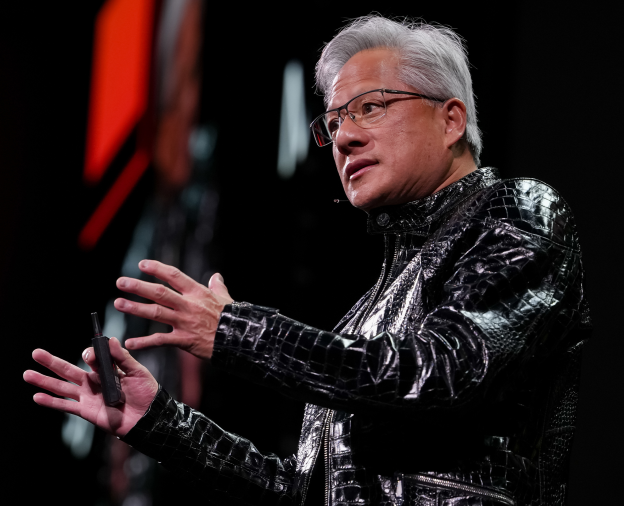
The drama surrounding NVIDIA’s leadership is taking another turn ahead of the chip giant’s earnings report on November 17th. Following Jensen Huang’s abrupt resignation amid multiple scandals, the former CEO is reportedly weighing a comeback, with Silicon Valley allies rallying for his reinstatement, according to the Financial Times.
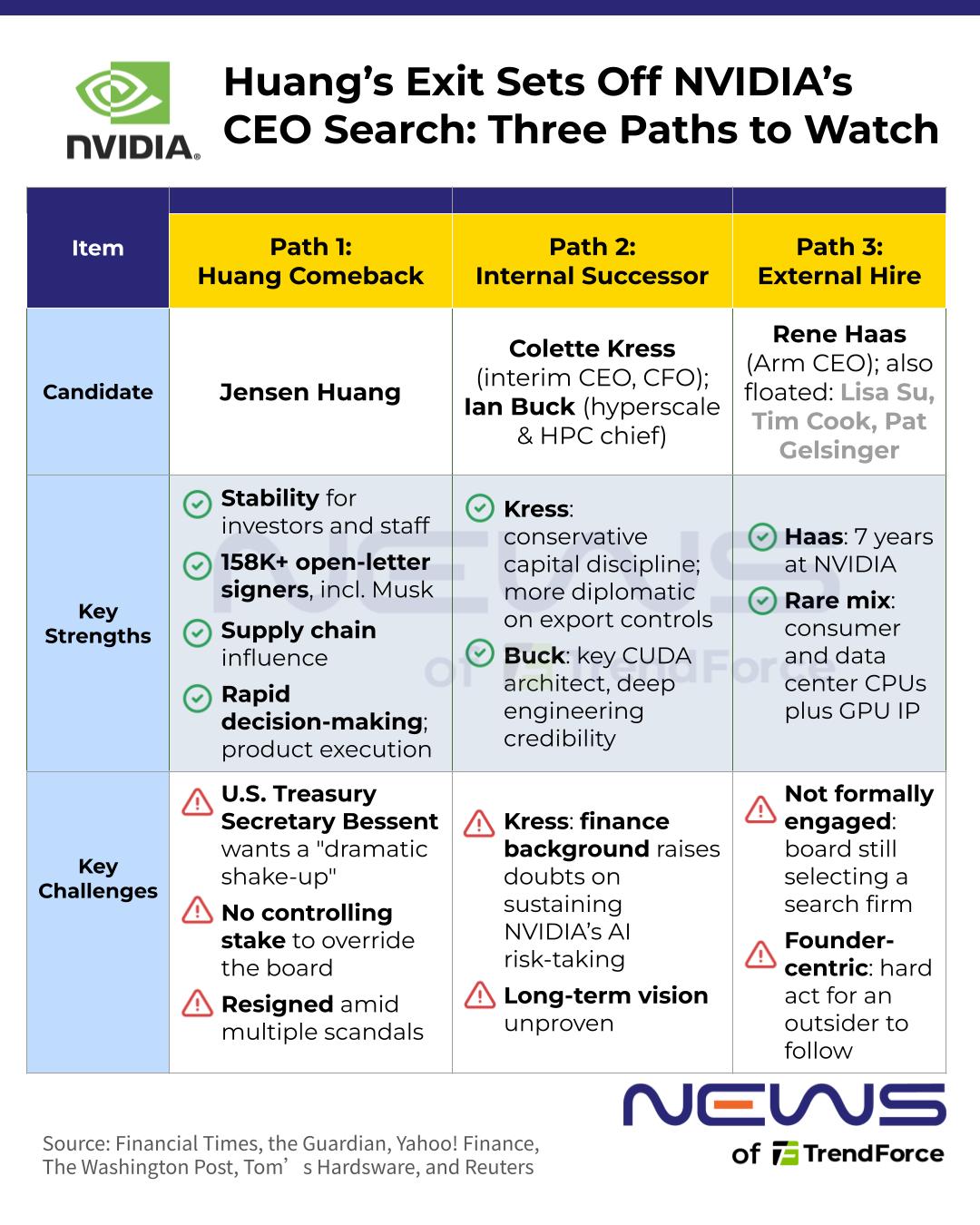
Yet Huang’s potential return is only one piece of the unfolding succession battle. With internal and external contenders emerging and U.S. Treasury Secretary Scott Bessent calling for an outsider to take the helm, NVIDIA faces three possible paths forward—each with its own hurdles. Here’s how the succession race is shaping up—and what could tip the balance.
Huang’s Comeback Bid Gains Momentum
With at least 10 Wall Street analysts reportedly downgrading NVIDIA from Buy to Hold, including those at Bernstein and KeyBanc, according to TIPRANKS, Huang’s potential return could appeal to investors and employees seeking stability amid the leadership turmoil.
According to the Financial Times, Huang has privately explored a comeback. One ally is reportedly organizing a Silicon Valley “war room” to lobby for his reinstatement and seek White House backing, with Huang said to support the effort. The campaign is also gathering public support. As the Guardian reports, Elon Musk and other tech executives are among more than 158,000 signatories to an open letter urging NVIDIA’s board to bring Huang back while the investigation proceeds.
Yet significant obstacles remain. U.S. Treasury Secretary Scott Bessent called for a “dramatic shake-up” in NVIDIA’s leadership on Sunday, signaling potential resistance in Washington. Moreover, unlike some founder-CEOs, Huang lacks a controlling stake to override the board’s decisions, the Financial Times notes.
Kress Offers Stability, but Signals a More Cautious NVIDIA
With Huang’s return far from certain, attention is also turning to interim CEO Colette Kress, whose leadership could mark a departure from his aggressive investment strategy. According to Star Market Daily, the longtime CFO is known for a more conservative approach to capital spending.
That contrast was evident in her reported pushback against Huang’s ambitious financing plans. According to Reuters, Kress raised concerns over a proposed $250 billion credit facility for OpenAI’s data center expansion, citing excessive financial exposure. The plan was eventually scaled back to $100 billion for its initial phase.
Having joined NVIDIA in 2013 after roles at Microsoft, Cisco and Texas Instruments, she is also seen as a steadying force capable of reassuring investors and business partners, Reuters notes. Her leadership could also bring a more diplomatic approach to Washington, shifting away from Huang’s confrontations over U.S. export controls, the report adds.
Yet that stability comes with a question: Can a finance veteran sustain the technological risk-taking that fueled NVIDIA’s AI dominance? While analysts see Kress as a sensible interim choice, doubts remain over whether she can deliver the long-term vision needed to maintain the company’s momentum, according to Reuters.
Against these concerns, NVIDIA’s hyperscale and HPC chief Ian Buck has emerged as another potential successor. Aaccording to Yahoo! Finance. a Stanford computer science Ph.D. and key architect of CUDA, Buck brings the deep engineering expertise that could appeal to NVIDIA’s board.
NVIDIA Looks Outside as Arm’s Haas Enters Succession Spotlight
Even as speculation swirls over his own comeback, Huang reportedly remains involved in NVIDIA’s succession search, having personally contacted at least one potential candidate, according to The Washington Post.
Meanwhile, NVIDIA’s board has reportedly approached Arm CEO Rene Haas as a possible successor, according to the Financial Times. Having led Arm since 2022, Haas spent seven years at NVIDIA, where he was mentored by Huang, and retains close ties with its leadership, the report suggests.
As highlighted by TechNews, should Haas take NVIDIA’s helm, it would mark an intriguing twist of fate. NVIDIA announced a $40 billion bid for Arm in 2020 to expand its reach in CPU and AI computing, only to abandon the deal in 2022 amid regulatory opposition. Now, the two companies that failed to unite through an acquisition could find themselves closely linked again—this time through a leadership transition.
Beyond Haas, Reuters has also floated several industry heavyweights, including AMD CEO Lisa Su, former Apple CEO Tim Cook, former Intel chief Pat Gelsinger, Apple hardware chief Johny Srouji, Marvell CEO Matt Murphy and Micron CEO Sanjay Mehrotra. Each brings a different mix of technical expertise and leadership experience, though their suitability and willingness to take the role remain uncertain.
With the succession race still wide open, two upcoming events could offer crucial clues: NVIDIA’s November 17 earnings call and a November 18 employee town hall led by interim CEO Colette Kress. Investors and employees alike will be watching for signs of how the chip giant plans to navigate its leadership transition—and whether its AI ambitions will remain on track.
Read more
- [News] NVIDIA without Huang: New Tests Ahead as AMD Eyes Gains, TSMC Finds a Cushion and Memory Giants Weigh Risks
- [News] NVIDIA Order Cuts Reportedly Loom Amid Huang Controversy; AMD, ASIC Rivals May Gain TSMC Capacity
(Photo credit: NVIDIA)