





 Download Report
 Contact Us
Seagate to Top HDD Market by 2028 on HAMR Lead

Last Modified
2026-10-07

Update Frequency
Aperiodically

Format
Toshiba is significantly expanding its HDD capacity in the Philippines, but given the lead time from investment to output, the benefits will materialize later, adding supply to the market without reshaping the competitive landscape. Areal density remains the key to HDD competition: Seagate leads with its fully in-house HAMR technology and is poised to overtake WD as the largest supplier, while Toshiba, still on MAMR, can only compete on volume.
Key Highlights
- Toshiba is undertaking its first large-scale HDD capacity expansion in years, targeting second-source demand as the duopoly remains sold out and maintains supply discipline, aiming to drive growth through shipment volume.
- Given the lead time from investment to volume ramp, the expansion's near-term contribution is limited; the benefits will be concentrated in later years, with a modest market share recovery.
- The HDD supply shortage persists, but as the duopoly advances its transition to HAMR, supply and demand will gradually approach balance, with WD's HAMR mass production progress as the key variable.
- Areal density determines TCO and competitiveness: Seagate leads with fully in-house HAMR and is poised to become the largest supplier; WD ranks second, relying on externally sourced components; Toshiba remains on MAMR, faces an unfavorable cost structure, and is likely positioned in markets less sensitive to areal density.
Table of Contents
- Toshiba Invests About JPY 60 Billion to Expand HDD Production, with Benefits Materializing Primarily in 2028; Platter Capacity Remains the Decisive Factor as Seagate Is Expected to Become the Largest HDD Suppliers
- Toshiba’s Latest HDD Investment Exceeds 70% of WD’s Annual Capex, Thus Bridging the Gap Created by the Duopoly’s Strict Supply Discipline
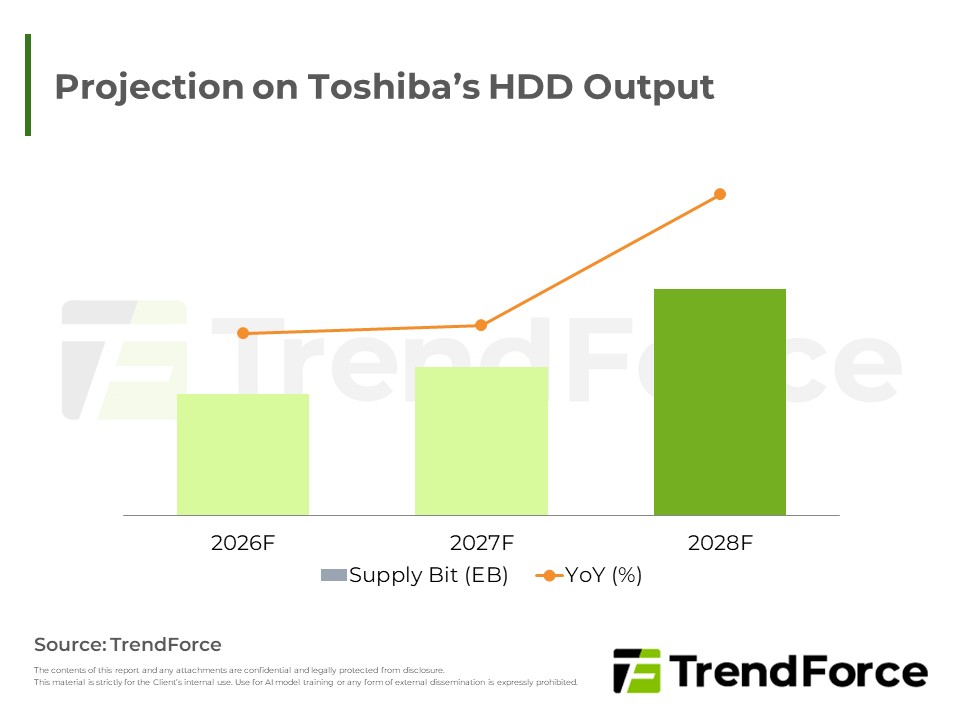
- Investment-to-Output Cycle Takes 12 to 24 Months; Toshiba’s 2027 Output Will Grow by Just 23% YoY to 250EB Before Surging by 52% YoY to 380EB in 2028
- Projection on Toshiba’s HDD Output
- 2027 HDD Sufficiency Ratio at -9.1% as Shortage Persists; 2028 Supply Growth (27.6%) to Outpace Demand (16.2%), Narrowing Sufficiency Ratio to -0.3% and Approaching Market Balance
- Toshiba to Climb Back to about 12% in Market Share by 2028, with Seagate Rising to First Place at Roughly 45% and WD dropping to about 43%
- Projected Market Share of the Three Major HDD Suppliers
- Single-Platter Capacity Determines HDD Competitiveness; Seagate Leads with its Fully In-House HAMR, followed by WD with Outsourced Components, and Toshiba Trailing Significantly in MAMR
- Conclusion: Toshiba’s Capacity Expansion Benefits Concentrate in 2028, with Market Share Recovering to ~12%, though End Customers Continue to Prioritize Single-Platter Capacity; Competitive Landscape Remains Largely Unchanged
<Total Pages: 9>

Spotlight Report
-

DRAM Monthly Datasheet Sep. 2026
2026/09/17
Semiconductors
EXCEL
-

NAND Flash Monthly Datasheet Sep. 2026
2026/09/17
Semiconductors
EXCEL
-

Global Memory Supply-Demand Divergence: Analyzing 2027 DRAM Structural Tightness and NAND Flash Oversupply
2026/07/28
Semiconductors
PDF
-

DRAM Contract Price Aug. 2026
2026/08/31
Semiconductors
PDF
-

DRAM Contract Price Jul. 2026
2026/07/31
Semiconductors
PDF
-

4Q26 Memory Price Forecast
2026/09/24
Semiconductors
PDF
NAND Flash PlatinumRelated Reports





Download Report
18,000

Membership
Spotlight Report
-
DRAM Monthly Datasheet Sep. 2026
2026/09/17
Semiconductors
EXCEL
-
NAND Flash Monthly Datasheet Sep. 2026
2026/09/17
Semiconductors
EXCEL
-
Global Memory Supply-Demand Divergence: Analyzing 2027 DRAM Structural Tightness and NAND Flash Oversupply
2026/07/28
Semiconductors
PDF
-
DRAM Contract Price Aug. 2026
2026/08/31
Semiconductors
PDF
-
DRAM Contract Price Jul. 2026
2026/07/31
Semiconductors
PDF
-
4Q26 Memory Price Forecast
2026/09/24
Semiconductors
PDF