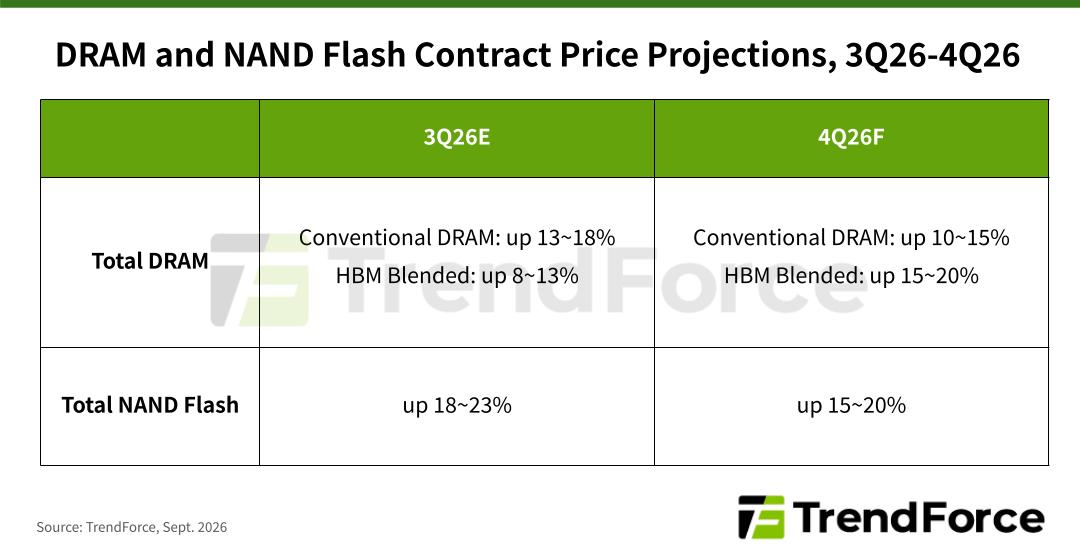
Server DRAM contract prices are rising, with gains varying by RDIMM capacity, while overall spot momentum remains limited. SK hynix and Samsung reported higher DRAM shipments and prices, along with growing profits. HBM4 is ramping, and next year’s supply is sold out. As the LTA share rises, DRAM pricing and supply are shifting toward long-term contracts.
Besides the mainstream product segments of the DRAM market, TrendForce’s research now encompasses specialty (consumer) DRAM products as well. Analyses in this area pertain to product development plans and production outputs of suppliers, price trends, etc.
Global Server Market – Trends and Outlook for 4Q26
Fourth-quarter contract prices for smartphone mobile DRAM are expected to range from flat to slightly higher, consolidating at elevated levels. With brand inventories at target and year-end cash flow under pressure, procurement has turned conservative. Catch-up price hikes from SK hynix and CXMT are likely to narrow their gap with Samsung. Weakening consumer demand has loosened spot prices, but as AI continues to crowd out production capacity, contract prices should remain elevated and form a high-level floor.
Server DRAM contract prices continued to climb this month, with suppliers keeping strong bargaining power by adjusting product and customer mix. Buyers are rapidly shifting toward low- to mid-capacity modules, narrowing the premium on high-capacity modules, while the demand gap between China and North America persists. As consumer brands cut purchases, suppliers are reallocating capacity to server DRAM, and whole-system demand from emerging CSPs is broadening their customer base.
PC DRAM contract prices keep rising in the fourth quarter, though gains are narrowing amid tense negotiations. Weak notebook shipments and rising inventory push second-tier OEMs toward white-label models with downgraded chips and lower next-year orders. Meanwhile, suppliers cut PC DRAM output in favor of servers, which keeps the market undersupplied.
Consumer DRAM supply remains tight, but year-end caution and elevated memory costs have slowed demand, narrowing contract price gains to flat-to-slight increases. Spot prices have retreated from their peaks and decoupled from contract prices, weighing on sentiment. With suppliers still exiting consumer DRAM, contract shortages are expected to persist, supporting gradual quarterly increases next year.
As the three major suppliers phase out mature process nodes, DDR4 supply is set to tighten notably, pushing up consumer DRAM contract prices. In the spot market, weak demand and typhoon disruptions have limited buyers' willingness to chase prices. Supported by AI demand, suppliers maintain low inventory and strong bargaining power, while PC OEMs and module houses, facing elevated inventory, have turned cautious. Smartphone brands have stopped expanding inventory, and CSP demand is diverging.
In 4Q26, buyer pushback at peak costs, high inventory and Chinese vendors’ rising share curb TLC eMMC/UFS gains, while MLC eMMC dips on substitution; 1Q27 off-season prices plateau as MLC faces heavier cuts.
US and China CSPs keep expanding AI infrastructure with GPU racks and in-house ASICs, lifting 2027 shipments despite supply risks.
Research Areas:
Industry News