

Global NEV Sales Rise 7.6% YoY in 3Q26 as BEV and PHEV Market Trends Diverge, Says TrendForce
TrendForce’s latest research reveals that global sales of NEVs, including BEVs, PHEVs, and FCVs, reached 5.79 million units in the third quarter of 2026, up 7.6% YoY. When HEVs are also included, the four vehicle categories collectively accounted for a record 35.2% of global automotive sales during the quarter.
TrendForce notes that the global EV market in the third quarter was characterized by strong BEV performance, weakening PHEV demand, and stable HEV sales. BEVs gained a larger share of overall sales as consumer interest in PHEVs cooled in China, while high fuel prices, longer BEV driving ranges, and increasingly BEV-oriented government subsidies across various markets further supported the shift toward fully-electric vehicles.
Top ten BEV brands expand combined market share as lower rankings see reshuffle
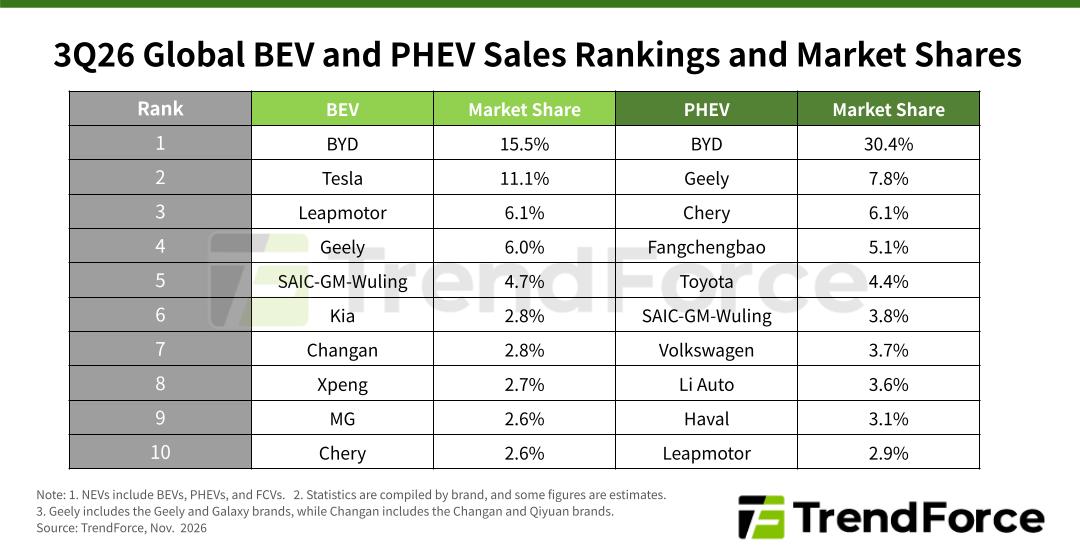
BYD retained its position as the world’s leading BEV brand with a market share of 15.5%, followed by Tesla. Leapmotor continued to roll out new models and strengthen its product portfolio, firmly securing third place globally with a 6.1% market share.
The lower half of the top ten saw further reshuffling. New model launches helped Xpeng return to eighth place for the first time since 4Q25, while MG took ninth place on the back of steady growth in overseas markets and improved performance in China from the previous quarter. Toyota, GAC Aion, and Xiaomi fell out of the top ten this quarter.
TrendForce notes that the top ten BEV brands’ combined market share grew from 52.5% in the second quarter to 57.1% in the third, underscoring the market’s increasing concentration as leading brands continue to strengthen their competitive positions.
European brands lose ground in PHEV market; Chinese automakers accelerate local production in Europe
In the PHEV segment, BYD maintained a commanding lead with a market share of 30.4%, while Chinese brands also occupied second through fourth place. Toyota climbed to fifth place, improving both its market share and ranking in the third quarter on the back of sales growth in the U.S. and Europe.
Li Auto ranked eighth as its sales mix shifted back from BEVs toward range-extended EVs (REEVs). In contrast, traditional European luxury automakers struggled to compete in the PHEV segment, with Mercedes-Benz, BMW, and Volvo all failing to secure a place among the global top ten and recording YoY sales declines.
As China and the EU shift from tariffs to an import quota system, Chinese automakers will be relieved of the pressure of rising tariff-related costs but will face new constraints on export volumes. Accelerating local manufacturing in Europe to unlock additional sales opportunities beyond import quotas has therefore once again become a critical strategy for gaining a competitive edge.
TrendForce forecasts global NEV sales to reach 22.49 million units in 2026, representing 9.5% YoY growth. Whether the year-end peak sales season can generate sufficient momentum will be critical to achieving this full-year forecast.
Looking ahead to 2027, global NEV sales growth could accelerate to 15.2% YoY, supported by a relatively low comparison base. Key growth drivers include the final year of China’s 50% vehicle purchase tax reduction, a low comparison base in the U.S. market, and continued efforts to advance vehicle electrification in Western Europe.
However, potential interest rate hikes, along with supply disruptions and price increases stemming from competition for semiconductor production capacity, could introduce uncertainty into next year's sales outlook.
For more on the latest technology industry news and trends, please visit News.