[Deep Dive] China’s Cloud Giants in Southeast Asia: Data Center Footprints, Compute Strategies and U.S. Control Risks
Jensen Huang’s return as NVIDIA CEO may have dominated tech headlines, but his comeback is unlikely to soften Washington’s stance on export controls. Central News Agency, citing several senior semiconductor industry executives, notes that U.S. scrutiny of AI chip exports and broader semiconductor restrictions on China are only expected to intensify.
Against this backdrop, as Washington tightens restrictions on access to AI compute—putting third-party and joint-venture arrangements under greater scrutiny—Chinese cloud service providers’ (CSPs) own data center capacity is taking on greater strategic significance, warranting a closer look at their regional footprints and business models.
ByteDance: From Johor’s Compute Leasing Powerhouse to Broader Regional Expansion
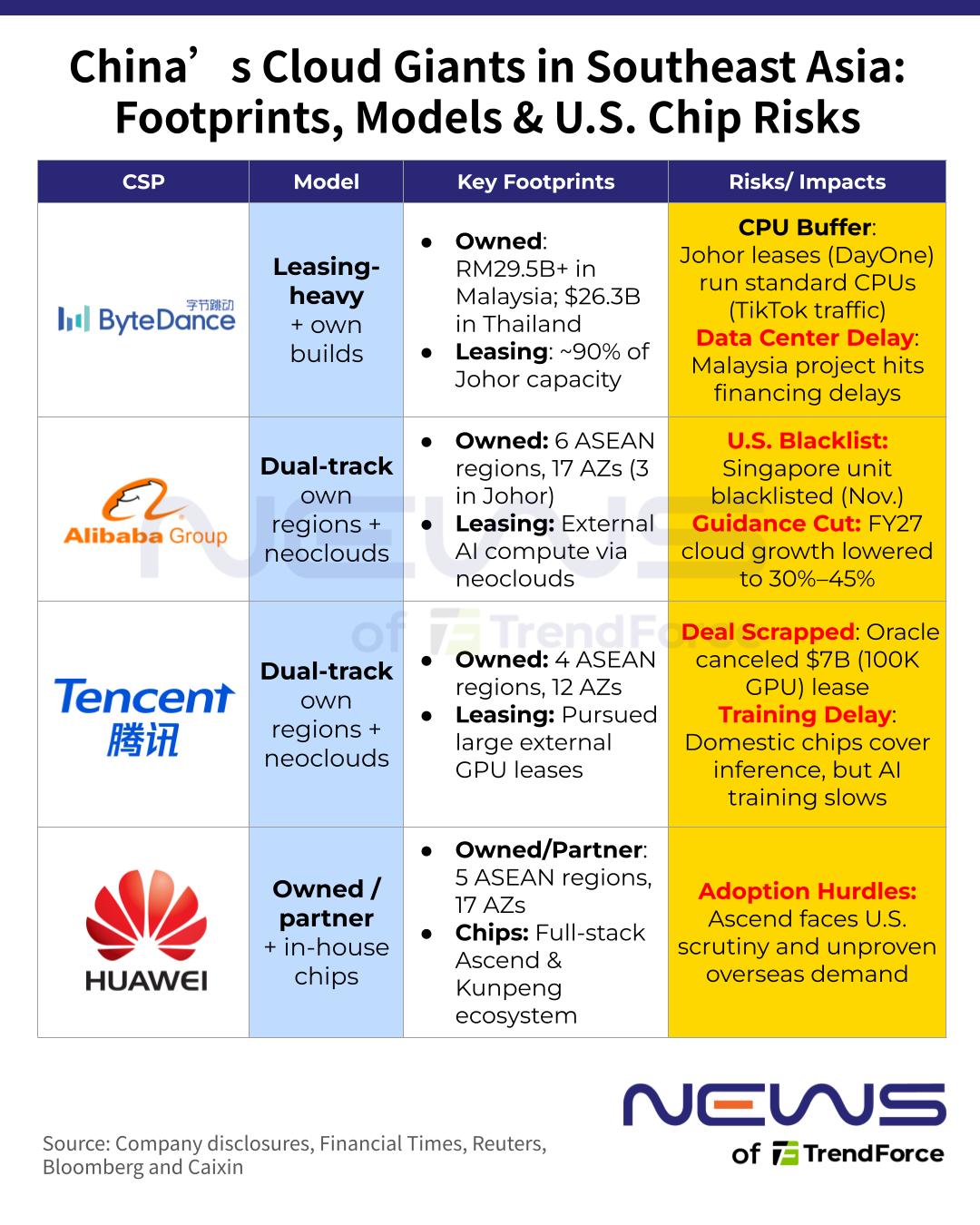
While ByteDance reportedly relies heavily on third-party capacity and whole-facility leasing, it is also pursuing its own infrastructure expansion. According to New Straits Times, the company’s data center investment in Malaysia exceeds RM29.5 billion, with a facility already established at Sedenak Tech Park in Kulai, Johor.
Its regional ambitions extend well beyond Malaysia. In May, Thailand’s Board of Investment (BOI) greenlit six major investment projects, headlined by TikTok’s THB 842.35 billion ($26.3 billion) data infrastructure expansion across Bangkok, Samut Prakan and Chachoengsao, according to Khaosod English. Meanwhile, Tom’s Hardware previously reported that the Chinese tech giant was considering a cluster of more than 7,000 B200 GPUs in Indonesia.
Beyond its own infrastructure, Johor is also central to ByteDance’s leasing strategy. According to TMT Post, Malaysia generated roughly 87% of first-half 2026 revenue for DayOne, a data center operator with a major presence in Johor, while ByteDance alone was estimated to account for nearly 70% of the operator’s total sales. Notably, industry and government sources cited by The Straits Times estimate that ByteDance leases around 90% of Johor’s computing capacity.
Yet The Straits Times also notes that TikTok accounts for less than 40% of DayOne’s 2.3 GW in customer bookings, with its leased facilities supporting CPU-based rather than AI workloads—a distinction that could help limit DayOne’s exposure to tightening U.S. AI chip restrictions.
Alibaba: Global Cloud Ambitions Face New Headwinds
On the other hand, Alibaba, the developer of the Qwen LLM family, is expanding its own cloud infrastructure while tapping neocloud providers for computing power. According to Data Center Magazine, Alibaba Cloud launched its third data center in Johor in November, bringing its Malaysian footprint to six facilities and boosting local capacity for cloud and AI workloads.
Beyond its growing Malaysian footprint, Alibaba Cloud operates public cloud regions across Southeast Asia, with four availability zones in Singapore, three in Jakarta (Indonesia), and two each in Bangkok (Thailand) and Manila (Philippines). Together with Kuala Lumpur and Johor, its regional network spans six cloud regions and 17 availability zones.
However, tightening U.S. export controls are prompting a rethink of its broader growth ambitions. According to Caixin, CEO Eddie Wu warned at the November 19 earnings call that the latest curbs would affect products and services in 2027 while adding supply chain uncertainty. Alibaba is now reassessing its 2027 business targets, with cloud revenue growth projected at 30%–45%, down from an earlier estimate of 50%.
Against this backdrop, Wu acknowledged that Alibaba may have to scale back its target of exceeding 20 GW in global data center capacity by 2032, while its capital spending plans could also be affected, the report adds. However, as domestically developed computing products scale up in 2028, cloud revenue growth is expected to rebound to 50% or higher.
Tencent: Infrastructure Push Meets Growing Compute Access Risks
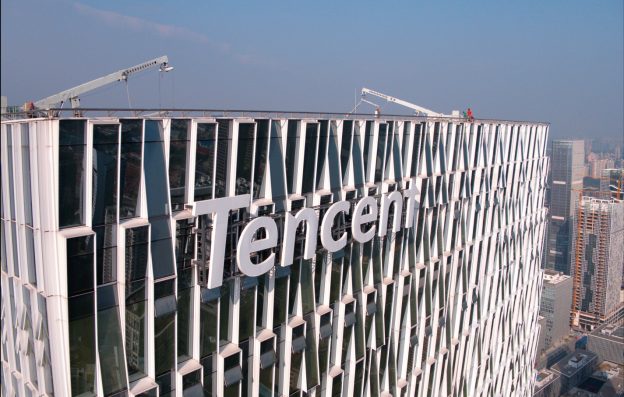
Like its Chinese hyperscaler peers, Tencent is accelerating investment to fuel its expansion. In mid-October, the tech giant raised roughly $5.7 billion through U.S. dollar and offshore yuan bond offerings, according to Reuters. The fundraising comes as its capital expenditure more than doubled year over year to RMB 96.3 billion in the first half of 2026, spanning computing equipment, software and data centers.
Southeast Asia is part of this broader infrastructure push. According to its official disclosures, Tencent Cloud operates four cloud regions and 12 availability zones across Singapore, Jakarta, Bangkok and Johor, having announced its first Malaysian region in August 2026.
Beyond expanding its own cloud footprint, Tencent has also sought additional computing power from third-party providers—a strategy increasingly under pressure from U.S. export controls. According to the Financial Times, as cited by Reuters, Oracle has reportedly scrapped a five-year AI compute leasing agreement with Tencent following concerns arising from U.S. technology export restrictions. The estimated $7 billion deal would have secured Tencent access to 100K advanced NVIDIA AI chips deployed across Southeast Asia.
Interestingly, Reuters, citing Tencent’s Chief Strategy Officer James Mitchell, points out that Washington’s latest rules were unlikely to significantly dent its cloud revenue. Mitchell pointed to the inference-driven nature of its cloud business as a buffer against the new restrictions. Gains in model efficiency, he noted, now allow Tencent to run AI workloads on a “surprisingly limited number” of domestic chips.
However, the bigger challenge could lie in model training. Tencent President Martin Lau, cited by the report, cautioned that restricted access to advanced computing power would likely slow the development of its next AI model in the near term.
Huawei: Cloud Growth Surges, but Ascend’s Overseas Push Faces Hurdles
Unlike other Chinese hyperscalers, Huawei is pursuing a different path in Southeast Asia, leveraging its homegrown Ascend AI accelerators and Kunpeng processors to build an alternative computing ecosystem.
Meanwhile, Huawei’s regional cloud business is gaining momentum. According to a 2025 press release, across ASEAN, Huawei Cloud operates five cloud regions and 17 availability zones (AZs), providing high-performance connectivity for local users. Touting itself as ASEAN’s fastest-growing cloud provider, Huawei Cloud says its regional business has expanded 30-fold over five years, with annual market growth exceeding 40%.
Huawei Cloud’s regional footprint combines its own infrastructure with partner-hosted facilities, though site-level details remain limited. In Thailand, where it was the first international public cloud provider to establish local data centers, Huawei Cloud now operates three AZs, according to a 2026 company release.
Yet Huawei’s cloud expansion in the region does not necessarily translate into wider adoption of its homegrown AI chips, whose overseas rollout faces U.S. regulatory pressure. In 2025, Bloomberg reported that Huawei had pitched thousands of its older-generation Ascend 910B processors to prospective customers in the UAE, Saudi Arabia and Thailand. More recently, Bloomberg reported in September that Malaysia was weighing the more advanced Ascend 910C for a $494 million sovereign AI project, though no procurement decision has been publicly confirmed.
As this roundup was being finalized, the Financial Times reports a potentially far-reaching move by NVIDIA: the chipmaker has reportedly instructed its manufacturing partners to halt server deliveries to Malaysia, Singapore, Thailand and Indonesia as Washington tightens China’s access to advanced AI compute.
The move exposes a limit of the in-house capacity strategy: owning data center space offers little protection if the servers to fill it cannot be delivered. How far owned capacity and homegrown compute can cushion Chinese CSPs is the next question to watch.
Read more
(Photo credit: NVIDIA)