[News] Beyond Megaspeed: Southeast Asia’s China-Linked AI Compute Network in Spotlight—Key Players at a Glance
While Jensen Huang’s abrupt exit as NVIDIA CEO has dominated headlines in recent weeks, another major development has been unfolding as well. Last week, the U.S. Bureau of Industry and Security (BIS) issued an Interim Final Rule (IFR) aimed at closing loopholes that could allow China to obtain restricted AI chips through third countries, requiring licenses for exports, reexports and in-country transfers to Indonesia, Malaysia, Singapore, Thailand and Brazil.
The move is bringing a little-noticed network of Southeast Asian computing providers serving Chinese cloud giants into sharper focus. According to estimates by the Washington-based think tank Institute for Progress (IFP), the region is projected to host roughly 75% of China’s overseas AI compute, measured in H100-equivalents (FP8), by the end of 2026.
Megaspeed, already under scrutiny amid the controversy surrounding Huang’s departure, is just one player in this broader ecosystem. From sprawling data center campuses to emerging AI infrastructure operators, here’s a closer look at the key players helping Chinese tech giants secure computing power beyond their home market.
DayOne and BDC: Heavy Reliance on ByteDance
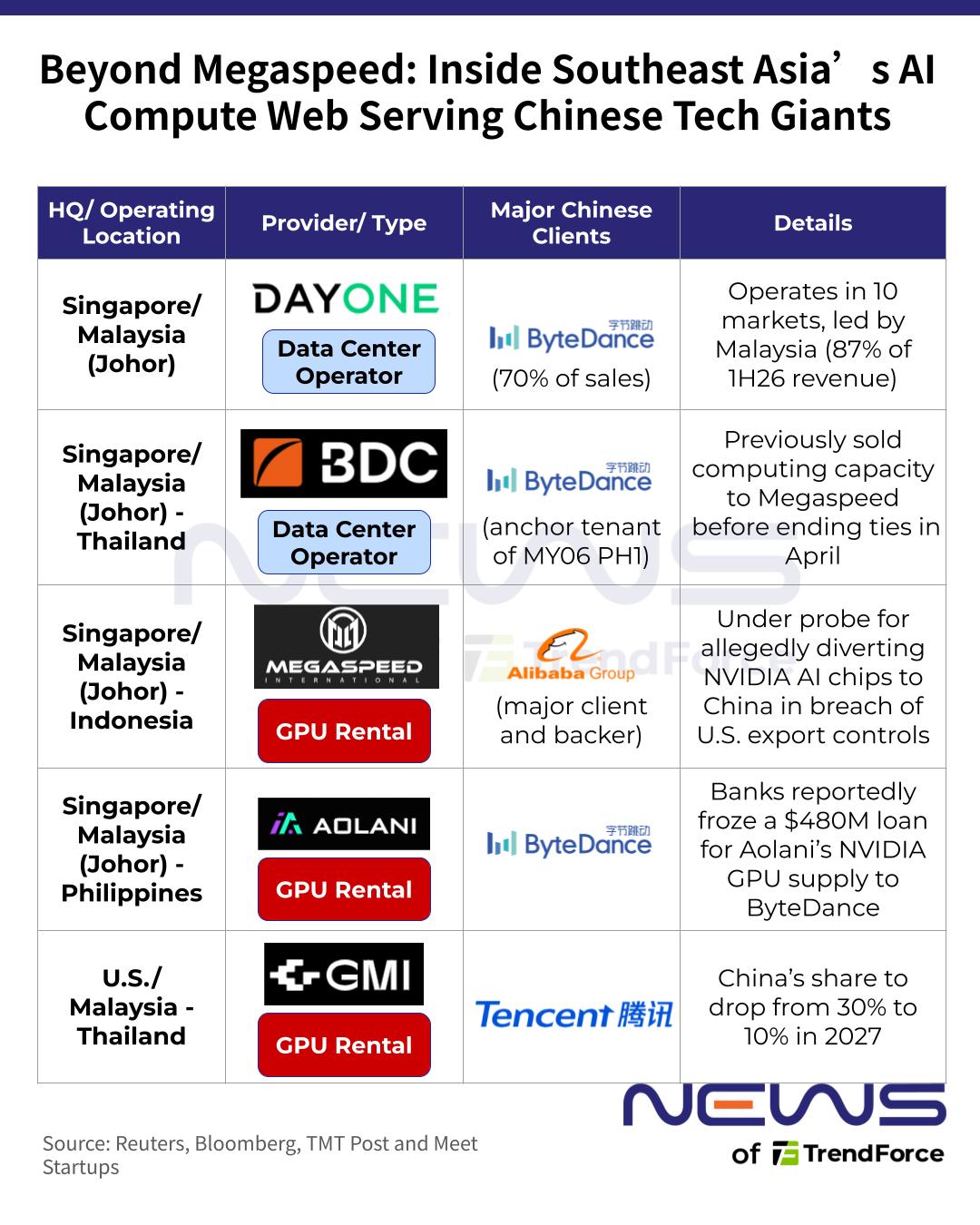
Among them, TikTok parent ByteDance has tapped two of the region’s largest data center borrowers—DayOne Data Centers and Bridge Data Centres—to secure computing capacity, according to Bloomberg.
As noted by Reuters, DayOne has filed for a Nasdaq listing in early October, with the company aiming to raise up to $5 billion at a valuation of as much as $20 billion. As explained by Reuters, Shanghai-based GDS Holdings set up GDS International in Singapore in 2022, which was rebranded as DayOne in January 2025 following its separation from the parent company. According to DayOne, it operates across 10 markets in Asia-Pacific and Europe, including Malaysia, Indonesia, Thailand, Japan, Hong Kong, Finland and Spain.
Notably, TMT Post points that land shortages, power constraints and regulatory hurdles in Singapore push some data center demand toward neighboring regions, with Malaysia’s Johor state and Indonesia’s Batam Island emerging as attractive alternatives. In the case of DayOne, it has built a cross-border data center network that combines Singapore’s connectivity advantages with the more abundant land and power resources in Johor and Batam, with Malaysia accounting for roughly 87% of DayOne’s revenue in the first half of 2026, the report adds.
Despite rapid revenue growth, DayOne continues to grapple with widening losses amid the heavy costs of data center expansion. Its business also remains heavily concentrated among a handful of major customers, led by ByteDance, which accounted for nearly 70% of revenue, according to TMT Post. Oracle ranked as its second-largest client.
Like DayOne, Bridge Data Centres (BDC) has forged close ties with ByteDance. According to Reuters, the TikTok parent was the anchor tenant for the first phase of BDC’s MY06 hyperscale data center in Johor, Malaysia.
Founded a decade ago by industry veterans Michael Foust and Kris Kumar in partnership with Bain Capital, BDC was merged into Chinese data center operator Chindata in 2019, ahead of the combined company’s Nasdaq debut in 2020, Reuters explains. Earlier this year, Bain Capital reportedly launched a sale process for at least a 40% stake in BDC, seeking a $5 billion valuation, according to the report.
Beyond Data Center Leasing: GPU Rental Firms Under Scrutiny
While major data center operators across Southeast Asia count ByteDance among their key customers, Washington’s latest restrictions on China’s access to advanced AI chips are drawing fresh attention to another group of players: GPU rental providers. Unlike conventional data center operators, which lease facilities to customers managing their own IT equipment, these firms provide direct access to computing power—potentially offering Chinese clients another route to restricted U.S. chips.
One such provider is Megaspeed. According to The New York Times, Alibaba is reportedly both a major customer and financial backer of the company. Through its subsidiary Speedmatrix, Megaspeed operates NVIDIA chips for the Chinese tech giant at data centers in Johor, Malaysia, as cited by Economic Daily News.
Connected to China via Singapore’s internet hubs and undersea cables, the facilities reportedly allow Alibaba and its clients to access NVIDIA computing power remotely without bringing the chips into China. According to RTI News, citing The Information, the ties date back to 2022, when NVIDIA’s sales team introduced Alibaba—then Asia’s largest cloud provider and a major A100 buyer—to Megaspeed founder Alice Huang. As U.S. export restrictions subsequently squeezed Alibaba’s access to advanced chips, NVIDIA sales representatives reportedly steered the company toward Megaspeed.
ByteDance could be pursuing a similar overseas computing arrangement. A March Reuters report, citing The Wall Street Journal, detailed the TikTok parent’s collaboration with Singapore-headquartered Aolani Cloud. The two companies were said to be planning the deployment of roughly 500 NVIDIA Blackwell systems in Malaysia, totaling approximately 36,000 B200 GPUs.
On the other hand, GPU rental service provider, GMI Cloud, whose footprint expanding throughout Thailand and Malaysia, provides rental services of NVIDIA’s H100, H200 and B200, according to its website. According to Bloomberg, the company is reportedly seeking a $300 million loan to purchase GPUs for its Thailand data center serving Chinese tech giant Tencent.
Washington’s latest chip restrictions could reshape the overseas AI computing networks Chinese tech giants have built across Southeast Asia. For regional providers, the question is no longer just how much capacity they can add, but whether Chinese customers can maintain access—or increasingly turn to domestic alternatives.
Read more
- [News] U.S. Targets China’s AI Compute Loophole, Tightens Chip Exports to Malaysia, Singapore and Three Others
- [News] U.S. Reportedly Approves NVIDIA H200 Sales to 10 Chinese Firms Including Alibaba, ByteDance, but Deals Stall
(Photo credit: NVIDIA)