[News] China’s SMEE Showcases Lithography Systems with 90%+ Localized Parts, Claims 10M+ Wafers Processed
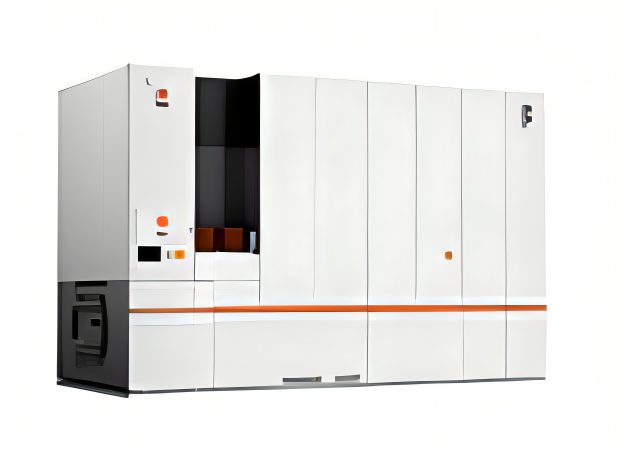
China is stepping up efforts to develop domestically produced lithography equipment. According to ijiwei, Shanghai Micro Electronics Equipment (SMEE) showcased models of its next-generation front-end dry scanning projection lithography systems, the SSC800 and SSB800, at the ninth China International Import Expo (CIIE), held in Shanghai from November 5 to 10. Highlighting China’s progress toward lithography self-sufficiency, the models feature transparent cutaway designs revealing their optical paths and internal electromechanical systems, the report adds.
As the report indicates, the platform supports both I-line and KrF lithography, with core components including projection optics, illumination systems, dual wafer and reticle stages, automated material handling systems, and precision alignment and leveling sensors developed domestically. More than 90% of its key components are sourced within China, reflecting progress in lithography equipment localization.
SMEE’s SSC800 KrF and SSB800 I-line systems are built on its proprietary dual wafer-stage platform and equipped with domestically developed high-numerical-aperture (NA) projection lenses. According to the report, their imaging performance is comparable to leading international products in the same category, while overlay accuracy and throughput continue to approach international benchmarks.
On the commercialization front, the systems have entered large-scale mass production, filling a gap in China’s domestic lithography equipment industry, the report notes. Multiple units have reportedly operated reliably at leading Chinese logic and memory fabs, collectively supporting the processing of more than 10 million wafers, with equipment availability exceeding 92%.
The two systems target different process requirements. According to EETOP, citing SMEE, the SSC800 KrF series supports lithography processes at 110nm and above, targeting applications including AI and high-performance computing, DRAM and NAND Flash, microprocessors, and Micro LED. Meanwhile, the SSB800 I-line series targets processes at 280nm and above, serving mature-node applications such as power semiconductors, analog ICs, and MEMS.
SMEE’s Role in China’s Domestic Lithography Industry
Founded in 2002, SMEE is China’s only manufacturer capable of consistently delivering mass-produced front-end dry lithography systems, with operations spanning equipment development, manufacturing, sales, and technical services, the report notes. The company was among 36 Chinese entities added to the U.S. Department of Commerce’s Entity List in December 2022, while Shanghai Electric is its largest shareholder, holding a 34.9099% stake, as the ijiwei report indicates.
China is also making progress in immersion DUV lithography. According to Reuters, citing sources, state-owned Shanghai Aishengna has begun mass-producing domestically developed immersion DUV systems after incorporating teams from SMEE and lithography startup Yuliangsheng. However, the systems still require further testing and remain far from matching ASML’s competing models, Reuters notes.
Huawei is also reportedly backing domestic firms developing critical components for advanced chipmaking equipment, including Yuliangsheng. According to the Financial Times, Yuliangsheng has co-developed China’s first domestically made advanced DUV lithography machine, with sources indicating plans to produce 12 systems by the end of 2026.
Read more
- [News] China Reportedly Spent $13B+ Stockpiling ASML DUV Tools in 2024–25 as Advanced Chip Push Continues
- [News] China Reportedly Mass-Produces Immersion DUV Tools; SMIC, Hua Hong, CXMT Deliveries Expected This Year
(Photo credit: SMEE)