[Breaking] Google Reportedly Sticks With Intel EMIB-T Despite 35% Substrate Yields as HumuFish Schedule Tightens
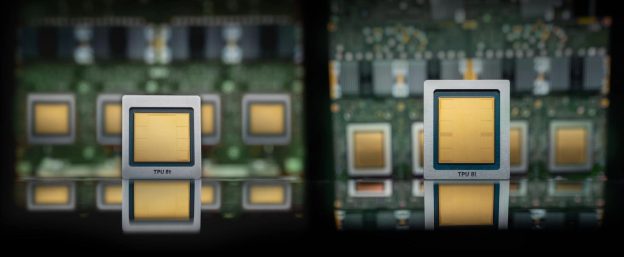
Uncertainty is growing over potential delays to Google’s TPU v9. Industry sources point to the HumuFish variation as a key area of concern: reported yield problems with Intel’s EMIB-T substrates have raised the possibility of a switch to TSMC’s CoWoS-L. Supply chain checks, however, indicate that HumuFish remains “100%” committed to EMIB-T.
Yield Gap Raises Production Readiness Concerns
According to Common Wealth Magazine, EMIB-T’s architecture poses two major challenges for substrate suppliers. First, differences in thermal expansion between ABF substrates and embedded silicon bridges make precise alignment difficult during high-temperature processing. Second, NCF (Non-Conductive Film), applied beneath the bridges’ TSVs, can trap air bubbles during bonding, potentially weakening adhesion and further weighing on yields.
Against this backdrop, industry sources say that EMIB-T substrate yields were around 35% in 3Q26, well short of the 50% target set for year-end.
However, efforts are underway. While the reported bottleneck centers on substrate suppliers’ difficulties embedding TSV-equipped silicon bridge dies, industry sources note that Intel has adjusted its substrate electroplating process, while suppliers including Ibiden, Unimicron, and Shinko continue working to improve yields.
With HumuFish not slated for mass production until 1H28, the supply chain still has time to tackle the remaining challenges, according to industry sources.
TPU v9 Packaging Orders Split Between TSMC and Intel
According to industry sources, Google’s TPU v9 lineup is confirmed to include three variants: Broadcom-designed WhaleFish, and MediaTek-designed HumuFish and TriggerFish. WhaleFish is expected to adopt TSMC’s CoWoS-L, with mass production slated for 2H27. HumuFish, meanwhile, is set to enter mass production in 1H28, relying exclusively on Intel’s EMIB-T. TriggerFish is also planned to use EMIB-T, with production targeted for 2H28 or later.
TechNews, citing analyst Ming-Chi Kuo, further explains that TriggerFish is positioned as an upgraded TPU v9 with stronger inference capabilities, designed to address both CPU and memory bottlenecks. According to Kuo, TriggerFish features three key upgrades over HumuFish: 2–3 times the SRAM capacity, an additional simulation die, and a shift to HBM4E from HumuFish’s HBM4.
HumuFish’s Potential Timeline Slip
Amid recent market rumors of HumuFish’s delay, industry sources indicate that the tape-out of Google-designed Compute Die A, built on TSMC’s N2 process, has been pushed back to late October, while other dies remain on schedule.
Against this backdrop, industry sources suggest the delay is expected to push back trial production of the complete package. Commercial Times further notes that the Google TPU v9 project (HumuFish) involving MediaTek could see its tape-out pushed back to January 2027 due to design revisions, potentially delaying shipments until 1Q28.
Taken together, HumuFish’s 1H28 mass production target still gives the supply chain time to work through EMIB-T’s remaining issues, but a tape-out that slips to January 2027 could compress that cushion. How quickly substrate yields climb, and whether design milestones hold, will determine if HumuFish stays on schedule. The outcome will also be a key test of Intel’s ability to win large external customers for advanced packaging.
Read more
- [News] Intel’s Advanced Packaging, Led by EMIB-T, Set to Hit Its Stride in 2029; DRAM Manufacturing Ruled Out
- [Breaking] Intel EMIB Substrate Yields Reportedly Hit 45%, Suppliers Eye 60% by 1Q27
(Photo credit: Google)