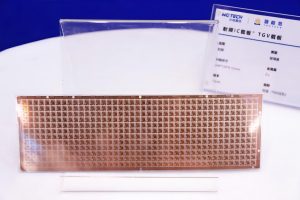
[News] Micro LED Optical Interconnects Take Center Stage at CIOE 2026

Micro LED optical interconnect technology emerged as a focal point during CIOE (China International Optoelectronic Exposition) 2026.
A wide range of ecosystem players—from epitaxy, chip, and display module providers like Enkris Semiconductor, LEKIN, Starksemi, and Raysolve, to system architecture vendors such as Nexilumen (Shanghai) and Intelligence Computing Optical Interconnects (An affiliated company of Wuhu Token Science)—showcased their latest breakthroughs in Micro LED optical interconnect solutions.
From an architecture perspective, these companies replace traditional semiconductor lasers with Micro LED arrays as light sources, leveraging high-density multi-channel parallel transmission to achieve ultra-high bandwidth density. Power consumption across these solutions generally targets 1–2 pJ/bit or lower—a dramatic reduction compared to legacy optical engine designs.
Coupled with wafer-level manufacturing and CMOS-compatible processes, the technology presents a viable pathway toward low-cost, high-volume manufacturing. As AI compute demand rapidly expands and short-reach interconnects hit physical bandwidth bottlenecks, Micro LED optical interconnects are transitioning from proof-of-concept toward commercial deployment.
Raysolve
Raysolve demonstrated a Micro LED optical interconnect validation platform co-developed with its partners, achieving multi-core fiber (MCF) signal transmission. Building on technical research initiated at HKUST in 2021, the company has expanded beyond micro-displays to address critical optical interconnect metrics, including light source modulation speed, high-efficiency collimation, and low crosstalk.
Raysolve is currently collaborating with leading optical interconnect and transceiver module vendors to advance functional validation, performance optimization, and end-market application testing.
Starksemi
Starksemi showcased its Micro LED optical interconnect architecture designed for high-speed photonic links. The company demonstrated high-bandwidth Micro LEDs achieving a -3dB bandwidth of approximately 2,500 MHz, significantly outperforming standard Micro LEDs (~500 MHz).
By utilizing high-density parallel channels, this architecture is projected to reduce energy consumption by up to 20x. Starksemi has begun shipping samples to strategic partners for product validation.
LEKIN
LEKIN exhibited a complete Micro LED optical interconnect solution based on its GaN-on-Silicon platform, alongside live demonstrations of GaN-on-Si Micro LED optical interconnect wafers. The solution features three core advantages:
- High Bandwidth: Engineered to meet requirements for 800G and 1.6T optical transceiver modules.
- Ultra-Low Power: Energy consumption of 1–2 pJ/bit, significantly lower than traditional laser engines.
- Thermal Stability: Operating temperature range spanning -40°C to 125°C
Enkris
Enkris presented 8-to-12-inch GaN-on-Si Micro LED light sources tailored for optical communications. Operating at a current density of 500 A/cm², the device achieves a 1.6 GHz bandwidth with power consumption below 1 pJ/bit.
As industry attention shifts toward high-speed visible light communication (VLC), Enkris is leveraging its large-diameter GaN-on-Si epitaxy capabilities to serve the optical communications sector.
Nexilumen
Nexilumen displayed prototype samples of its self-developed high-performance Micro LED optical interconnect system.
Long-Wavelength InGaN Micro LEDs: Achieved an emitter energy efficiency of 0.056 pJ/bit, along with a 2.85 GHz electro-optical modulation bandwidth and stable 1.5 Gbps data transmission at a low current density of 6.25 A/cm².
Short-Wavelength Micro LEDs: 405 nm variants surpassed 3GHz bandwidth across the entire current range, maintaining high-frequency response above 3GHz under both low (3.2 mA) and high (32 mA) drive currents.
The engineering team is currently integrating CMOS driver circuits with Micro LED arrays via monolithic and heterogeneous integration, with plans to build a 1.6 Tbps optical interconnect system prototype in the near term.
Intelligence Computing Optical Interconnects
Intelligence Computing Optical Interconnects, in collaboration with its shareholder Wuhu Token Sciences, demonstrated a short-reach high-speed Micro LED optical interconnect link targeting an overall end-to-end energy efficiency of less than 1 pJ/bit. Lightlink has initiated industry-university-research collaborations to advance technical validation and commercialization.
Industry Outlook
Micro LED optical interconnects are gaining traction across the supply chain, backed by high market expectations. According to TrendForce, Micro LED-based Co-Packaged Optics (CPO) transceiver modules could enter volume production as early as 2H28, with market output value expected to reach approximately USD 848 million by 2030.
(Photo credit: CIOE)