[News] Huawei Says Ascend Market Share Tops NVIDIA in China, Backs NPO Over CPO for Optical Interconnects
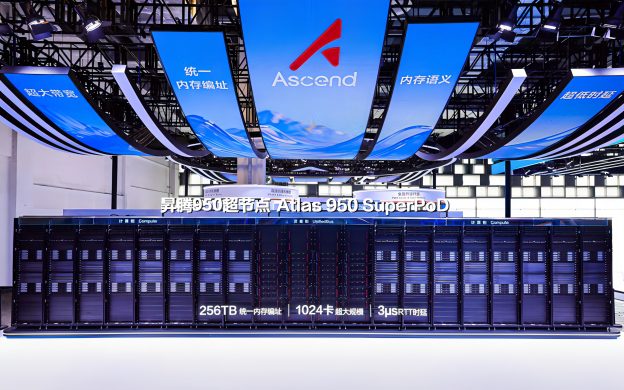
Huawei is pushing ahead with its AI computing strategy across chips, interconnects, and system-level infrastructure. According to ijiwei, Huawei Rotating Chairman Eric Xu shared the outlook during the Huawei Connect (HC) conference in Shanghai, where he and HiSilicon Chief Scientist Dr. Liao Heng discussed Huawei’s newly introduced Peerium computing architecture and UnifiedBus (UB) interconnect.
As the report points out, Xu said the Ascend 950PR, designed mainly for inference, is already available in limited volumes. The 950DT-based SuperPoD, aimed primarily at training, remains in testing, with volume supply expected around the end of 2026 or early 2027.
Supply remains the bigger constraint. Xu said Huawei is selling everything it can produce and hopes its supply chain will expand faster. The shortage is also limiting its overseas push, with domestic demand still far exceeding supply. While Huawei has supplied small volumes of Ascend 950 SuperPoDs to a handful of countries, it has no plans for a broad international rollout and is prioritizing Chinese customers.
Meanwhile, Xu said Ascend has likely surpassed NVIDIA in China based on data Huawei can track, though NVIDIA’s exact market share is difficult to determine. He expects the global supply-demand balance for AI computing chips to largely recover around 2029, with China potentially taking longer.
The broader shift toward domestic AI chips is also accelerating. According to TrendForce, China is stepping up support for homegrown AI chips in 2026, with domestic solutions expected to capture nearly 90% of the country’s high-end AI chip market this year.
Huawei Backs NPO Over CPO for Optical Interconnects
One area where Huawei is taking a distinct approach is optical interconnects. According to the report, Xu highlighted Huawei’s newly introduced NPO-based Hi-ONE module, which supports 7.2T of bandwidth. Its optical engine sits about 5 centimeters from the main chip, leaving only that short section dependent on copper connections and making the SuperPoD essentially all-optical. Hi-ONE also integrates the light source directly into the module.
Xu said Huawei decided early on to pursue NPO rather than CPO, arguing that NPO should remain the better option for a considerable period in terms of engineering implementation, cost, maintenance, and yield. While NPO requires about 5 centimeters of copper connection, versus roughly 5 millimeters for CPO, he said it cuts costs by nearly 40%. If the optical engine fails, it can also be replaced without discarding the AI chip.
Huawei Turns to System-Level Integration
Beyond optical interconnects, Huawei is also emphasizing system-level performance to offset limitations in individual chips. At the center of that strategy is Peerium, the new computing architecture behind Huawei’s Ascend 950-based SuperPoD. Xu added that SuperPoDs and clusters combining Peerium with UB interconnect technology can significantly improve model flops utilization (MFU), which Huawei has already validated, the report notes.
Huawei’s push is also extending into the software ecosystem. Reuters reported on September 30 that DeepSeek and Huawei are developing open-source programming infrastructure for Ascend, including compute and communication libraries. The two companies have also jointly optimized computation and communication for a SuperNode built around 128 Ascend 950 chips.
Read more
- [News] Huawei Expands LogicFolding Chips to Mate 90 Flagships, but Design Requires More Wafers
- [News] Huawei Reportedly Backs China’s DUV Drive, with 12 Systems Targeted by End-2026; SMIC Testing Underway
(Photo credit: Huawei)