[News] Kioxia, NVIDIA Begin 1.1 PB SSD-Based GPU Memory Expansion Tests to Address HBM Capacity Limits
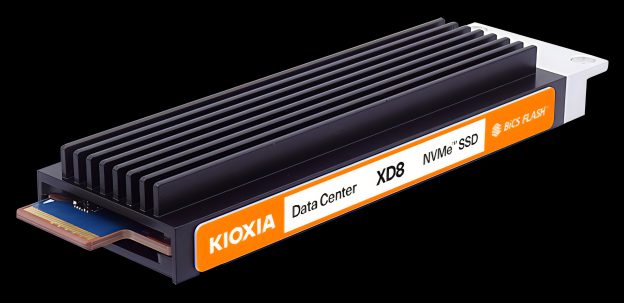
Japanese memory chipmaker Kioxia is advancing its collaboration with NVIDIA to expand effective GPU memory capacity using solid-state drives (SSDs). According to Nikkei, the two companies have begun rack-scale proof-of-concept (PoC) testing, marking a new step in Kioxia’s efforts to tap an AI memory market dominated by South Korean suppliers.
AI servers typically pair graphics processing units (GPUs) with high-bandwidth memory (HBM), which is primarily supplied by South Korean chipmakers such as SK hynix. While slower data access speeds have traditionally limited the use of SSDs for GPU memory functions, the collaboration aims to overcome these limitations, allowing SSDs to take over some HBM functions without eliminating the need for HBM, Nikkei reports.
The PoC combines Kioxia’s NVMe SSDs with NVIDIA’s Scaled Accelerated Data Access (SCADA) software, enabling GPUs to access larger datasets more efficiently. The software supports fine-grained data access, allowing GPUs to request data in 512-byte increments and retrieve only the necessary portions, according to EDN Japan.
To evaluate the technology at scale, the two companies have equipped an NVIDIA GB200 NVL72 rack with 144 Kioxia XD8 Series SSDs, providing approximately 1.1 PB of storage capacity. The goal is to verify whether the system can process a database containing approximately 2 trillion vectors, with potential applications extending to large datasets used in graph neural networks (GNNs), EDN Japan adds.
Despite the substantial increase in storage capacity, actual performance remains a key consideration. As XenoSpectrum notes, search latency may vary depending on whether the required data is stored locally or must be retrieved from another server node. Kioxia has yet to disclose how much SSD capacity each GPU can access or key performance metrics such as search latency and throughput.
For now, the collaboration remains at the technical validation stage, with no commercialization timeline or mass production plans disclosed, Investor.com reports.
Kioxia Targets GP2 Sampling in 2027, Eyes 100 Million IOPS in 2028
In a separate announcement on November 26, Kioxia unveiled its GP2 Series SSD, designed for direct GPU access. Featuring third-generation XL-FLASH memory, the new SSD delivers more than 18 million random read input/output operations per second (IOPS), nearly double the performance of its predecessor, GP1, introduced in August. Kioxia plans to provide GP2 evaluation samples to select customers by the end of 2027.
Meanwhile, the company has already begun supplying GP1 samples to select partners for PoC testing, according to TECH+. Looking ahead, Kioxia aims to achieve up to 100 million random read IOPS in 2028 with a next-generation GP Series SSD featuring PCIe 7.0, third-generation XL-FLASH and an improved controller.
According to TrendForce, Kioxia ranked fourth globally in enterprise SSD revenue in 2Q26, with an 11.3% market share, behind Samsung, SK hynix Group, and Micron. Its revenue more than doubled QoQ to US$4.64 billion, driven by growing shipments to major North American cloud providers and a larger share of procurement by server OEMs.
Read more
- [News] Kioxia Reportedly to Sample CXL Modules Soon, Reaffirms Strong NVIDIA CMX Ties
- [News] Kioxia Reportedly Weighs $10B U.S. Listing in 2027; Toshiba Cuts Stake to 12.84%
(Photo credit: Kioxia)