[News] Chinese Chip Tools Reportedly Match 80% of Korean Performance, 30% Cheaper; Memory Fabs Fuel Growth
Accelerating domestic substitution and a wave of foundry and memory capacity expansion are fueling growth in China’s semiconductor equipment market. Cost competitiveness is another key advantage, according to EToday. Zheng Gang, chairman of Shanghai Zhihui Venture Capital, quoted a South Korean industry insider as saying that Chinese tools now deliver 80–90% of their South Korean counterparts’ performance at prices more than 30% lower, the report suggests.
Beyond pricing, Zheng pointed to China’s greater tolerance for failure among small and medium-sized enterprises (SMEs) as another competitive edge. By deploying homegrown tools on actual production lines and allowing room for trial and error, the country has been able to accelerate technological improvements, he noted.
The gains are already visible in market share. With fresh capital flowing into the sector and memory fab buildouts providing more opportunities for tool qualification, domestic suppliers are gaining ground in the world’s largest chipmaking equipment market. According to figures presented by Zheng, their share of China’s wafer fabrication equipment market rose from just 4% in 2017 to 16% in 2024 and 21% in 2025.
Memory Expansion Fuels China’s Equipment Order Boom
China’s accelerating memory buildout is emerging as a major catalyst for domestic equipment suppliers. According to The Economic Observer, industry interviews indicate that CXMT launched a fresh round of equipment tenders in the second quarter of 2026, targeting capacity additions of 50,000–60,000 wafers per month this year, translating into equipment purchases of roughly CNY 35–43 billion. Equipment installation at YMTC’s Phase 3 production lines is also in full swing, with production slated to begin by year-end, the report suggests.
As noted by the report, together, CXMT and YMTC are expected to add 150,000 wafers per month in 2026, well above initial estimates of 100,000–120,000. Public information cited by the report also shows that the two companies currently have four new cleanroom facilities under construction, offering room for further long-term capacity expansion of roughly 400,000 wafers annually.
Among domestic equipment makers, NAURA Technology and Advanced Micro-Fabrication Equipment (AMEC) stand to be major beneficiaries of the memory buildout. Their core product portfolios span etching and thin-film deposition, which together account for roughly half of equipment spending on DRAM production lines, according to The Economic Observer. Lithography ranks second, while metrology and inspection tools reportedly represent 12–15% of the total.
CXMT, YMTC Drive Domestic Equipment Penetration Higher
Taking CXMT as an example, the report notes that Chinese-made tools account for less than 20% of the DRAM maker’s previous-generation process platform currently in volume production, but the localization rate could exceed 40% on its next-generation platform. Meanwhile, domestic equipment already accounts for over 50% of procurement for YMTC’s Phase 3 production lines, spanning key processes such as etching, deposition and inspection, according to the report.
Beyond immediate orders, the memory expansion is also enabling domestic equipment makers to accumulate valuable customer-side validation data. If current trends continue, the Economic Observer expects Chinese suppliers to capture roughly twice the share of equipment orders for every additional 10,000 wafers of monthly capacity compared with three to four years ago.
Read more
- [News] China Reportedly Spent $13B+ Stockpiling ASML DUV Tools in 2024–25 as Advanced Chip Push Continues
- [News] China Reportedly Mass-Produces Immersion DUV Tools; SMIC, Hua Hong, CXMT Deliveries Expected This Year
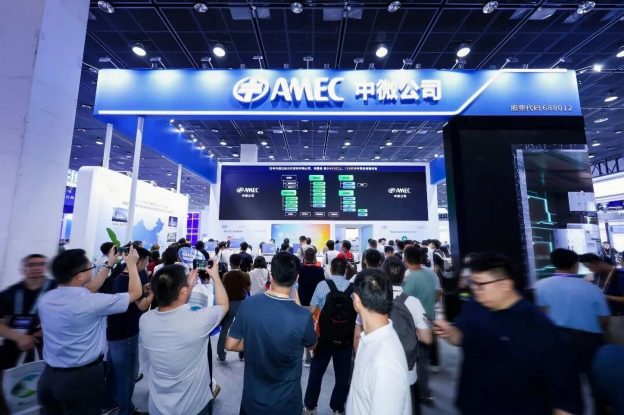
(Photo credit: AMEC)