

Rising Costs Threaten Notebook Demand in 2027, Raising Risks of Shipment Declines and Price Increases, Says TrendForce
TrendForce's latest notebook industry research reveals that the primary risk facing the market in 2027 is expected to shift from supply constraints to the impact of rising costs on demand. Global notebook shipments are currently projected to decline by a low-single-digit percentage in 2027.
However, if DRAM and CPU prices remain elevated, brands may be forced to pass more of these costs on to consumers. These higher retail prices could further extend replacement cycles, potentially pushing the full-year shipment decline into the high-single-digit range.
In 2026, improved CPU availability, early procurement by brands, and the pull-forward of some replacement demand helped support notebook shipments. However, this does not indicate a meaningful recovery in end-market demand.
With some purchases originally expected in the second half of 2026 and beyond already brought forward, replacement momentum in subsequent periods is likely to weaken. Furthermore, as lower-cost inventories are gradually depleted, brands will face more direct pressure from rising CPU, DRAM, and SSD prices.
TrendForce notes that for a mainstream notebook with a manufacturer's suggested retail price (MSRP) of US$900, CPU, DRAM, and SSD components accounted for approximately 68% of the bill of materials (BOM) cost in 3Q26. This highlights the growing influence of core component costs on product pricing.
Brands consequently face difficult trade-offs. Raising retail prices risks weakening demand, while absorbing higher costs would squeeze gross margins. Alternatively, reducing specifications such as memory capacity to control BOM costs could undermine product competitiveness.
In 2027, brands are therefore unlikely to be able to maintain pricing, specifications, and profitability simultaneously. The extent to which they pass higher costs on to consumers will be a key factor shaping demand.
Higher costs in emerging manufacturing locations prompt brands to reassess production strategies
Against this backdrop, notebook brands may reconsider production strategies previously adjusted to mitigate geopolitical risks. If tariff pressures do not intensify further, the factors guiding manufacturing glocalization are likely to shift from minimizing policy risks toward production costs, supply-chain completeness, and operational efficiency.
With component prices remaining elevated, the additional logistics, component sourcing, and supply-chain management costs associated with emerging manufacturing locations will come under greater scrutiny. This could encourage brands to relocate some capacity previously established outside China for risk diversification back to the country.
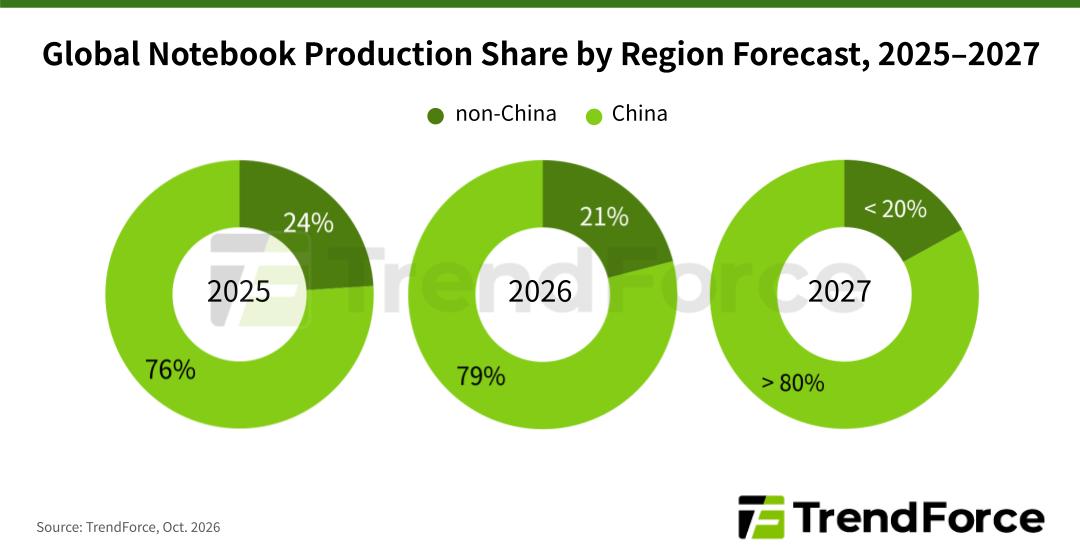
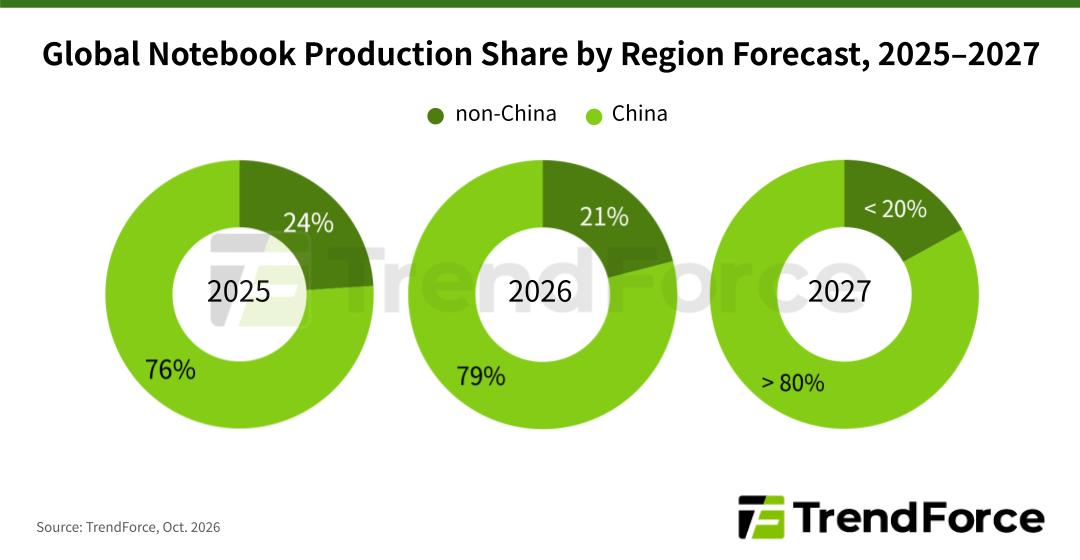
TrendForce estimates that the share of global notebook production outside China will decline from approximately 24% in 2025 to 21% in 2026, potentially falling below 20% in 2027. This suggests that brands are reassessing the balance between supply-chain diversification and manufacturing efficiency as policy and cost conditions evolve.
In 2027, supply conditions for notebook components may become more uneven. DRAM supply is likely to stay tight as AI server applications continue to absorb advanced-process capacity, while PC DRAM faces the risk of limited supply growth. Conversely, NAND Flash supply constraints might ease in the second half of 2027 with new capacity coming online.
Outside memory, components like PCBs, MLCCs, and PMICs are also under pressure due to capacity allocation decisions, raw material costs, and geopolitical issues. These challenges could result in higher prices or longer lead times, increasing brands’ cost burdens and complicating supply-chain management.
TrendForce indicates that the focus of the notebook market in 2027 will shift from whether sufficient components are available to whether consumers can absorb higher prices. If brands can mitigate the impact on retail prices by adjusting product mixes and specifications while absorbing some of the additional costs, the shipment decline could remain in the low-single-digit range.
Conversely, if component costs continue to rise and are fully passed on to consumers, demand could weaken further, pushing the full-year shipment decline into the high-single-digit range. Brands’ ability to strike a new balance among pricing, specifications, supply stability, and profitability will be critical to stabilizing the notebook market in 2027.
For more on the latest technology industry news and trends, please visit News.